

Loading...
Loading...
Product Specifications
Description
A MLXIPL antibody blocking peptide.
Application Notes
This peptide is useful as a blocking peptide for NB400-135. For further blocking peptide related protocol, click here.
Specificity
This peptide is specific for NB400-135 only.
Protein / Peptide Type
Antibody Blocking Peptide
Reviewed Applications
Read 1 review rated 4 using NB400-135PEP in the following applications:
Formulation, Preparation, and Storage
NB400-135PEP
| Formulation | Peptide dissolved in dH2O. Contains no BSA. |
| Preservative | No Preservative |
| Concentration | 1.0 mg/ml |
| Shipping | The product is shipped with dry ice or equivalent. Upon receipt, store it immediately at the temperature recommended below. |
| Stability & Storage | Store at -80C. Avoid freeze-thaw cycles. |
Background: CHREBP
The CHREBP protein is missing in the multisystem developmental disorder, Williams-Beuren syndrome. CHREBP antibodies are useful tools for studying lipid and fatty acid metabolism.
Alternate Names
BHLHD14, CHREBPcarbohydrate-responsive element-binding protein, Class D basic helix-loop-helix protein 14, MIOWS basic-helix-loop-helix leucine zipper protein, MLX interacting protein-like, MLX interactor, MLX-interacting protein-like, MONDOBWilliams-Beuren syndrome chromosomal region 14 protein, WBSCR14Williams-Beuren syndrome chromosome region 14 protein 1, Williams Beuren syndrome chromosome region 14, Williams-Beuren syndrome chromosome region 14 protein 2, WS-bHLHbHLHd14carbohydrate response element binding protein
Gene Symbol
MLXIPL
Additional CHREBP Products
Product Documents for CHREBP Antibody Blocking Peptide
Certificate of Analysis
To download a Certificate of Analysis, please enter a lot or batch number in the search box below.
Product Specific Notices for CHREBP Antibody Blocking Peptide
This product is for research use only and is not approved for use in humans or in clinical diagnosis. This product is guaranteed for 1 year from date of receipt.
Customer Reviews for CHREBP Antibody Blocking Peptide (1)
4 out of 5
1 Customer Rating
Have you used CHREBP Antibody Blocking Peptide?
Submit a review and receive an Amazon gift card!
$25/€18/£15/$25CAN/¥2500 for a review with an image
$10/€7/£6/$10CAN/¥1110 for a review without an image
Submit a review
Customer Images
Showing
1
-
1 of
1 review
Showing All
Filter By:
-
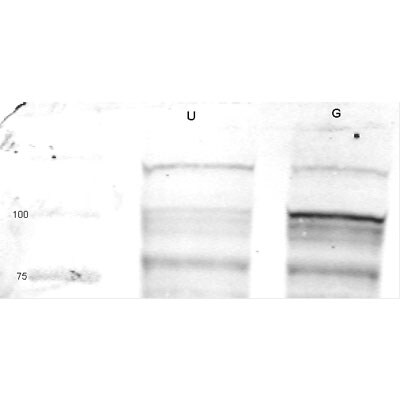
Application: Western BlotSample Tested: HepG2 nuclear extractsSpecies: HumanVerified Customer | Posted 05/25/2012

There are no reviews that match your criteria.
FAQs for CHREBP Antibody Blocking Peptide
Showing
1
-
1 of
1 FAQ
Showing All
-
Q: Please I want to block ChREBP Ab (NB400-135) using ChREBP peptide I need help to no the procedure and how much I need to add from the peptide to the ChREBP Ab
A: Here is a protocol for a blocking peptide control for a western blot: Materials and Reagents Blocking buffer (usually TBST plus either 5% non-fat dry milk or 3% BSA for Western blot, or PBS plus 1% BSA for IHC) - Antibody - Blocking (immunizing) peptide - Two tubes - Two identical samples (e.g. a Western blot with two identical lanes, cut in half; two slides containing the cells of interest; etc) Method 1. Determine the optimal concentration of antibody that consistently gives a positive result in your particular protocol. Using that concentration, determine how much antibody you will need for two experiments. a. For example, an antibody is being used successfully in Western blot at 0.5 ug/ml. You will need 2 ml of antibody solution to stain one strip of a Western blot. Thus, you would use 1 ug of antibody in 2 ml buffer for each strip. 2. Dilute the necessary amount of antibody in blocking buffer to the final volume needed for the two experiments. Divide this equally into two tubes. 3. In the first tube, labeled locked, add the blocking peptide to a final concentration of 1 ug/ml (2 ug total peptide in this example). In the second tube, labeled Control, add an equivalent amount of buffer. 4. Incubate both tubes, with agitation, at room temperature for 30 minutes, or overnight at 4 degrees C. 5. Perform the staining protocol on the two identical samples, using the blocked antibody for one and the control for the other. Be careful not to mix up the strips using the blocked and control antibodies! 6. Observe the staining. The staining that disappears when using the blocked antibody is specific to the antibody. (See note i) Notes i. If more than one band disappears in Western blot by peptide/antigen competition, those bands contain the antigenic determinants and could be fragments of the full antigen or a complex containing the antigen.
Loading...