
DuoSet ELISA Development Systems - ELISA Kits
DuoSet™ ELISA Development Systems provide the core reagents required to develop a sandwich ELISA for the quantitative measurement of specific protein biomarkers in biological samples. Each system includes a matched antibody pair, a mass-calibrated recombinant protein standard, streptavidin-HRP, and a detailed protocol to support assay optimization for protein biomarker analysis.
When complete kits are not an option, DuoSet ELISA Development Systems are an economical alternative to purchasing antibodies and protein standards separately.
New to DuoSet ELISAs? Browse our FAQ section below for answers to common questions about available analytes, validated sample types, workflow considerations, and selecting the right ELISA solution for your research.
DuoSet ELISA Features
- Provides sufficient reagents for either five or fifteen 96-well plates, offering a cost-effective solution for performing multiple ELISAs
- Contains carefully selected and validated antibodies, reducing development time
- Includes mass-calibrated recombinant protein standard, reducing assay variability
- Can be adapted for use across multiple platforms and 384 well
- Provides biotinylated detection antibodies and streptavidin-HRP, enabling chemiluminescent or colorimetric detection
- Over 750 DuoSet ELISA Development Systems with analytes supporting a range of biological processes
DuoSet ELISA Development Systems Assay Principle
DuoSet ELISA Development Systems use a sandwich ELISA format in which a matched capture and detection antibody pair specifically binds the target analyte. Streptavidin-HRP and a substrate reaction generate a measurable signal proportional to the amount of analyte present in the sample. The supplied antibody pair and mass-calibrated recombinant protein standard provide the foundation for assay development and optimization.
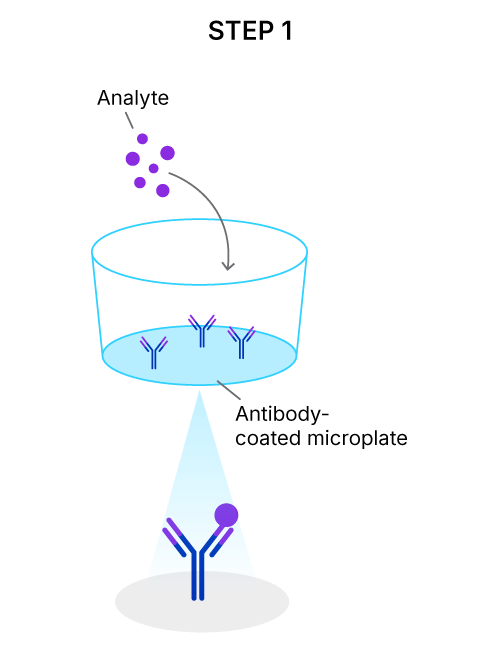
Analyte-specific antibody (capture antibody) is bound to a user-provided polystyrene microplate. Unbound capture antibody is washed away. Plates are blocked and washed. Samples or standards are added and any target antigen (analyte) present is bound by the immobilized antibody. Unbound materials are washed away.
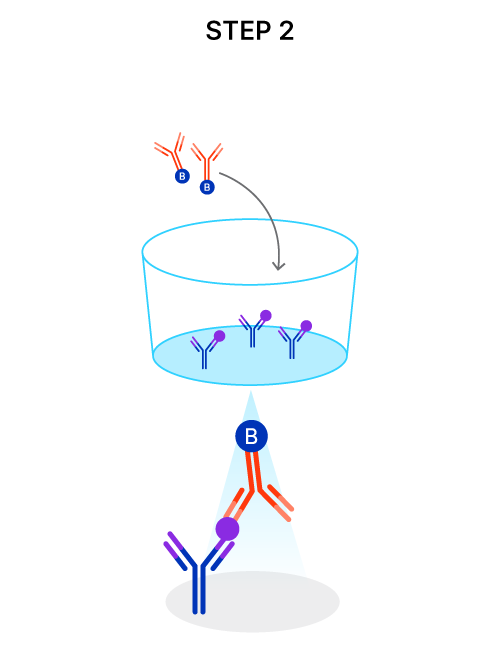
A biotinylated detection antibody is added and binds to a second epitope on the target antigen.
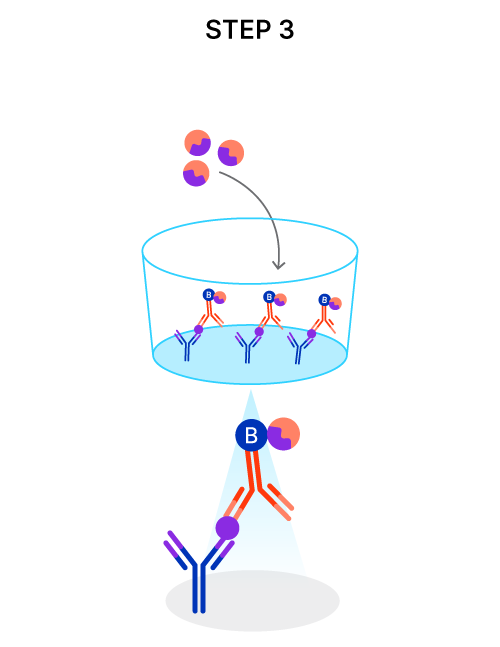
Streptavidin-Horseradish Peroxidase (HRP) is used to bind to the detection antibody. Unbound streptavidin-HRP is washed away.
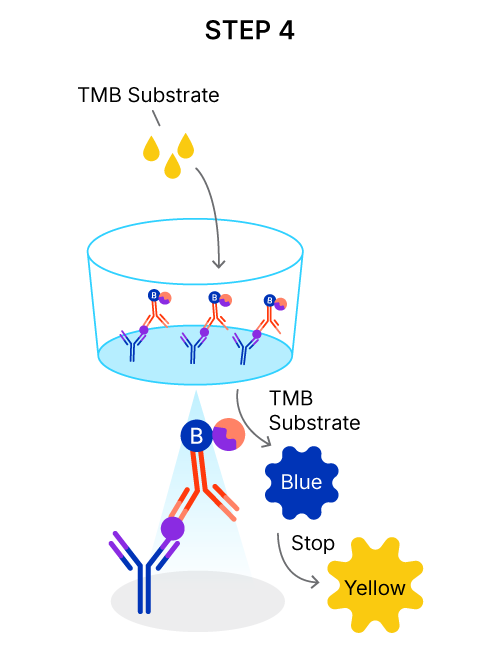
Tetramethylbenzidine (TMB) substrate solution is added to the wells and a blue color develops in proportion to the amount of analyte present in the sample. Color development is stopped turning the color in the wells to yellow. The absorbance of the color at 450 nm is measured.

Additional Supplies
Supplemental products are available in a convenient Ancillary Reagent Kit for performing five 96-well or 384-well assays. Components are also available separately in bulk sizes allowing for assay customization. For a complete list of supplies needed for your DuoSet ELISA Development System, refer to the product-specific datasheet.
DuoSet Ancillary Reagent Kits
Each DuoSet Ancillary Reagent Kit provides a comprehensive collection of reagents and plates to assay five 96-well or 384-well DuoSet ELISA plates.
DuoSet Ancillary Reagent Kits include:
- 96-Well or 384-Well Plates
- Plate Sealers
- 1-Step Color Reagent
- Stop Solution
- ELISA Plate-Coating Buffer
- Reagent Diluent
- Wash Buffer
| Product | Included DuoSet Reagent Diluent* | Catalog # |
|---|---|---|
| DuoSet Ancillary Reagent Kit 1 | Reagent Diluent 1 | DY007B |
| DuoSet Ancillary Reagent Kit 2 | Reagent Diluent 2 | DY008B |
| DuoSet Ancillary Reagent Kit 3 | Reagent Diluent 3 | DY009B |
| *To identify the appropriate Reagent Diluent, please consult the online product datasheet for your DuoSet ELISA Development System of interest. Each analyte presents varying requirements. Numbering of the Ancillary Reagent Kits reflects the Reagent Diluent provided. | ||
Bulk Supplemental Products
Optimize the performance of your DuoSet ELISA System using recommended supplemental reagents.
ELISA Best Practices Poster
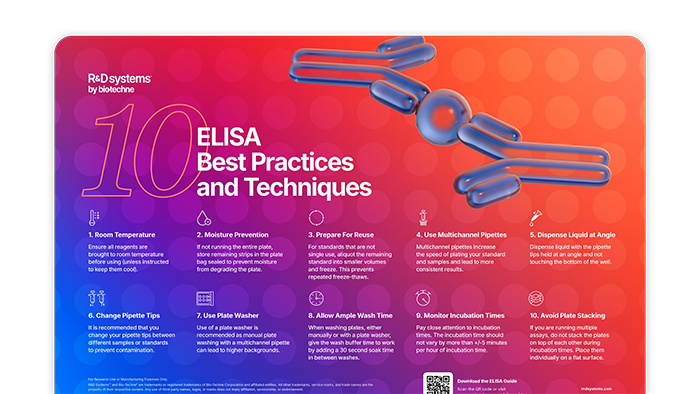
Discover the top 10 best practices and techniques that can help even the experienced ELISA user get the most from their assay.
Adapting DuoSet ELISAs to 384-Well
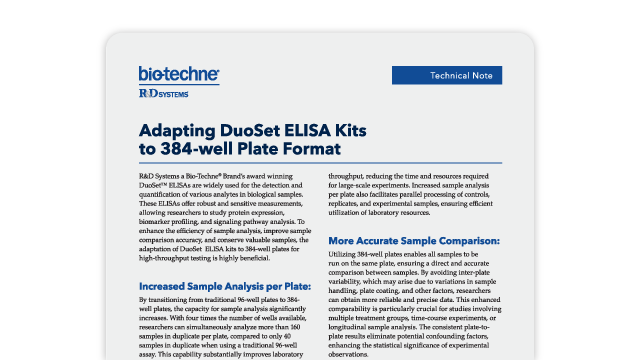
Learn how to adapt DuoSet ELISAs to 384-well format to increase throughput, conserve samples, and improve data consistency.
DuoSet ELISA Protocol Video
Master the DuoSet ELISA workflow with step-by-step guidance from assay set-up to reliable data generation and analysis.
A DuoSet ELISA (enzyme-linked immunosorbent assay) Development System provides the core reagents required to develop a sandwich ELISA for the quantitative measurement of a specific protein analyte in a biological fluid. Each system includes a matched capture and detection antibody pair, streptavidin-HRP, and a recombinant protein standard for generating a standard curve. DuoSet ELISAs are available for measuring a broad range of protein biomarkers commonly studied in immunology, cell biology, neuroscience, and cancer research. Researchers provide the microplate and other assay reagents, allowing flexibility for assay optimization and adaptation to alternative formats such as 384-well plates.
DuoSet ELISA Development Systems are available for more than 750 analytes, including cytokines, chemokines, growth factors, soluble receptors, proteases, and other protein biomarkers.
DuoSet ELISA Development Systems are validated for quantitative protein measurement in cell culture supernatants. Because DuoSet ELISAs are designed as assay development systems, researchers can further optimize and validate them for additional biological sample types, including serum and plasma.
DuoSet ELISA Development Systems quantify specific proteins using a sandwich ELISA approach. The assay begins by coating a microplate with an analyte-specific capture antibody. Samples and standards are then added, allowing the target protein to bind to the immobilized antibody. A biotinylated detection antibody recognizes a second epitope on the analyte, and streptavidin-HRP is subsequently used for signal generation. Addition of a TMB substrate produces a color change proportional to the amount of analyte present in the sample. The absorbance is measured and compared to a standard curve to determine the analyte concentration.
For a detailed step-by-step workflow, see the How to Run an R&D Systems DuoSet ELISA Protocol Video.
Sandwich ELISA, direct ELISA, indirect ELISA, and competitive ELISA are common immunoassay formats used to detect and quantify proteins. DuoSet ELISA Development Systems use a sandwich ELISA format, in which a capture antibody immobilized on a microplate binds the target antigen and a detection antibody that recognizes a different epitope on the same analyte is used for detection. This approach is widely used for the quantitative measurement of cytokines, chemokines, growth factors, proteases, soluble receptors, and other protein biomarkers due to its high specificity and sensitivity.
In a direct ELISA, a labeled primary antibody binds directly to an immobilized target antigen. In an indirect ELISA, an unlabeled primary antibody binds to an immobilized target antigen and a labeled secondary antibody directed against the host species of the primary antibody is used for detection. In a competitive ELISA, the sample antigen competes with a labeled antigen for binding to a capture antibody coated on a microplate. The more antigen present in the sample, the less conjugated antigen will bind to the capture antibody. This results in a signal that is inversely proportional to antigen concentration. Competitive ELISAs are often used for small molecules or analytes that may not be well suited for sandwich assay designs.
The optimal ELISA format depends on the target antigen, sample type, sensitivity requirements, and experimental goals. Researchers requiring a flexible sandwich ELISA workflow can use DuoSet ELISA Development Systems to develop and optimize assays for their specific applications.
DuoSet ELISA Development Systems and Quantikine™ ELISA Kits both use a sandwich ELISA format for quantitative protein measurement, but they differ in the components provided and the level of assay setup required.
DuoSet ELISA Development Systems provide the core assay reagents, including matched capture and detection antibody pairs, streptavidin-HRP, and a protein standard. Researchers supply additional components such as microplates, blocking reagents, buffers, substrate solutions, and other consumables needed to perform the assay. This format offers flexibility for assay optimization and adaptation to alternative formats such as 384-well plates.
In contrast, Quantikine ELISA Kits are complete, ready-to-use immunoassays that include pre-coated microplates, all required assay reagents, detailed protocols, and extensive performance validation data. Quantikine Kits are fully optimized and validated for designated sample types and are designed to simplify workflow while delivering reproducible results with minimal assay optimization required.
Researchers seeking assay flexibility often choose DuoSet ELISA Development Systems, while those requiring a fully optimized, validated, ready-to-use assay may prefer Quantikine ELISA Kits.
DuoSet ELISA Development Systems are designed for researchers who require assay flexibility. Unlike ready-to-use ELISA kits, they provide the core assay reagents while allowing researchers to select additional assay components, optimize protocols for specific sample types, and adapt workflows to their experimental needs. This flexibility makes them well-suited for 384-well, high-throughput, and large-scale research applications. DuoSet ELISA Development Systems also offer a cost-effective solution for laboratories performing multiple assays or seeking greater control over assay configuration and workflow design.
Yes, the flexibility of the DuoSet format makes it particularly well-suited for adaptation to alternative assay formats and higher-throughput screening applications. DuoSet ELISA Development Systems can be successfully adapted to a 384-well plate format, enabling higher-throughput analysis with more than 160 samples run in duplicate per plate, compared to approximately 40 samples in duplicate in a traditional 96-well assay. The 384-well format also requires smaller sample volumes and allows more samples to be evaluated on the same plate, helping improve data consistency by minimizing inter-plate variability.
For a detailed step-by-step workflow, see the How to Adapt DuoSet ELISA Kits to 384-well Plate Format Protocol.
Looking for other ELISA assay formats, targets, or brands? View All ELISA Kits, including Novus kits here.