

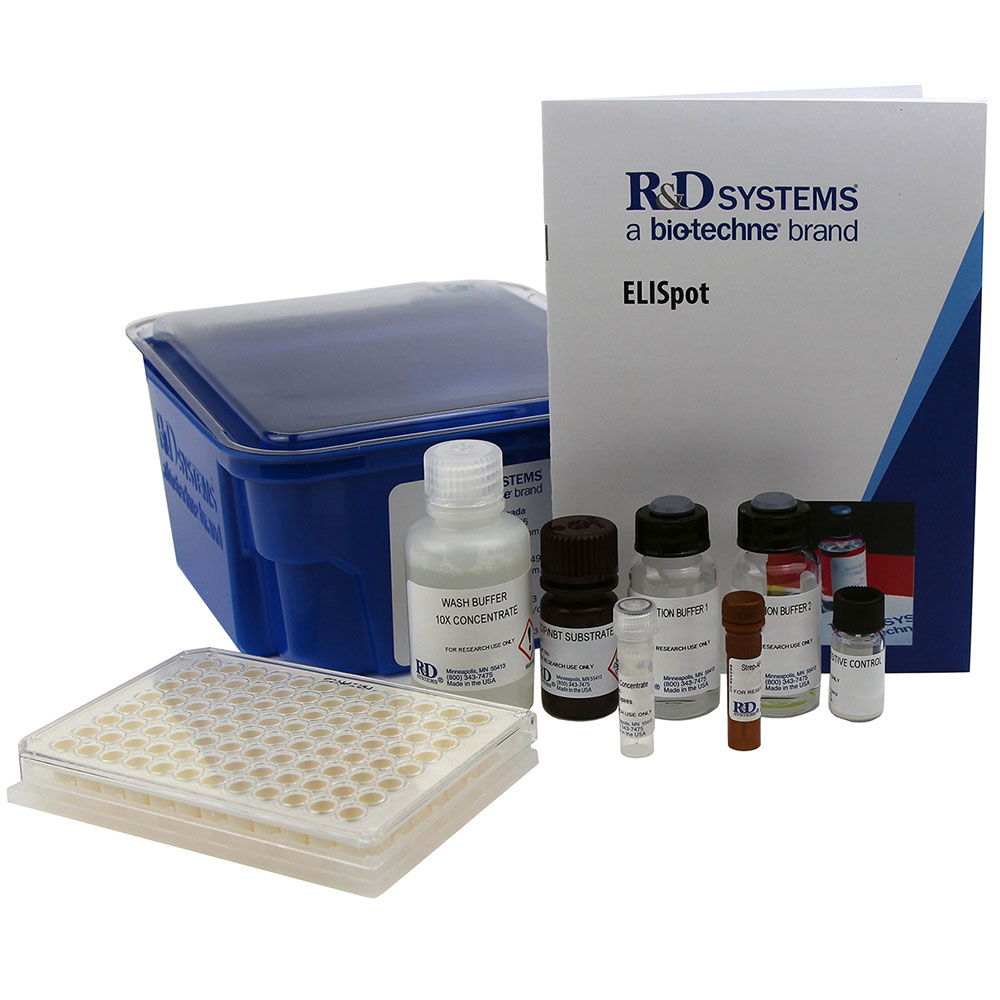
Human Apolipoprotein A-I ELISpot Kit

R&D Systems | Catalog # EL3664

R&D Systems
Discontinued Product
EL3664 has been discontinued. View all Apolipoprotein A-I/ApoA1 products.

Key Product Details

Species

Human

Assay Type

Quantitative Sandwich ELISA

Format

96-well PVDF-backed microplate

Assay Length

3 hours 15 mins to 4 hours 30 mins*

Sample Type

Whole Cells

Product Summary for Human Apolipoprotein A-I ELISpot Kit

* Following cell stimulation.


PRODUCT SUMMARY
ELISpot kits are highly sensitive, microplate-based assays for the detection of cytokine secreting cells. This kit is designed for the detection and enumeration of . Complete ELISpot kits are ready-to-run and require no assay development or refinement.

This ELISpot assay employs a capture antibody specific for , pre-coated onto a PVDF-backed microplate. Appropriately stimulated cells are pipetted directly into the wells and the immobilized antibody in the immediate vicinity of the secreting cells binds secreted . Following wash steps and incubation with a biotinylated detection antibody, alkaline-phosphatase conjugated to streptavidin is added. Unbound enzyme is subsequently removed by washing and a substrate solution (BCIP/NBT) is added. A blue-black colored precipitate forms at the sites of cytokine localization and appears as spots, with each individual spot representing an individual secreting cell. The spots can be counted with an automated ELISpot reader system or manually using a stereomicroscope.


PRODUCT FEATURES

  • Detect and quantitate individual cells secreting
  • High sensitivity - ELISpot assays can measure responses with frequencies well below 1 in 100,000 cells
  • No in vitro expansion of cells required
  • High-throughput - ELISpot assays use only a small number of primary cells

KIT CONTENTS

  • Microplate
  • Biotinylated Detection Antibody
  • Streptavidin conjugated to Alkaline Phosphatase
  • Dilution Buffers
  • Wash Buffer Concentrate
  • BCIP/NBT Chromogen
  • Positive Control

OTHER REAGENTS REQUIRED

  • Pipettes and pipette tips
  • Deionized or distilled water
  • Squirt bottle, manifold dispenser, or automated microplate washer
  • 500 mL graduated cylinder
  • 37 °C CO2 incubator
  • Sterile culture media
  • Dissection microscope or an automated ELISpot reader
Loading...

Formulation, Preparation, and Storage

Shipping

The product is shipped at ambient temperature. Upon receipt, store it immediately at the temperature recommended below.

Storage

Store the unopened product at 2 - 8 °C. Do not use past expiration date.

Background: Apolipoprotein A-I/ApoA1

The apolipoproteins are a structurally-unrelated group of proteins that have some association with the transport of lipids in blood. Apolipoproteins, plus phospholipids, cholesterol and triglycerides, form spherical particles with a lipid/hydrophobic center and a (apolipo)protein coat. The apolipoprotein coat promotes aqueous solubility and serves as a ligand for lipoprotein receptors. HDL may contain apolipoproteins A, C, D, E, J, L and M, while LDL contains apolipoproteins B and E.

ApoAI and ApoA2 are major protein components of serum high-density lipoprotein (HDL) and are produced by the liver and small intestine. They are involved in reverse cholesterol transport from tissues to the liver. Polymorphisms of ApoA2 are associated with disorders of cholesterol and fatty acid metabolism. Human ApoB (Apolipoprotein B-100) is a 550 kDa, secreted, palmitoylated glycoprotein that is part of LDL and VLDL particles. It is made by liver and is 4536 aa in length. It binds LDL to the ApoB/E receptor. ApoC activates lipoprotein lipase and may self-associate to form amyloid-type fibrils.

ApoE is a 34 kDa protein component of serum chylomicrons, VLDL, and HDL particles. It mediates the binding, uptake, and catabolism of these particles through interactions with the ApoE receptor and LDL receptors in the liver and brain. ApoE is important in fatty acid homeostasis and memory formation. Polymorphisms encode three variants (ApoE2, 3, 4) which are differentially related to the development of atherosclerosis and neurogenerative disorders, particularly Alzheimer's disease.

Serum amyloid A proteins (SAAs) are a family of homologous apolipoproteins of high density lipoprotein (HDL). They can be divided into two groups. The first group consists of the acute phase SAA1 and SAA2 that associate with HDL during inflammation and remodel the HDL particle by displacing apolipoprotein A1. The second group consists of constitutively expressed SAA4 and SAA5 that exist as minor apolipoproteins on HDL but make up more than 90% of the total SAA during homeostasis.

Alternate Names

Alp-1, APOA1, Apolipoprotein AI, Brp-14, Ltw-1, Lvtw-1, Sep-1, Sep-2

Entrez Gene IDs

335 (Human); 11806 (Mouse); 25081 (Rat)

Gene Symbol

APOA1

Additional Apolipoprotein A-I/ApoA1 Products

Product Documents for Human Apolipoprotein A-I ELISpot Kit

Certificate of Analysis

To download a Certificate of Analysis, please enter a lot or batch number in the search box below.

Note: Certificate of Analysis not available for kit components.

Product Specific Notices for Human Apolipoprotein A-I ELISpot Kit

For research use only

Related Research Areas

Customer Reviews for Human Apolipoprotein A-I ELISpot Kit

There are currently no reviews for this product. Be the first to review Human Apolipoprotein A-I ELISpot Kit and earn rewards!

Have you used Human Apolipoprotein A-I ELISpot Kit?

Submit a review and receive an Amazon gift card!

$25/€18/£15/$25CAN/¥2500 Yen for a review with an image

$10/€7/£6/$10CAN/¥1110 Yen for a review without an image

Submit a review
Amazon Gift Card

FAQs

No product specific FAQs exist for this product.

View all FAQs for ELISpot and FluoroSpot Kits