
Recombinant human Xylosyl- and glucuronyltransferase Like-acetylglucosaminyltransferase 1 (LARGE1) is a metal-dependent, ubiquitously-expressed, golgi single-pass type II membrane glycosyltransferase protein (1). LARGE1 is composed of a short cytoplasmic peptide, a transmembrane domain, a coiled-coil stem involved in dimerization, and two catalytic domains separated by a linker that are responsible for its bifunctional activity as a xylosyltransferase (Xyl-T domain) and glucuronyltransferase (GlcA-T domain) (1). It is thought the physiological dimeric form of LARGE1 is in parallel with homo-association of the Xyl-T and GlcA-T domains to bring catalytic domains in close proximity from opposing monomers (1). As a bifunctional glycosyltransferase, LARGE1 is responsible for addition of alternating of xylose and glucuronic acid repeating units to form the polysaccharide matriglycan, a post-translational modification unique to alpha-dystroglycan (2). Matriglycan creates binding sites for laminin G-like domains making it important for proper muscle function (1,3). Improper glycosylation of alpha dystroglycan by LARGE1 is responsible for various forms of congenital muscular dystrophy, termed dystroglycanopathies, with muscular and neurological effects as seen in Walker-Warburg syndrome (1, 4-6). In addition, LARGE1 deficiency may play a role in some types of cancer (7, 8). Pharmacological supplementation treatments of LARGE1 may be applied to treat dystroglycanopathy and cancer (8-11). The enzymatic activity of recombinant human LARGE1 was determined using a phosphate-coupled glycosyltransferase assay (12).
Recombinant Human LARGE1 His-tag Protein, CF
R&D Systems | Catalog # 11634-LG

Loading...
Key Product Details
- R&D Systems CHO-derived Recombinant Human LARGE1 His-tag Protein (11634-LG)
- Quality control testing to verify active proteins with lot specific assays by in-house scientists
- All R&D Systems proteins are covered with a 100% guarantee
Source
CHO
Accession Number
Applications
Enzyme Activity
Loading...
Product Specifications
Source
Chinese Hamster Ovary cell line, CHO-derived human LARGE1 protein
Phe34-Ser756, with an N-terminal 6-His tag
Phe34-Ser756, with an N-terminal 6-His tag
Purity
>95%, by SDS-PAGE visualized with Silver Staining and quantitative densitometry by Coomassie® Blue Staining.
Endotoxin Level
<1.0 EU per 1 μg of the protein by the LAL method.
N-terminal Sequence Analysis
His
Predicted Molecular Mass
85 kDa
SDS-PAGE
86-95, under reducing conditions
Activity
Measured by its ability to transfer xylose from UDP-xylose to 4-Methylumbelliferyl-beta -D-Glucuronide.The specific activity is >4 pmol/min/μg, as measured under the described conditions.
Scientific Data Images for Recombinant Human LARGE1 His-tag Protein, CF
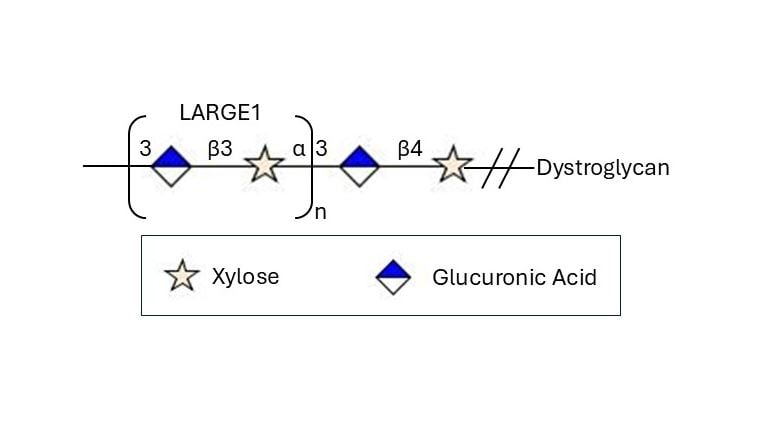
Recombinant Human LARGE1 His-tag Enzyme Activity Diagram.
Recombinant Human LARGE1 His-tag (Catalog # 11634-LG) is responsible for addition of alternating of xylose and glucuronic acid repeating units to form polysaccharide matriglycan.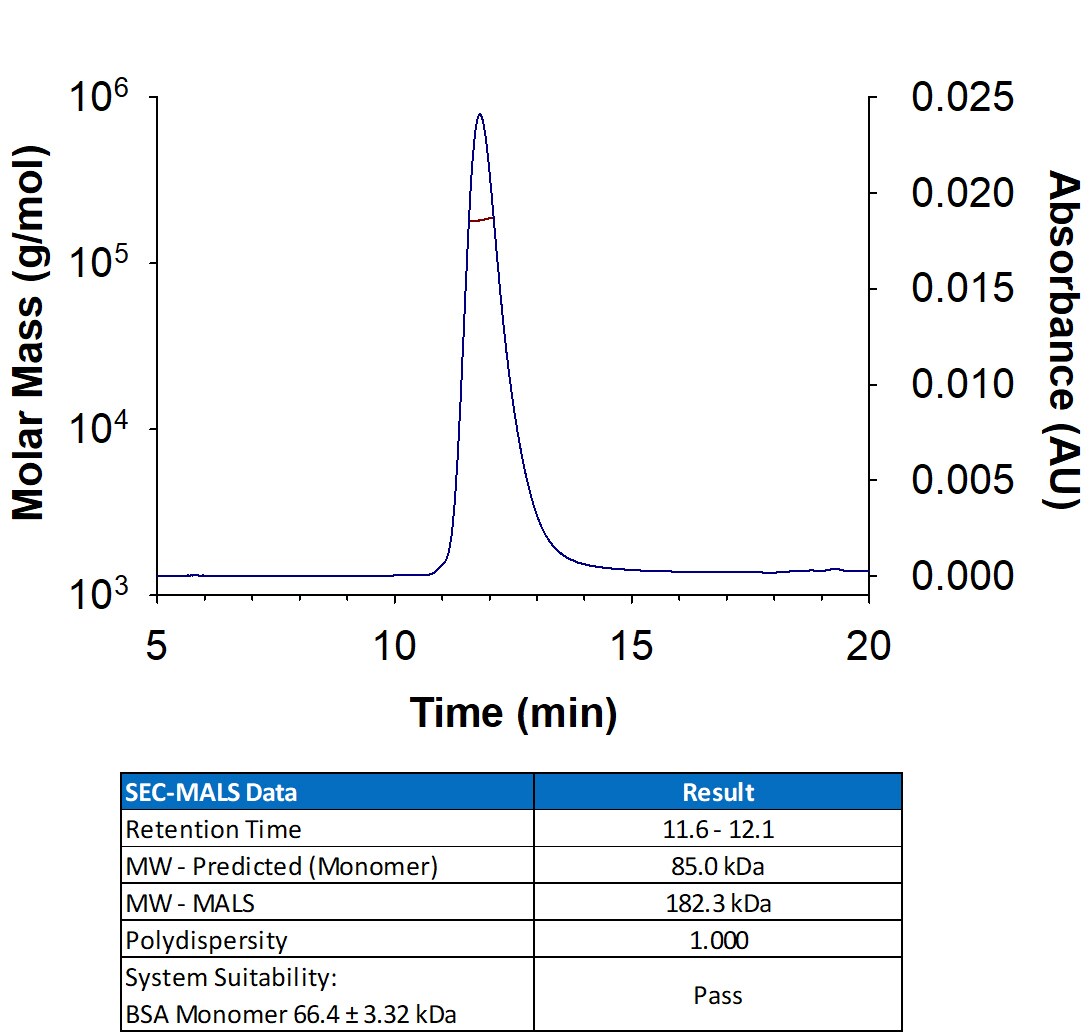
Recombinant Human LARGE1 His-tag Protein SEC-MALS.
Recombinant Human LARGE/N-His Protein (Catalog # 11634-LG-Develeopment) has a molecular weight (MW) of 182.3 kDa as analyzed by SEC-MALS, suggesting that this protein is a dimer. MW may differ from predicted MW due to post-translational modifications (PTMs) present (i.e. Glycosylation).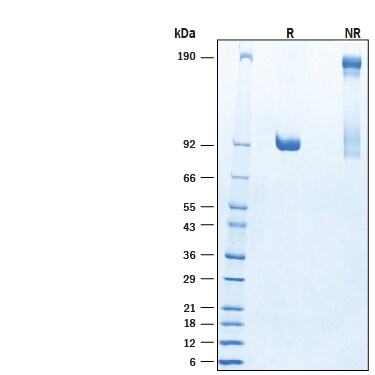
Recombinant Human LARGE1 His-tag SDS-PAGE.
2 μg/lane of Recombinant Human LARGE1 His-tag (Catalog # 11634-LG) was resolved with SDS-PAGE under reducing (R) and non-reducing (NR) conditions and visualized by Coomassie® Blue staining, showing bands at 86-95 kDa, under reducing conditions.Formulation, Preparation, and Storage
11634-LG
| Formulation | Supplied as a 0.2 μm filtered solution in Tris and NaCl. |
| Shipping | The product is shipped with polar packs. Upon receipt, store it immediately at the temperature recommended below. |
| Stability & Storage | Use a manual defrost freezer and avoid repeated freeze-thaw cycles.
|
Background: LARGE1
References
- Katz, M., et al. (2022) PLoS One. 17:e0278713.
- Yoshida-Moriguchi T and KP Campbell. (2015) Glycobiology. 25:702.
- Fujimura, K. et al. (2005) Biochem. Biophys. Res. Commun. 329:1162.
- Longman, C. et al. (2003) Hum. Mol. Genet. 12:2853.
- Clement, E. et al. (2008) Ann. Neurol. 64:573.
- Meilleur, K.G. et al. (2014) J. Neuropathol. Exp. Neurol. 73:425.
- De Bernabe, D.B. et al. (2009) J. Biol. Chem. 284:11279.
- Liu, Y., et al. (2021) Pharmgenomics Pers. Med. 14:87.
- Barresi, R. et al. (2004) Nat. Med. 10:696.
- Godfrey, C. et al. (2011) Curr. Opin. Genet. Dev. 21:278.
- Hewitt, J.E. (2012) Genome Med. 4:23.
- Wu, Z.L. et al. (2011) Glycobiology 21:727.
Long Name
xylosyl- and glucuronyltransferase LARGE1
Alternate Names
MDC1D, MDDGA6, MDDGB6
Gene Symbol
LARGE1
UniProt
Additional LARGE1 Products
Product Documents for Recombinant Human LARGE1 His-tag Protein, CF
Certificate of Analysis
To download a Certificate of Analysis, please enter a lot or batch number in the search box below.
Note: Certificate of Analysis not available for kit components.
Product Specific Notices for Recombinant Human LARGE1 His-tag Protein, CF
For research use only
Customer Reviews for Recombinant Human LARGE1 His-tag Protein, CF
There are currently no reviews for this product. Be the first to review Recombinant Human LARGE1 His-tag Protein, CF and earn rewards!
Have you used Recombinant Human LARGE1 His-tag Protein, CF?
Submit a review and receive an Amazon gift card!
$25/€18/£15/$25CAN/¥2500 for a review with an image
$10/€7/£6/$10CAN/¥1110 for a review without an image
Submit a review
Protocols
View specific protocols for Recombinant Human LARGE1 His-tag Protein, CF (11634-LG):
Materials
- Assay Buffer: 100 mM Sodium Acetate, 10 mM MnCl2, pH 5.5
- Recombinant Human LARGE1 (rhLARGE1) (Catalog # 11634-LG)
- Donor Substrate: UDP-Xylose, 10 mM stock in deionized water
- Acceptor Substrate: 4-Methylumbelliferyl-beta -D-Glucuronide (4-MUG), 50 mM stock in DMSO
- Glycosyltransferase Activity Kit (Catalog # EA001)
- Clear 96-well Plate
- Plate Reader with Absorbance Read Capability
- Dilute UDP-Xylose to 0.3125 mM in Assay Buffer.
- Dilute Coupling Phosphatase 1 (supplied in kit) to 10 µg/mL in Assay Buffer.
- Dilute 4-MUG to 10 mM in Assay Buffer.
- Prepare Reaction Mixture by combining equal volumes of 0.3125 mM UDP-Xylose, 10 µg/mL Coupling Phosphatase 1 and 10 mM 4‑MUG.
- Dilute rhLARGE1 to 37.5 µg/mL in Assay Buffer.
- Dilute 1 mM Phosphate Standard (supplied in kit) by adding 40 µL of the 1 mM Phosphate Standard to 360 µL of Assay Buffer for a 100 µM stock. This is the first point of the standard curve.
- Continue standard curve by performing six one-half serial dilutions of the 100 µM Phosphate stock in Assay Buffer. The standard curve has a range of 0.078 to 5.0 nmol per well.
- Load 50 µL of each dilution of the standard curve into a plate. Include a curve blank containing 50 μL of Assay Buffer.
- Load 20 µL of 50 µg/mL rhLARGE1 into the plate. Include a Control containing 20 µL of Assay Buffer.
- Start the reaction by adding 30 µL of Reaction Mixture to the wells, excluding the standard curve and curve blank.
- Seal plate and incubate at 37 °C for 3 hours.
- Add 30 µL of Malachite Green Reagent A (supplied in kit) to all wells. Mix briefly.
- Add 100 µL of deionized water to all wells. Mix briefly.
- Add 30 µL of Malachite Green Reagent B (supplied in kit) to all wells. Mix briefly and incubate for 20 minutes at room temperature.
- Read plate at 620 nm (absorbance) in endpoint mode.
- Calculate specific activity:
Specific Activity (pmol/min/µg) = | Phosphate released* (nmol) x (1000 pmol/nmol) |
| Incubation time (min) x amount of enzyme (µg) |
*Derived from the phosphate standard curve using linear or 4-parameter fitting and adjusted for Control.
Per Reaction:
- rhLARGE1: 0.75 µg
- Coupling Phosphatase 1: 0.1 µg
- UDP-Xylose: 0.0625 mM
- 4-MUG: 2 mM
Loading...