Interferon-stimulated Gene 15 (ISG15), also known as Ubiquitin Cross-reacting Protein (UCRP), is a Ubiquitin-like protein that is covalently coupled to target proteins in a process termed ISGylation. It is a 165 amino acid (aa) polypeptide with a predicted molecular weight of 18 kDa. ISG15/UCRP exhibits 66% aa sequence identity with its mouse ortholog. Structurally, ISG15/UCRP consists of two tandem Ubiquitin-like domains that share a similar 3-dimensional structure with Ubiquitin and other Ubiquitin-like modifiers including NEDD8 and SUMO1. Modification of targets by ISG15/UCRP occurs in a stepwise enzymatic process similar to that of Ubiquitin. Enzymes regulating ISGylation include the activating (E1) enzyme UBE1L, the conjugating (E2) enzyme UbcH8, and ligases (E3) such as EFP/TRIM25 and HERC5 (1-4). Removal of ISG15/UCRP is catalyzed by the deconjugating enzyme UBP43/USP18 (5). Functionally, ISG15/UCRP has putative roles in the immune response and tumorigenesis. This is reflected by intracellular ISG15/UCRP targets that include Cyclin D1, tumor suppressor p63, IRF3, and a range of viral proteins (6-8). It is induced by type 1 interferons and microbial infection, and knockout mice exhibit an increased sensitivity to infection by some viruses (6). ISG15/UCRP can also be secreted by cells of the immune system and may act in a cytokine-like manner (9). For instance, it is produced by human granulocytes in response to mycobacterium exposure, and natural killer cells and T cells respond to extracellular ISG15/UCRP with IFN-gamma production (10). Further supporting a role in immune function, ISG15/UCRP mutations are associated with MSMD, an inherited disorder characterized by increased susceptibility to mycobacterial infection (10
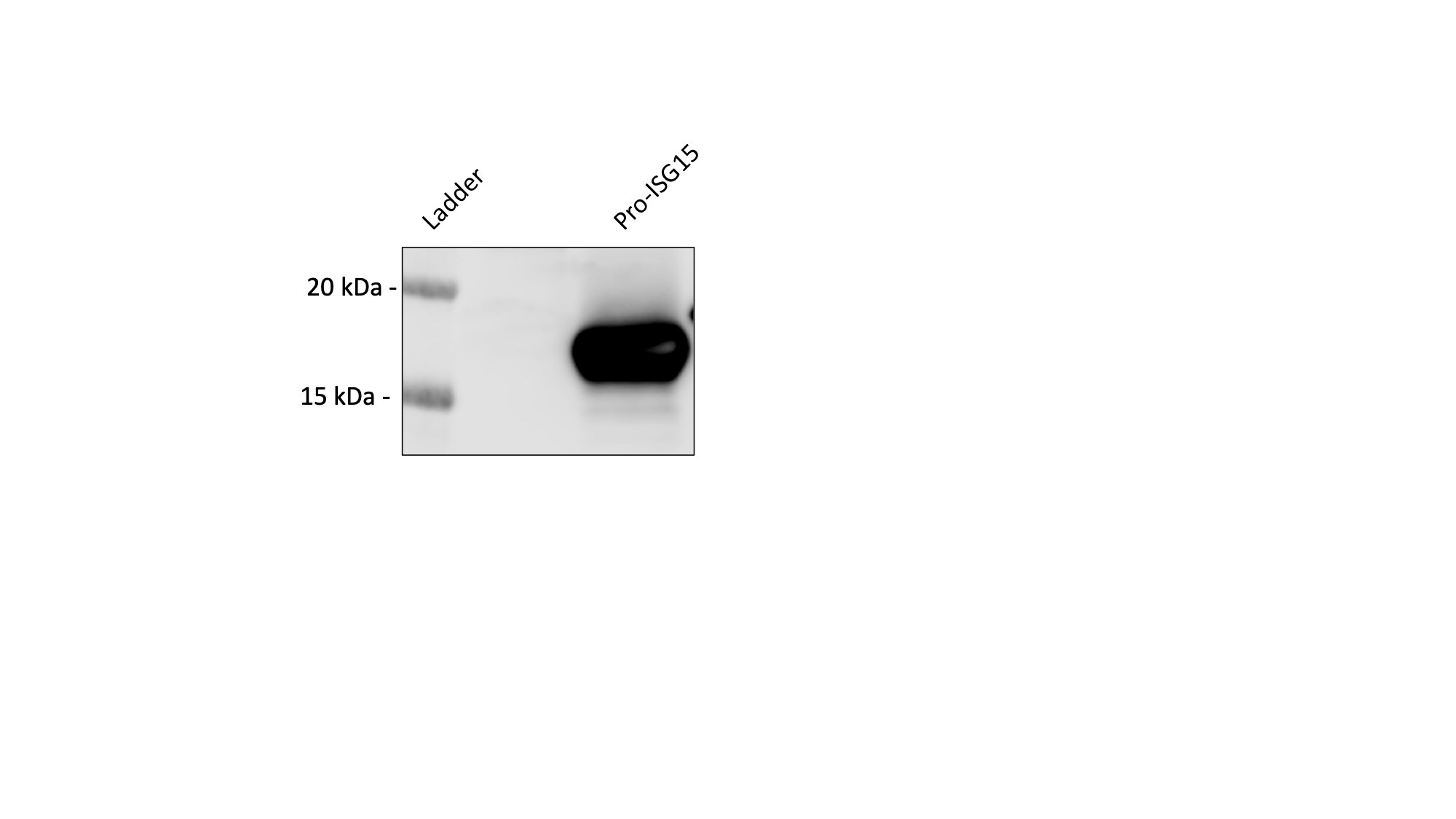
Pro-ISG15 (165 amino acids) is the inactive precursor of ISG15 (163 amino acids).The precursor is processed at the C-terminus by an ISG15-specific protease UBP43 (also knownas USP18). The mature form of ISG15 contains the conserved C-terminal di-glycine residues which are critical in activation and conjugation reactions. This protein can be used as a negative control in ISGylation reactions or as a substrate for UBP43.
 Powered by Bioz