Recombinant Human Ubiquitin Vinyl Methyl Ester Protein, CF
Recombinant Human Ubiquitin Vinyl Methyl Ester Protein, CF Summary
Product Specifications
Contains underivatized and C-terminal Vinyl Methyl Ester derivatized protein, quantity is by derivatized content
Product Datasheets
Carrier Free
CF stands for Carrier Free (CF). We typically add Bovine Serum Albumin (BSA) as a carrier protein to our recombinant proteins. Adding a carrier protein enhances protein stability, increases shelf-life, and allows the recombinant protein to be stored at a more dilute concentration. The carrier free version does not contain BSA.
In general, we advise purchasing the recombinant protein with BSA for use in cell or tissue culture, or as an ELISA standard. In contrast, the carrier free protein is recommended for applications, in which the presence of BSA could interfere.
U-203
| Formulation | 2.15 mg/ml (250 μM) in 50 mM MES pH 6.0 |
| Shipping | The product is shipped with dry ice or equivalent. Upon receipt, store it immediately at the temperature recommended below. |
| Stability & Storage: | Use a manual defrost freezer and avoid repeated freeze-thaw cycles.
|
Reconstitution Calculator
Background: Ubiquitin
Ubiquitin is a 76 amino acid (aa) protein that is ubiquitously expressed in all eukaryotic organisms. Ubiquitin is highly conserved with 96% aa sequence identity shared between human and yeast Ubiquitin, and 100% aa sequence identity shared between human and mouse Ubiquitin (1). In mammals, four Ubiquitin genes encode for two Ubiquitin-ribosomal fusion proteins and two poly-Ubiquitin proteins. Cleavage of the Ubiquitin precursors by deubiquitinating enzymes gives rise to identical Ubiquitin monomers each with a predicted molecular weight of 8.6 kDa. Conjugation of Ubiquitin to target proteins involves the formation of an isopeptide bond between the C-terminal glycine residue of Ubiquitin and a lysine residue in the target protein. This process of conjugation, referred to as ubiquitination or ubiquitylation, is a multi-step process that requires three enzymes: a Ubiquitin-activating (E1) enzyme, a Ubiquitin-conjugating (E2) enzyme, and a Ubiquitin ligase (E3). Ubiquitination is classically recognized as a mechanism to target proteins for degradation and as a result, Ubiquitin was originally named ATP-dependent Proteolysis Factor 1 (APF-1) (2,3). In addition to protein degradation, ubiquitination has been shown to mediate a variety of biological processes such as signal transduction, endocytosis, and post-endocytic sorting (4-7).
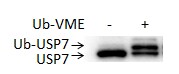
Ubiquitin-Vinyl Methyl Ester is a potent, irreversible and specific inhibitor of Ubiquitin C-terminal hydrolases (UCHs), Ubiquitin-specific proteases (USPs) and deubiquitinating enzymes (DUBs). It is useful for inhibiting the hydrolysis of poly-Ubiquitin chains on substrate proteins in vitro and thus enhances poly-Ubiquitin chain accumulation. Some DUBs, such as those of the JAMM class, are not inhibited by Ubiquitin-Vinyl Methyl Ester.

- Sharp, P.M. & W.-H. Li. (1987) Trends Ecol. Evol. 2:328.
- Ciechanover, A. et al. (1980 ) Proc. Natl. Acad. Sci. USA 77:1365.
- Hershko, A. et al. (1980) Proc. Natl. Acad. Sci. USA 77:1783.
- Greene, W. et al. (2012) PLoS Pathog. 8:e1002703.
- Tong, X. et al. (2012) J. Biol. Chem. 287:25280.
- Wei, W. et al. (2004) Nature 428:194.
- Wertz, I.E. et al. (2004) Nature 430:694.
FAQs
No product specific FAQs exist for this product, however you may
View all Proteins and Enzyme FAQsReviews for Recombinant Human Ubiquitin Vinyl Methyl Ester Protein, CF
Average Rating: 4 (Based on 1 Review)
Have you used Recombinant Human Ubiquitin Vinyl Methyl Ester Protein, CF?
Submit a review and receive an Amazon gift card.
$25/€18/£15/$25CAN/¥75 Yuan/¥2500 Yen for a review with an image
$10/€7/£6/$10 CAD/¥70 Yuan/¥1110 Yen for a review without an image
Filter by: