Recombinant Human Ubiquitin Vinyl Sulfone Protein, CF

R&D Systems | Catalog # U-202

R&D Systems
Discontinued Product
U-202 has been discontinued. An alternative/replacement product is available: U-202B. View all Ubiquitin products.

Key Product Details

Source

E. coli

Accession Number

Conjugate

Vinyl Sulfone

Applications

Enzyme Activity
Loading...

Product Specifications

Source

E. coli-derived human Ubiquitin protein
Contains underivatized and C-terminal VS derivatized protein, quantity is by derivatized content

Purity

>98%, by HPLC.

Predicted Molecular Mass

8.6 kDa

Activity

Add Recombinant Human Ubiquitin-Vinyl Sulfone to in vitro assays to inhibit deubiquitinating enzymes. Reaction conditions will need to be optimized for each specific application. We recommend an initial Recombinant Human Ubiquitin-Vinyl Sulfone concentration of 1-5 μM.

Reviewed Applications

Read 1 review rated 4 using U-202 in the following applications:

Formulation, Preparation, and Storage

U-202
Formulation 2.15 mg/ml (250 μM) in 50 mM MES, pH 6.0
Shipping The product is shipped with dry ice or equivalent. Upon receipt, store it immediately at the temperature recommended below.
Stability & Storage Use a manual defrost freezer and avoid repeated freeze-thaw cycles.
  • 6 months from date of receipt, -70 °C as supplied.
  • 3 months, -70 °C under sterile conditions after opening.

Background: Ubiquitin

Ubiquitin is a 76 amino acid (aa) protein that is ubiquitously expressed in all eukaryotic organisms. Ubiquitin is highly conserved with 96% aa sequence identity shared between human and yeast Ubiquitin, and 100% aa sequence identity shared between human and mouse Ubiquitin (1). In mammals, four Ubiquitin genes encode for two Ubiquitin-ribosomal fusion proteins and two poly-Ubiquitin proteins. Cleavage of the Ubiquitin precursors by deubiquitinating enzymes gives rise to identical Ubiquitin monomers each with a predicted molecular weight of 8.6 kDa. Conjugation of Ubiquitin to target proteins involves the formation of an isopeptide bond between the C-terminal glycine residue of Ubiquitin and a lysine residue in the target protein. This process of conjugation, referred to as ubiquitination or ubiquitylation, is a multi-step process that requires three enzymes: a Ubiquitin-activating (E1) enzyme, a Ubiquitin-conjugating (E2) enzyme, and a Ubiquitin ligase (E3). Ubiquitination is classically recognized as a mechanism to target proteins for degradation and as a result, Ubiquitin was originally named ATP-dependent Proteolysis Factor 1 (APF-1) (2,3). In addition to protein degradation, ubiquitination has been shown to mediate a variety of biological processes such as signal transduction, endocytosis, and post-endocytic sorting (4-7).

Ubiquitin-Vinyl Sulfone is a potent, irreversible and specific inhibitor of Ubiquitin C-terminal hydrolases (UCHs), Ubiquitin-specific proteases (USPs) and deubiquitinating enzymes (DUBs). This protein is useful for inhibiting the hydrolysis of poly-Ubiquitin chains on substrate proteins in vitro, thus enhancing poly-Ubiquitin chain accumulation.  Some DUBs, such as those of the JAMM class, are not inhibited by Ubiquitin-Vinyl Sulfone.

References

  1. Sharp, P.M. & W.-H. Li. (1987) Trends Ecol. Evol. 2:328.
  2. Ciechanover, A. et al. (1980 ) Proc. Natl. Acad. Sci. USA 77:1365.
  3. Hershko, A. et al. (1980) Proc. Natl. Acad. Sci. USA 77:1783.
  4. Greene, W. et al. (2012) PLoS Pathog. 8:e1002703.
  5. Tong, X. et al. (2012) J. Biol. Chem. 287:25280.
  6. Wei, W. et al. (2004) Nature 428:194.
  7. Wertz, I.E. et al. (2004) Nature 430:694.
  8. Borodovsky A., et al. (2001) EMBO J. 20: 5187-5196.
  9. Borodovsky A., et al. (2002) Chem. Biol. 9: 1149-1159.
  10. Borodovsky A., et al. (2005) Chem. Biochem. 6: 287-291.
  11. Hemelaar J., et al. (2004) Mol. Cell. Bio. 24: 84-95.
  12. Kessler B.M. (2006) Exp. Rev. Proteomics. 3 :213-221.
  13. Misaghi S., et al. (2005) J. Biol. Chem. 280: 1512-1520.
  14. Wang G., et al. (2003) Org. Lett. 5: 737-740.
  15. Verma R., et al. (2002) Science 298: 611-615.

Alternate Names

UBB

Entrez Gene IDs

7314 (Human); 298693 (Rat)

Gene Symbol

UBB

UniProt

Additional Ubiquitin Products

Product Documents for Recombinant Human Ubiquitin Vinyl Sulfone Protein, CF

Certificate of Analysis

To download a Certificate of Analysis, please enter a lot or batch number in the search box below.

Note: Certificate of Analysis not available for kit components.

Product Specific Notices for Recombinant Human Ubiquitin Vinyl Sulfone Protein, CF

For research use only

Citations for Recombinant Human Ubiquitin Vinyl Sulfone Protein, CF

Customer Reviews for Recombinant Human Ubiquitin Vinyl Sulfone Protein, CF (1)

4 out of 5
1 Customer Rating
5 Stars
0%
4 Stars
100%
3 Stars
0%
2 Stars
0%
1 Stars
0%

Have you used Recombinant Human Ubiquitin Vinyl Sulfone Protein, CF?

Submit a review and receive an Amazon gift card!

$25/€18/£15/$25CAN/¥2500 Yen for a review with an image

$10/€7/£6/$10CAN/¥1110 Yen for a review without an image

Submit a review
Amazon Gift Card

Customer Images


Showing  1 - 1 of 1 review Showing All
Filter By:
  • Recombinant Human Ubiquitin Vinyl Sulfone Protein, CF
    Name: Anonymous
    Application: Enzymatic activity in vitro
    Verified Customer | Posted 09/06/2018
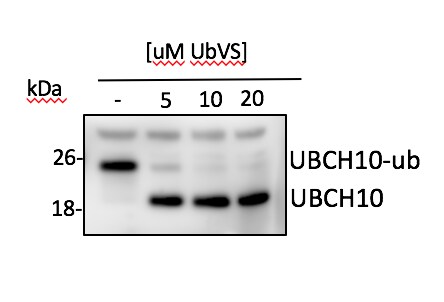
    Descritption of the figure: Treatment of the Xenopus extracts with UbVS at different concentration. UbVS induce ubiquitin depletion (measured as E2 discharge) in dose-dependent manner Ubch10: discharged E2 Ubch10-ub:charged E2
    Recombinant Human Ubiquitin Vinyl Sulfone Protein, CF U-202

There are no reviews that match your criteria.

Showing  1 - 1 of 1 review Showing All

FAQs

No product specific FAQs exist for this product.

View all FAQs for Proteins and Enzymes
Loading...