
Human WISP-1 (Wnt-induced secreted protein-1; also CNN4) is a 40 kDa, secreted, heparin-binding glycoprotein that is a member of the CCN (or CTGF/Cyr61/Nov) cysteine-rich protein family (1-5). It is synthesized as a 367 aa precursor that contains a series of structural homology modules. Following a 22 amino acid (aa) signal sequence, there is a 68 aa IGFBP-like domain (aa 53-120), a 57 aa von Willebrand factor type C (VWC) module (aa 126-182), a 40 aa TSP type I domain (aa 220-259) and a 75 aa, C-terminal cysteine knot motif (aa 273-347). The VWC module is associated with protein-protein interaction, the TSP domain binds sulfated glycoconjugates, and the cysteine knot mediates dimerization and receptor binding (4). It is likely that WISP-1 normally circulates as an 80 kDa homodimer (2). At least five alternative splice forms are known for WISP-1. One is 30 kDa in size, 258 aa in length, and shows a substitution of a His for aa 95-182. This removes the VWC domain (2, 6). A second isoform is 155 aa in length and shows a frameshift at Arg 117 with a unique 38 aa C-terminal extension. A third is 195 aa in length and shows a 31 aa substitution for the first 203 aa of the full length precursor (6). This retains the VWC and cysteine knot domains. A fourth shows a 43 aa substitution for aa 117-367 for a total length of 163 aa. This effectively removes everything but the IGFBP-like domain (7). The last splice form contains a deletion of aa 25-269 for a total length of 122 aa. Thus, only the signal sequence and cysteine knot motifs are retained (8). This leaves only the IGFBP-like domain (9). Full-length mature human WISP-1 is 85% aa identical to both mouse and rat WISP-1. WISP-1 is expressed by osteoblasts and may contribute to fracture healing by promoting bone cell formation (10, 11).
Recombinant Human WISP-1/CCN4 Protein, CF
R&D Systems | Catalog # 1627-WS

Loading...
Key Product Details
- R&D Systems NS0-derived Recombinant Human WISP-1/CCN4 Protein (1627-WS)
- Quality control testing to verify active proteins with lot specific assays by in-house scientists
- All R&D Systems proteins are covered with a 100% guarantee
Source
NS0
Accession Number
Applications
Bioactivity
Loading...
Product Specifications
Source
Mouse myeloma cell line, NS0-derived human WISP-1/CCN4 protein
Thr23-Asn367, with a 10-His tag
Thr23-Asn367, with a 10-His tag
Purity
>90%, by SDS-PAGE visualized with Silver Staining and quantitative densitometry by Coomassie® Blue Staining.
Endotoxin Level
<1.0 EU per 1 μg of the protein by the LAL method.
N-terminal Sequence Analysis
Thr23
Predicted Molecular Mass
39.3 kDa
SDS-PAGE
62 kDa, reducing conditions
Activity
Measured by its ability to inhibit the cell growth of DU145 human prostate carcinoma cells.
The ED50 for this effect is <6.00 µg/mL.
The ED50 for this effect is <6.00 µg/mL.
Reviewed Applications
Read 1 review rated 5 using 1627-WS in the following applications:
Formulation, Preparation, and Storage
1627-WS
| Formulation | Lyophilized from a 0.2 μm filtered solution in PBS with Trehalose. |
| Reconstitution | Reconstitute at 250 μg/mL in sterile PBS.
Loading...
|
| Shipping | The product is shipped at ambient temperature. Upon receipt, store it immediately at the temperature recommended below. |
| Stability & Storage | Use a manual defrost freezer and avoid repeated freeze-thaw cycles.
|
Calculators
Background: WISP-1/CCN4
References
- Pennica, D. et al. (1998) Proc. Natl. Acad. Sci. USA 95:14717.
- Tanada, S. et al. (2001) Oncogene 20:5525.
- Brigstock, D.R. et al. (2003) J. Clin. Pathol. Mol. Pathol. 56:127.
- Desnoyers, L. (2004) Curr. Pharm. Des. 10:3913.
- Brigstock, D.R. (2003) J. Endocrinol. 178:169.
- Li, Z. (2005) GenBank Accession # AAP43925.
- Li, Z. (2005) GenBank Accession # AAP43926.
- Li, Z. (2005) GenBank Accession # AAP43924.
- Cervello, M. et al. (2004) Ann. N.Y. Acad. Sci. 1028:432.
- French, D.M. et al. (2004), Am. J. Pathol. 165:855.
- Parisi, M.S. et al. (2006) Bone 38:671.
Long Name
Wnt-1 Induced Secreted Protein 1
Alternate Names
CCN4, WISP1
Gene Symbol
CCN4
UniProt
Additional WISP-1/CCN4 Products
Product Documents for Recombinant Human WISP-1/CCN4 Protein, CF
Certificate of Analysis
To download a Certificate of Analysis, please enter a lot or batch number in the search box below.
Note: Certificate of Analysis not available for kit components.
Product Specific Notices for Recombinant Human WISP-1/CCN4 Protein, CF
For research use only
Related Research Areas
Citations for Recombinant Human WISP-1/CCN4 Protein, CF
 Powered by Bioz
Customer Reviews for Recombinant Human WISP-1/CCN4 Protein, CF (1)
5 out of 5
1 Customer Rating
Have you used Recombinant Human WISP-1/CCN4 Protein, CF?
Submit a review and receive an Amazon gift card!
$25/€18/£15/$25CAN/¥2500 for a review with an image
$10/€7/£6/$10CAN/¥1110 for a review without an image
Submit a review
Customer Images
Showing
1
-
1 of
1 review
Showing All
Filter By:
-
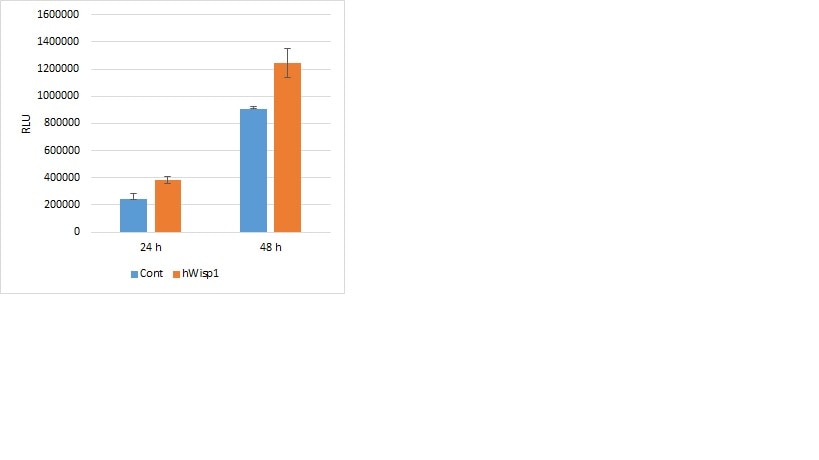
Application: Cell ProliferationVerified Customer | Posted 04/28/2018

There are no reviews that match your criteria.
FAQs for Recombinant Human WISP-1/CCN4 Protein, CF
Showing
1
-
1 of
1 FAQ
Showing All
-
Q: Is the 10 His-tag on Recombinant Human WISP-1/CCN4 Protein, CF, on the N-terminus or C-terminus?
A: The 10 His-tag on Recombinant Human WISP-1/CCN4 Protein, CF, is on the C-terminus.
Loading...