

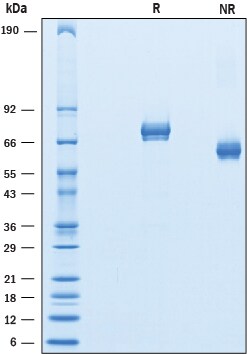
Growth and differentiation factor-associated serum protein 1 (GASP-1), also known as WAP, Follistatin/Kazal, Immunoglobulin, Kunitz and Netrin domain containing protein 2 (WFIKKN2), appears to be a multifunctional molecule comprised of several conserved domains. GASP-1, along with the highly related GASP-2 (WFIKKN1), contains a WAP domain, a Follistatin/Kazal domain, an Immunoglobulin domain, two Kunitz‐type protease inhibitor domains and a netrin domain (1). GASP-1 was first isolated in a screen to identify proteins in mice that copurify with Myostatin (GDF8) (1). Mature mouse GASP-1 is 542 amino acids (aa) and shares 94% and 98% aa identity with mature human and rat GASP-1, respectively.
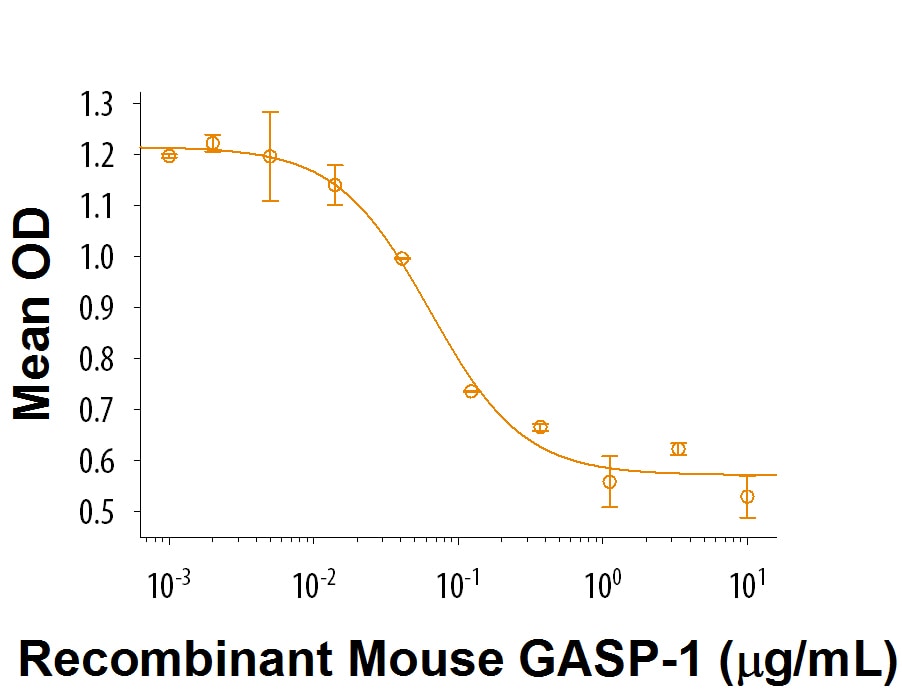
WAP, Follistatin, Kazal and Netrin domains are all implicated in protease inhibition, and GASP-1 and 2 may be protease inhibitor proteins involved in muscle development (1). In humans, GASP-1 and 2 show distinct expression patterns, with GASP-1 expression during development highest in the brain, skeletal muscle, thymus and kidney (2). In mice, GASP-1 expression can be detected in the neural tube and limb buds of developing embryos, while in adult mice it is found in numerous tissue types (3, 4). Both GASP-1 and 2 appear to bind several members of the TGF beta family with high affinity, including Activin, BMP2, BMP4, TGF-beta 1, GDF-8 and GDF-11 (1, 5, 6). Interestingly, GASP-1 has been shown to specifically inhibit the activity of GDF-8 and GDF-11 but not the other TGF-beta family proteins (1, 4, 6). GASP-1 binds directly but independently to both mature myostatin and the myostatin propeptide (1). Over expression of GASP-1 in mice results in animals that are hyper muscled, consistent with reduction in GDF-8 signaling (7).
