Recombinant Mouse LDLR Protein
R&D Systems | Catalog # 2255-LD

Loading...
Key Product Details
- R&D Systems NS0-derived Recombinant Mouse LDLR Protein (2255-LD)
- Quality control testing to verify active proteins with lot specific assays by in-house scientists
- All R&D Systems proteins are covered with a 100% guarantee
Source
NS0
Accession Number
Applications
Binding Activity
Loading...
Product Specifications
Source
Mouse myeloma cell line, NS0-derived mouse LDLR protein
Ala22-Arg790 (Ala23Val and Cys27Gly), with a C-terminal 10-His tag
Ala22-Arg790 (Ala23Val and Cys27Gly), with a C-terminal 10-His tag
Purity
>90%, by SDS-PAGE under reducing conditions and visualized by silver stain.
Endotoxin Level
<0.10 EU per 1 μg of the protein by the LAL method.
N-terminal Sequence Analysis
Ala22
Predicted Molecular Mass
85.7 kDa
SDS-PAGE
130-135 kDa, reducing conditions
Activity
Measured by its binding ability in a functional ELISA.
When Human LDL is immobilized at 5 μg/mL (100 μL/well), the concentration of Recombinant Mouse LDLR that produces 50% of the optimal binding response is 0.4-4 μg/mL.
When Human LDL is immobilized at 5 μg/mL (100 μL/well), the concentration of Recombinant Mouse LDLR that produces 50% of the optimal binding response is 0.4-4 μg/mL.
Scientific Data Images for Recombinant Mouse LDLR Protein
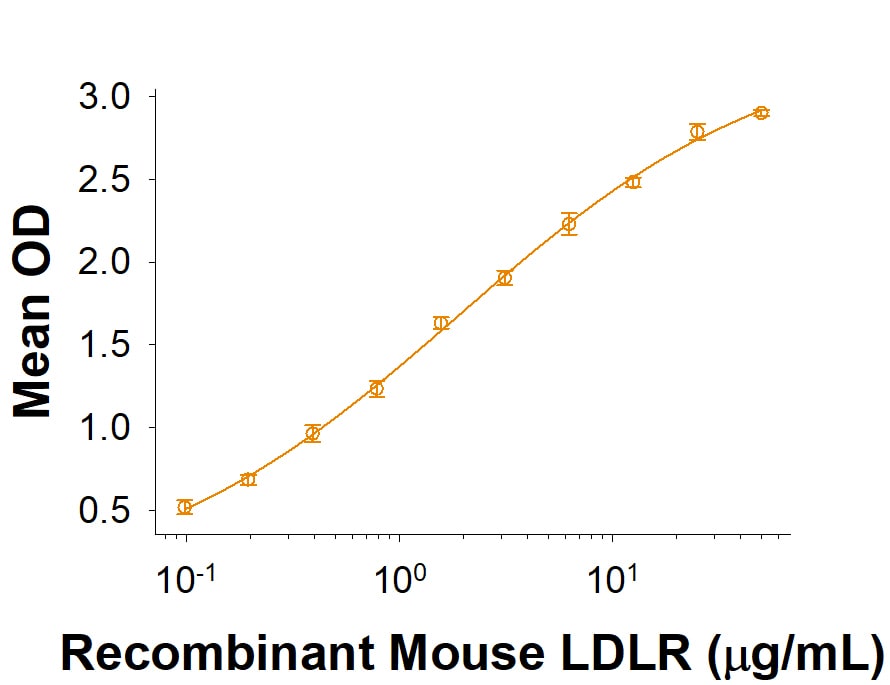
Recombinant Mouse LDLR Protein Binding Activity
When Human LDL is immobilized at 5 μg/mL (100 μL/well), Recombinant Mouse LDLR (Catalog # 2255-LD) binds with an ED50 of 0.4-4 μg/mL.Formulation, Preparation, and Storage
Carrier Free
What does CF mean?CF stands for Carrier Free (CF). We typically add Bovine Serum Albumin (BSA) as a carrier protein to our recombinant proteins. Adding a carrier protein enhances protein stability, increases shelf-life, and allows the recombinant protein to be stored at a more dilute concentration. The carrier free version does not contain BSA.
What formulation is right for me?In general, we advise purchasing the recombinant protein with BSA for use in cell or tissue culture, or as an ELISA standard. In contrast, the carrier free protein is recommended for applications, in which the presence of BSA could interfere.
Carrier: 2255-LD
| Formulation | Lyophilized from a 0.2 μm filtered solution in PBS with BSA as a carrier protein. |
| Reconstitution | Reconstitute at 100 μg/mL in sterile PBS containing at least 0.1% human or bovine serum albumin. |
| Shipping | The product is shipped at ambient temperature. Upon receipt, store it immediately at the temperature recommended below. |
| Stability & Storage | Use a manual defrost freezer and avoid repeated freeze-thaw cycles.
|
Carrier Free: 2255-LD/CF
| Formulation | Lyophilized from a 0.2 μm filtered solution in PBS with Trehalose. |
| Reconstitution | Reconstitute at 200 μg/mL in sterile PBS. |
| Shipping | The product is shipped at ambient temperature. Upon receipt, store it immediately at the temperature recommended below. |
| Stability & Storage | Use a manual defrost freezer and avoid repeated freeze-thaw cycles.
|
Calculators
Background: LDLR
beta -propeller structures (class B LDL repeats) in the extracellular domain (ECD) (1-7). A membrane-proximal Ser/Thr-rich region shows extensive O-linked glycosylation (4, 8). A cytoplasmic NPxY motif links the LDL R to clathrin pits for endocytosis, and binds to select adaptor proteins (1, 4, 8). The mouse LDL R ECD shares 78%, 86%, 76% and 76% aa sequence identity with human, rat, bovine, and porcine LDL R, respectively. LDL R is constitutively and widely expressed. Its class A LDL domains near the N-terminus bind apoB and apoE, the apolipoproteins of low- and very low-density lipoproteins (LDL and VLDL), respectively (1, 2, 4, 9). Hepatocyte LDL R is responsible for endocytosis and clearing of most plasma LDL cholesterol (2, 9). At the low pH of the endocytic vesicle, it dissociates, allowing degradation of LDL and recycling of LDL R to the cell surface (1, 4). Lack of LDL R expression or function causes familial hypercholesterolemia (FH) (4, 9, 10). The protease PCSK9 (proprotein convertase subtilisin/kexin type 9) can also cause increased plasma cholesterol by promoting LDL R degradation rather than recycling to the cell surface (10-12). Soluble forms of approximately 140 kDa and 28 kDa are reported to be released by phorbol esters or interferons, respectively (6, 7).
References
- Go, G.W. and A. Mani (2012) Yale J. Biol. Med. 85:19.
- Ren, G. et al. (2010) Proc. Natl. Acad. Sci. USA 107:1059.
- Bujo, H. and Y. Saito (2006) Arterioscler. Thromb. Vasc. Biol. 26:1246.
- Gent, J. and I. Braakman (2004) Cell. Mol. Life Sci. 61:2461.
- Polvino, W.J. et al. (1992) Somat. Cell Mol. Genet. 18:443.
- Begg, M.J. et al. (2004) Eur. J. Biochem. 271:524.
- Fischer, D.G. et al. (1993) Science 262:250.
- Stolt, P.C. and H.H. Bock (2006) Cell. Signal. 18:1560.
- Defesche, J.C. (2004) Semin. Vasc. Med. 4:5.
- De Castro-Oros, I. et al. (2010) Appl. Clin Genet. 3:53.
- Zhang, D.W. et al. (2008) Proc. Natl. Acad. Sci. USA 105:13045.
- Tavori, H. et al. (2013) Circulation 127:2403.
Long Name
Low Density Lipoprotein Receptor
Alternate Names
LDL R
Entrez Gene IDs
Gene Symbol
LDLR
UniProt
Additional LDLR Products
Product Documents for Recombinant Mouse LDLR Protein
Certificate of Analysis
To download a Certificate of Analysis, please enter a lot or batch number in the search box below.
Note: Certificate of Analysis not available for kit components.
Product Specific Notices for Recombinant Mouse LDLR Protein
For research use only
Related Research Areas
Citations for Recombinant Mouse LDLR Protein
 Powered by Bioz
Customer Reviews for Recombinant Mouse LDLR Protein
There are currently no reviews for this product. Be the first to review Recombinant Mouse LDLR Protein and earn rewards!
Have you used Recombinant Mouse LDLR Protein?
Submit a review and receive an Amazon gift card!
$25/€18/£15/$25CAN/¥2500 for a review with an image
$10/€7/£6/$10CAN/¥1110 for a review without an image
Submit a review
Loading...
Associated Pathways