
Immunoassay Development Solutions
Find the Best Immunoassay Strategy
Choosing the right immunoassay development strategy is critical to building a long-term, scalable assay solution tailored to your research needs. R&D Systems™ immunoassay development solutions deliver flexible support adapted to your specific requirements— whether you want to buy, develop your own immunoassay in-house or prefer a custom, fully validated solution designed for your project.
Our portfolio offers a comprehensive range of immunoassay solutions, but if your needs go beyond an existing kit, the team is ready to support you in developing your own assay or creating a custom solution tailored to your research goals.




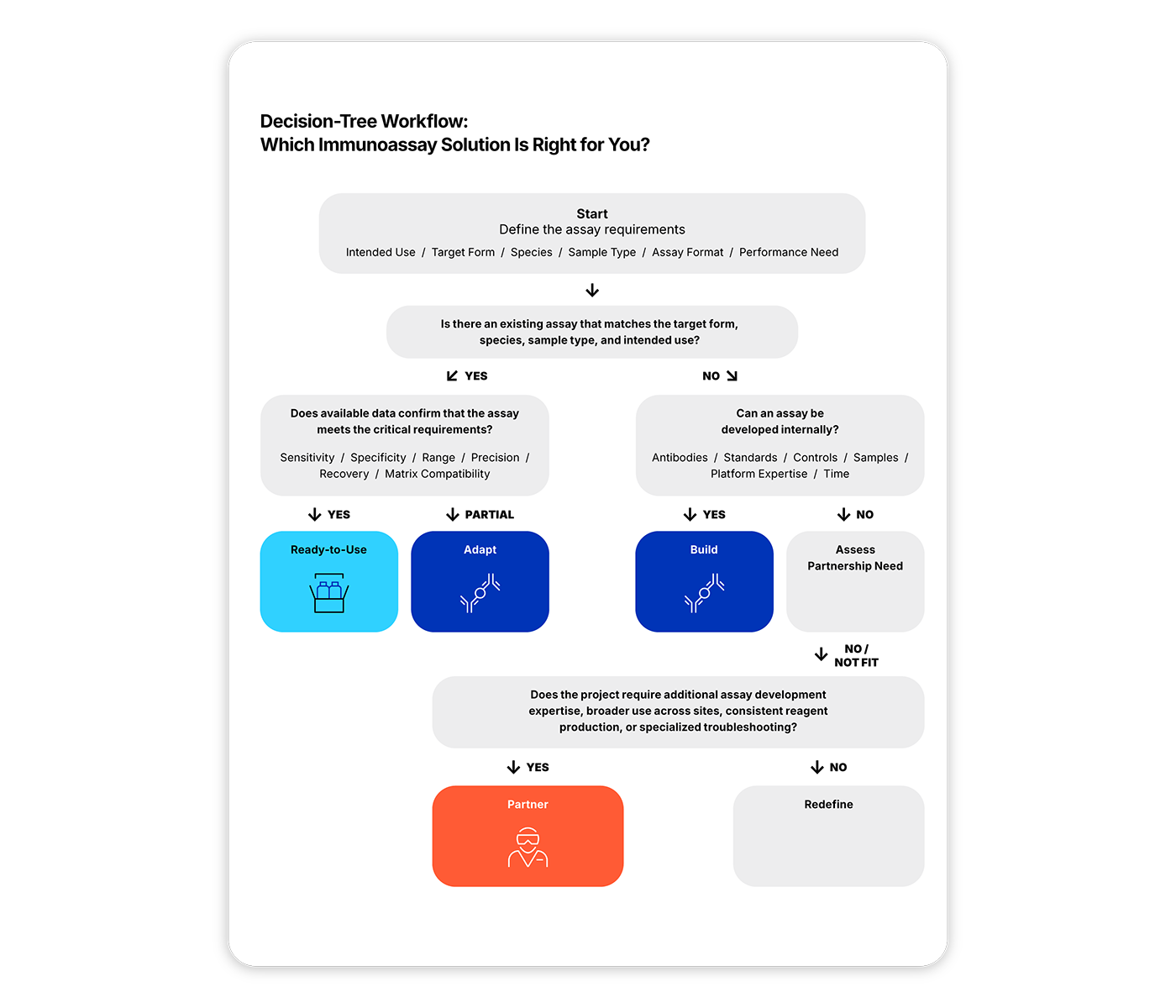
Which Immunoassay Solution is Right for You?
Use this practical decision-tree to evaluate the best assay option to meet your needs. Download our full practical guide to immunoassay development for additional guidance.
Start With the Right Inputs
R&D Systems immunoassay antibodies and ELISA development kits give you assay-ready inputs designed to work together from the start. When available, our ELISA-validated antibodies and matched antibody pairs come with immunogen-information and recommended starting concentrations so you can reduce trial-and-error and reach a working assay faster. With multiple binder options per target and antibodies developed using full-length proteins, R&D Systems portfolio gives you the flexibility to identify antibodies that recognize accessible, biologically relevant regions—so you can measure your target accurately, even in complex conditions.
Need Support to Build Your Immunoassay?
Optimizing an Assay: How Do I Improve What isn’t Working?
In many assays, the biggest challenge isn’t binding the target—it’s detecting the right part of the biology. Therapeutics can mask epitopes, and sample matrices can interfere with otherwise strong binders. When developing your immunoassay, factors such as matrix effects, weak signals, and epitope blockage can significantly impact assay performance, including the limit of detection and specificity.
Matrix Effect
Cause: Unexpected interference from sample components leading to inaccurate or inconsistent results.
Solutions:
- Dilute samples
- Use assay buffers with blocking agents
- Include matched matrix controls
- Consider sample clean-up or purification steps
Weak Signal
Cause: Low assay sensitivity resulting in poor or no detectable signal.
Solutions:
- Verify antibody quality and storage conditions
- Optimize antibody concentrations in both capture and detection steps
- Ensure detection reagents are active and prepared fresh
Blocked Epitope
Cause: Target epitopes are inaccessible, leading to poor antibody binding and assay failure.
Solutions:
- Modify sample preparation procedures to preserve epitope accessibility
- Use antibodies targeting different epitopes or domains of the analyte
- Test multiple antibody pairs to identify combinations
Download our practical guide to immunoassay development to identify the possible causes of your issue and follow our recommended troubleshooting steps to help ensure a successful immunoassay. If you need additional support, please reach out to our technical service department.
Resources to Support Your Immunoassay Development
To help you succeed, R&D Systems website provide comprehensive guides and detailed application notes designed to walk you through best practices, optimize assay conditions, and troubleshoot common issues.
Scaling an Assay: How Do I Move a Successful Assay Forward?
An assay that works in early development must also perform consistently as programs advance. Our R&D Systems portfolio supports continuity from early screening through later-stage development with scalable formats and consistent supply—so you can move forward without needing to redesign your assay. If you require large volumes, request a bulk quote to ensure your supply needs are met efficiently. For specialized needs (concentration, vial sizing, etc), our made-to-order options provide customized solutions tailored to your project requirements. To explore the best approach for your assay development, our experts will guide you through our flexible solutions and support your success.
Support at Every Step
Work with our experts to design, optimize, and scale immunoassays tailored to your unique program needs.
Our experts provide guidance throughout the entire process, from initial assay design and reagent selection to optimization, validation, and scale-up. We offer access to high-quality, well-characterized antibodies and reagents, customizable assay formats, and tailored solutions that meet specific research needs.
Available Services
Immunoassay development starts with selecting the target and antibodies, choosing the assay format, and optimizing conditions. The assay is validated for accuracy, tested with real samples, assessed for stability, then scaled up and documented for regulatory use.
To start immunoassay development, you need key reagents including high-quality capture and detection antibodies specific to your target antigen, purified antigen or standard for calibration, appropriate blocking buffers to minimize nonspecific binding, wash buffers, enzyme conjugates or labeled detection reagents, and substrates for signal generation. Additionally, suitable assay plates or solid supports and sample diluents are essential to set up and optimize the assay.
Researchers should consider custom immunoassay development when commercial kits don’t meet their target, sample type, sensitivity, or format needs. Custom immunoassay development enables tailored solutions that optimize assay performance for biomarkers and therapeutics discovery.
To troubleshoot a poorly performing immunoassay, check reagent quality, optimize antibody levels, ensure proper sample handling, and confirm incubation and washing steps. Also verify detection reagents and equipment are working correctly to improve assay results.