
Utilizing Maurice in Upstream Process Development
One of the most time-consuming processes in biopharmaceutical development occurs upstream, where critical decisions about clone selection and process conditions must be made long before purified material is available for downstream development. Media composition, temperature shifts, and culture conditions can all influence critical quality attributes at this stage, yet the analytical tools typically used here offer limited resolution and poor throughput. Without reliable early data, quality issues that could have been identified and addressed upstream are instead discovered later, at a considerably greater cost. Automated platforms capable of delivering high-resolution, multi-attribute data directly from crude samples represent a meaningful step forward, and this blog briefly describes the use of automated capillary electrophoresis platform, Maurice, in upstream bioprocess development.
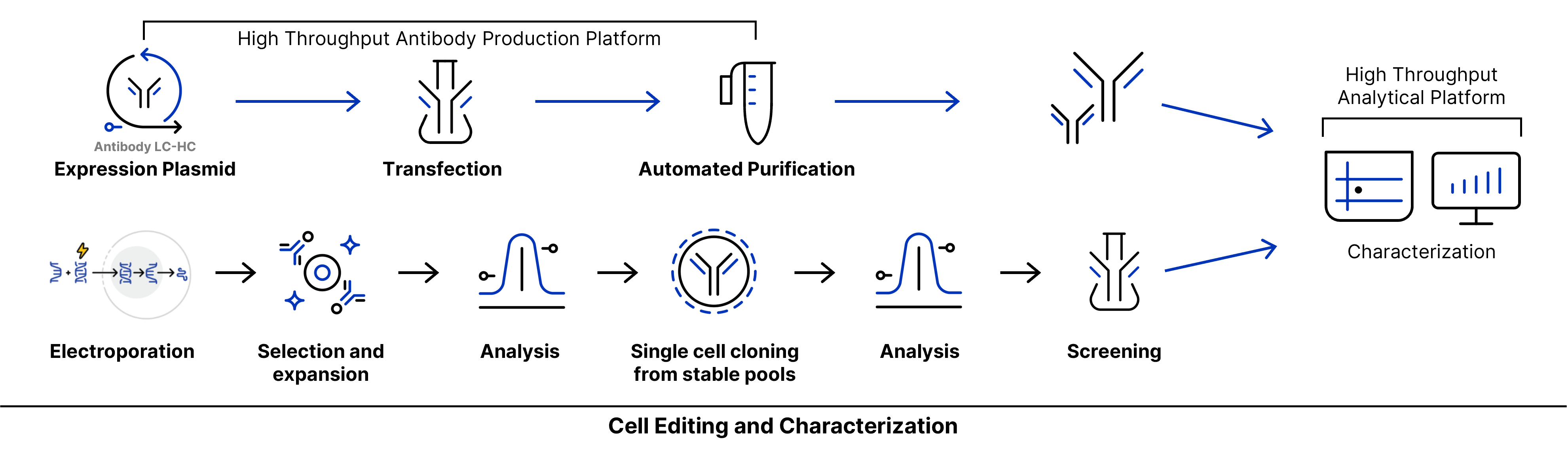
Maurice Platforms Are Suitable in Labs Preceding Analytical Development and QC
Maurice™ platforms have historically been utilized as robust analytical tools for purified or semi-purified samples in analytical development and QC, where their combination of CE-SDS and imaged capillary isoelectric focusing (icIEF) is well established. Upstream workflows present a fundamentally different challenge: low sample concentration, minimally purified material, and pressure to generate actionable data quickly. Recent studies, listed at the bottom of this page, have shown how the Maurice Turbo CE-SDS and Maurice icIEF 400 assays address this directly.
High-Throughput Size Analysis in the Upstream Stage
The Turbo cartridge completes CE-SDS separations in approximately 5.5–8 minutes per sample, enabling large upstream sample sets to be processed within a day. Critically, it reliably resolves intact antibody, fragments, and high-molecular-weight species directly from cell culture supernatants, with no purification required. With %RSD values typically at ≤1–4%, the data quality is sufficient to draw meaningful comparisons across conditions with subtle differences. For labs evaluating media formulations, temperature shifts, or clone-to-clone variability, this translates to quantitative size and purity data at the stage where it most influences development decisions, a significant improvement over gel-based methods or qualitative readouts.
Multi-Attribute Characterization on a Single Platform
However, size variants alone rarely provide a complete picture. Charge heterogeneity frequently reflects underlying post-translational modifications or degradation pathways relevant to stability and manufacturability, and these signals can emerge early in development. In a study by Pan et al., icIEF charge variant profiles were among the key attributes used to establish comparability between preclinical and clinical batches of multi-specific antibodies, with acidic, main, and basic species distributions remaining consistent across pool-of-clones and lead clone material at both 500 L and 2000 L manufacturing scale1. The ability to detect and track these subtle charge differences upstream is precisely what makes the Maurice platform valuable at this stage of development.
The icIEF 400 cartridge enables higher productivity for charge variant analysis with up to 400 injections and 40 batches per run. In addition, by incorporating the recently published SupersonicIEF method2, up to 96 samples can be analyzed in 12 hours.
Maurice enables CE-SDS and icIEF on a single automated platform, allowing upstream labs to assess both attributes without instrument transfers or extensive sample prep. Upstream icIEF workflows using absorbance or native fluorescence detection have demonstrated resolution of subtle shifts in acidic, main, and basic species across a range of cell culture conditions, supporting earlier and more informed decisions.
Applications in High-Throughput Antibody Discovery
In antibody discovery settings, where the goal is the rapid analysis of a vast number of candidates, an instrument like Maurice proves particularly valuable. Studies profiling more than 100 recombinant antibodies have used Turbo CE-SDS to differentiate heat-stable from heat-labile candidates based on fragmentation profiles, while icIEF revealed set-wise pI trends and patterns of charge heterogeneity. On-board mixing further reduces hands-on time, enabling Maurice to integrate alongside high-throughput expression and purification platforms as part of a continuous upstream workflow.
As such, Maurice platforms are no longer confined to purified or semi-purified samples or late-stage development. It is a capable upstream analytical platform, delivering multi-attribute, high-throughput data at the pace of modern biotherapeutic development demands.
References
- Pan, J., McPhee, J., Dow, A., Burke, D., Gupta, B., Rose, P., Wang, X., Pinto, N., Letarte, S., Huang, Y., Li, G. B., Agarwal, K., Smith, K., & Liu, R. (2025). Utilizing non-clonal CHO cell derived materials for preclinical studies of complex molecules. BMC biotechnology, 25(1), 33. https://doi.org/10.1186/s12896-025-00968-4
- McElroy, W., & Heger, C. D. (2024). Development of the SupersonicIEF Method for High-Throughput Charge Variant Analysis. Electrophoresis, 45(21-22), 1968–1975. https://doi.org/10.1002/elps.202400117
Whitepaper
Assessment of Product Quality in Upstream Process Development Using Maurice™ CE-SDS and icIEF
Application Note

Integrating Upstream Production with Downstream Rapid Characterization for High-Throughput Antibody Development
Webinar
Addressing the Challenges of Size and Purity Analysis for Fusion Proteins, ADCs, and AAVs using CE-SDS