Apolipoprotein E/ApoE Antibody - R136S Mutant
Novus Biologicals | Catalog # NBP3-13452

![Western Blot: Apolipoprotein E/ApoE AntibodyR136S Mutant [NBP3-13452]](https://resources.rndsystems.com/images/products/Apolipoprotein-E-ApoE-Antibody---R136S-Mutant-Western-Blot-NBP3-13452-img0001.jpg "Western Blot: Apolipoprotein E/ApoE AntibodyR136S Mutant [NBP3-13452]")
Scientific images may be resized, cropped, or adjusted for brightness or contrast for presentation purposes. These updates are limited to presentation and do not affect the underlying scientific interpretation of the data. Where available, additional source data may be provided upon request.
Loading...
Key Product Details
Species Reactivity
Human
Applications
Western Blot
Label
Unconjugated
Antibody Source
Polyclonal Rabbit IgG
Loading...
Product Specifications
Immunogen
Carrier-protein conjugated synthetic peptide surrounding mutant R136S of human Apolipoprotein E/ApoE. The exact sequence is proprietary.
Clonality
Polyclonal
Host
Rabbit
Isotype
IgG
Description
Centrifuge briefly prior to opening.
Scientific Data Images for Apolipoprotein E/ApoE Antibody - R136S Mutant
Western Blot: Apolipoprotein E/ApoE AntibodyR136S Mutant [NBP3-13452]
Western Blot: Apolipoprotein E/ApoE Antibody - R136S Mutant [NBP3-13452] - Non-transfected (-) and transfected (+) 293T whole cell extracts (30 ug) were separated by 12% SDS-PAGE, and the membrane was blotted with Apolipoprotein E/ApoE (Mutant R136S) antibody (NBP3-13452) diluted at 1:1000. The HRP-conjugated anti-rabbit IgG antibody (NBP2-19301) was used to detect the primary antibody.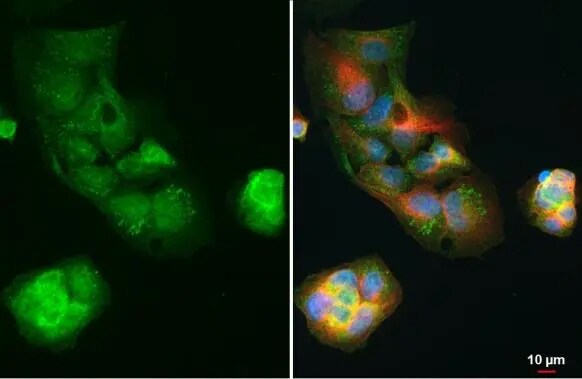
Immunocytochemistry/ Immunofluorescence: Apolipoprotein E/ApoE Antibody - R136S Mutant [NBP3-13452] -
Immunocytochemistry/ Immunofluorescence: Apolipoprotein E/ApoE Antibody - R136S Mutant [NBP3-13452] - Apolipoprotein E/ApoE antibody detects Apolipoprotein E/ApoE protein at cytoplasm by immunofluorescent analysis.Sample: HepG2 cells were fixed in 4% paraformaldehyde at RT for 15 min.
Green: Apolipoprotein E/ApoE stained by Apolipoprotein E/ApoE antibody (NBP3-13452) diluted at 1:500.
Red: alpha Tubulin, a cytoskeleton marker, stained by alpha Tubulin antibody [GT114] diluted at 1:1000.
Blue: Fluoroshield with DAPI.
Applications for Apolipoprotein E/ApoE Antibody - R136S Mutant
Application
Recommended Usage
Western Blot
Optimal dilutions of this antibody should be experimentally determined.
Formulation, Preparation, and Storage
Purification
Antigen Affinity-purified
Formulation
PBS, 1% BSA, 20% Glycerol
Preservative
0.025% Proclin 300
Concentration
Concentrations vary lot to lot. See vial label for concentration. If unlisted please contact technical services.
Shipping
The product is shipped with polar packs. Upon receipt, store it immediately at the temperature recommended below.
Stability & Storage
Store at 4C short term. Aliquot and store at -20C long term. Avoid freeze-thaw cycles.
Background: Apolipoprotein E/ApoE
Lipoproteins are responsible for carrying cholesterol and other fats through the bloodstream as little packages and are essential for the normal breakdown of these molecules. In particular, apolipoprotein E is a major component of specific lipoproteins called very low-density lipoproteins (VLDL). A major function of VLDLs is to remove excess cholesterol from the blood and carry it to the liver for processing. Maintaining normal levels of cholesterol is essential for the prevention of cardiovascular diseases, including heart attacks and strokes.
The three Apo E isoforms are strongly associated with cardiovascular disease and Alzheimer's disease, so ApoE antibodies have become useful tools for research in both of these areas.
Alternate Names
APOE
Gene Symbol
APOE
Additional Apolipoprotein E/ApoE Products
Product Documents for Apolipoprotein E/ApoE Antibody - R136S Mutant
Certificate of Analysis
To download a Certificate of Analysis, please enter a lot or batch number in the search box below.
Product Specific Notices for Apolipoprotein E/ApoE Antibody - R136S Mutant
This product is for research use only and is not approved for use in humans or in clinical diagnosis. Primary Antibodies are guaranteed for 1 year from date of receipt.
Related Research Areas
Customer Reviews for Apolipoprotein E/ApoE Antibody - R136S Mutant
There are currently no reviews for this product. Be the first to review Apolipoprotein E/ApoE Antibody - R136S Mutant and earn rewards!
Have you used Apolipoprotein E/ApoE Antibody - R136S Mutant?
Submit a review and receive an Amazon gift card!
$25/€18/£15/$25CAN/¥2500 for a review with an image
$10/€7/£6/$10CAN/¥1110 for a review without an image
Submit a review
Protocols
Find general support by application which include: protocols, troubleshooting, illustrated assays, videos and webinars.
- Cellular Response to Hypoxia Protocols
- R&D Systems Quality Control Western Blot Protocol
- Troubleshooting Guide: Western Blot Figures
- Western Blot Conditions
- Western Blot Protocol
- Western Blot Protocol for Cell Lysates
- Western Blot Troubleshooting
- Western Blot Troubleshooting Guide
- View all Protocols, Troubleshooting, Illustrated assays and Webinars
Loading...
Associated Pathways