
Quantikine Colorimetric Sandwich ELISA Kits
R&D Systems Quantikine™ ELISA Kits are complete, ready-to-use quantitative immunoassays designed for the measurement of specific protein biomarkers in biological samples. Each kit includes pre-validated reagents, an assay standard, and detailed protocols to support sensitive, reproducible protein quantification using a sandwich ELISA format. Carefully selected antibody pairs, precision automated microplate coating, and optimally formulated diluents help minimize assay variability and maintain consistent performance across experiments. Assays are available for a wide range of targets, including cytokines, chemokines, growth factors, proteases, soluble receptors, and other protein biomarkers.
New to Quantikine ELISAs? Browse our FAQs below for answers to common questions about target analytes, compatible sample types, and research applications.
Quantikine ELISA Features
- Complete ready-to-use kits containing all required assay reagents
- Quantitative protein measurement with colorimetric detection
- Extensively validated for accuracy, precision, sensitivity, and specificity
- Lot-to-lot consistency supported by rigorous quality testing
- Detailed protocol booklets including sensitivity, recovery, linearity, and inter- and intra-assay precision specifications
Compatible Sample Types
Depending on the assay, Quantikine ELISA Kits can be used with a variety of sample types, including:
- Serum
- Plasma
- Cell culture supernatants
- Tissue homogenates
- Cell lysates
- Additional biological fluids
Compatible sample types vary by analyte and kit. Refer to the individual product-specific data sheets for validated sample types and preparation recommendations.
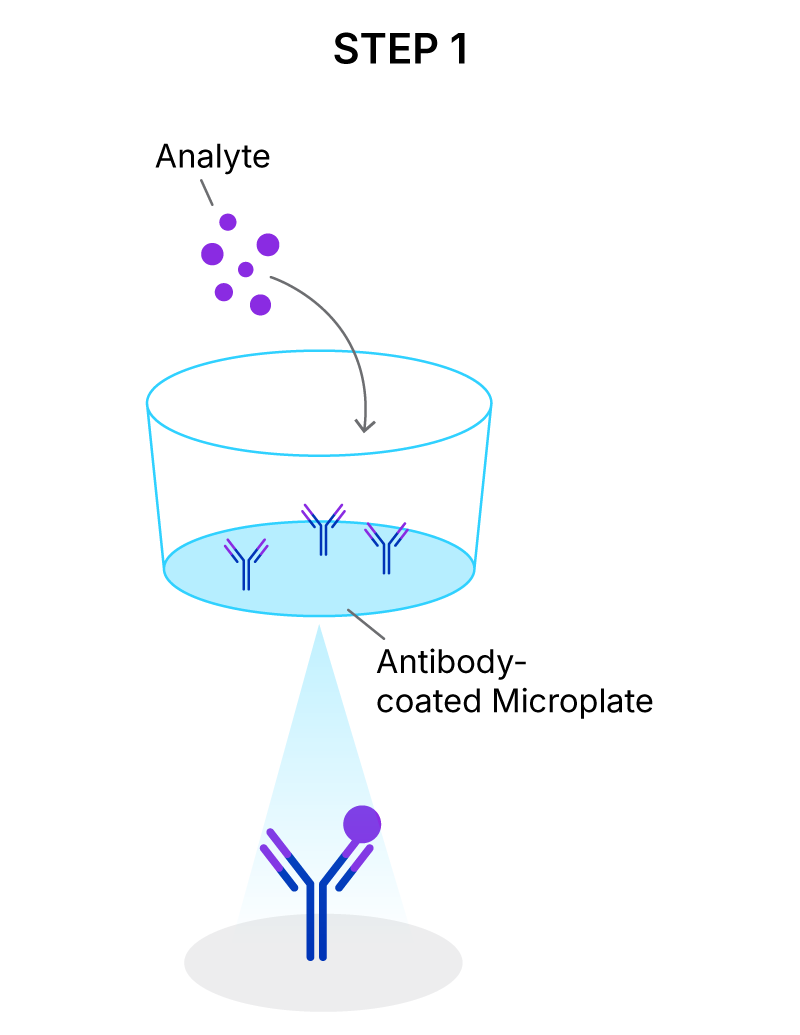
A microplate pre-coated with capture antibody is provided. Samples or standards are added and any analyte present is bound by the immobilized antibody. Unbound materials are washed away.
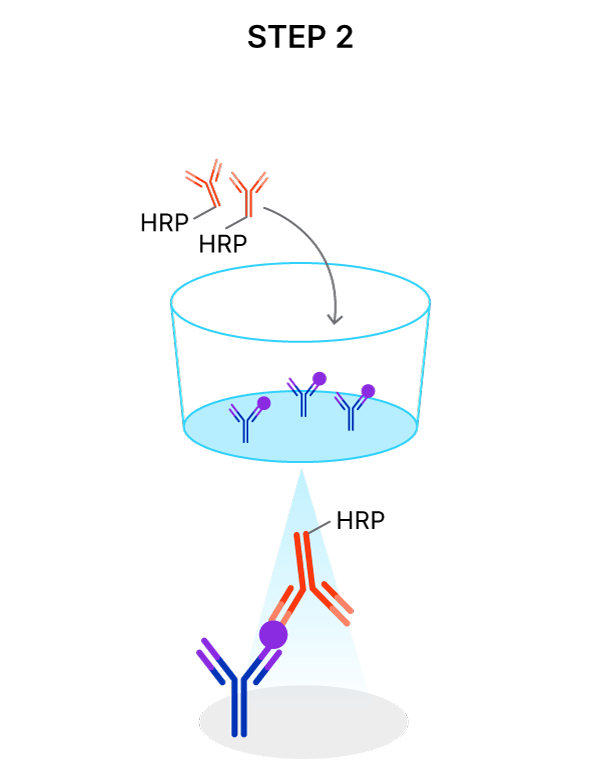
A second horseradish peroxidase (HRP)-labeled antibody (detection antibody) is added and binds to the captured analyte. Unbound detection antibody is washed away.
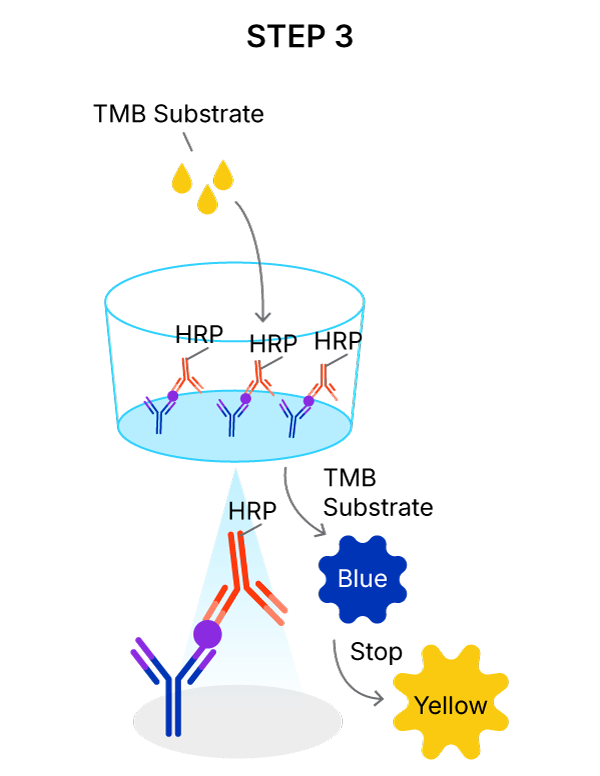
Tetramethylbenzidine (TMB) substrate solution is added to the wells and a blue color develops in proportion to the amount of analyte present in the sample. Color development is stopped turning the color in the wells to yellow. The absorbance of the color at 450 nm is measured.

Kit Contents
Kit contents may vary slightly. Please refer to the product-specific inserts for a complete list of contents for each individual assay.
- Pre-coated 96-well Microplate
- Conjugated Detection Antibody
- Calibrated Immunoassay Standard
- Assay Diluent
- Calibrator Diluent(s)
- Wash Buffer
- Color Reagent A and B
- Stop Solution
- Plate Sealers
Applications for Quantikine ELISA Kits
Our diverse portfolio of immunoassay platforms and assays are designed to optimize your biomarker research workflow and provide fast, reproducible data while conserving your precious samples. The application examples below highlight how Quantikine ELISA Kits are used to support biomarker validation, immune monitoring, and cell therapy research through quantitative measurement of specific protein biomarkers.
Following biomarker discovery studies, researchers often use Quantikine ELISA Kits to confirm whether promising candidates identified during initial screening remain associated with disease or treatment outcomes in follow-up studies. Because Quantikine ELISAs provide quantitative measurement of individual protein biomarkers, they are well suited for follow-up studies that require accurate and reproducible analysis of specific targets.
See how Luminex assays can be used to discover biomarkers and how Quantikine ELISAs can be used to validate results and responses over time in our Crohn’s Disease biomarker research application note.
Evaluating immune responses is often critical for understanding the activity and safety of cell therapies. Quantikine ELISA Kits enable researchers to quantitatively measure cytokines and other biomarkers that reflect changes in immune and inflammatory activity. Tracking these biomarkers over time can help researchers better understand treatment-associated immune responses. One important safety consideration is Cytokine Release Syndrome (CRS), a systemic inflammatory response that may occur following cell therapy and viral infections such as influenza and COVID-19. IFN-γ is an early cytokine associated with CRS and contributes to downstream inflammatory signaling.
To learn more about how our high sensitivity Quantikine ELISAs are used to measure IFN-γ and support cytokine monitoring studies, read our IFN-gamma immunoassay application note.
Quantikine ELISA Protocol Video
Run your Quantikine ELISA with confidence. This step-by-step video walks through sample preparation, plate processing, and key assay steps to help ensure reliable results.
ELISA Best Practices Poster
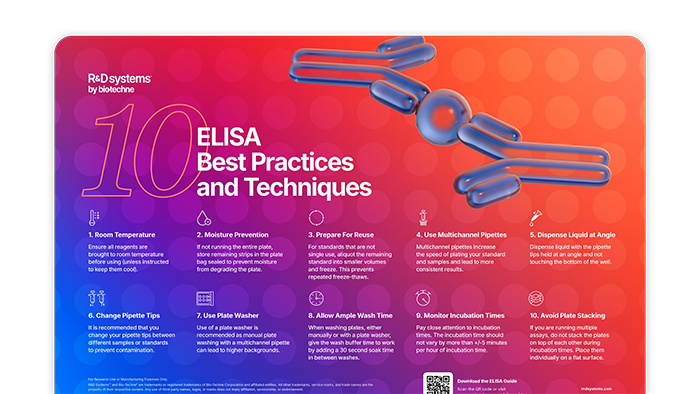
Maximize the performance of your ELISA kit by following the 10 ELISA best practices and techniques that R&D Systems scientists recommend based on 30 years of immunoassay development experience.
NEW! Compact ELISA Plate Reader
Save space and costs with Simple Reader™, a compact, cost-effective plate reader offering precise results.
A Quantikine ELISA (enzyme-linked immunosorbent assay) is a colorimetric sandwich ELISA developed by R&D Systems for the quantitative measurement of specific protein biomarkers in biological fluids. In these assays, target proteins are captured by an immobilized antibody and detected with an enzyme-linked detection antibody. Following substrate development, the resulting colorimetric signal is proportional to the analyte concentration and can be quantified using a standard curve.
R&D Systems antibodies and proteins are at the core of every Quantikine ELISA Kit. Our antibodies are highly specific, manufactured in-house to ensure reproducibility, and tested for suitability in multiple different applications. In addition, the proteins used for the immunoassay standard and as antibody immunogens are typically full-length, recombinant proteins that are confirmed to be biologically active. This ensures that our standard closely mimics the natural protein and that the antibodies will recognize the native form of the analyte.
Quantikine ELISAs are run in 96-well microplates coated with a capture antibody specific for the analyte of interest. Upon incubation with experimental samples, standards, or controls, the target analyte is captured by this antibody. A conjugated detection antibody binds to a different epitope on the target analyte. A substrate solution is subsequently added to produce a signal that is proportional to the amount of analyte bound.
For a detailed step-by-step workflow, see the How to Run an R&D Systems Quantikine ELISA Video Protocol.
ELISA assays can be performed using several different formats depending on the analyte being measured. In a direct ELISA, a labeled antibody binds directly to an immobilized target antigen. In an indirect ELISA, an unlabeled primary antibody binds the target antigen immobilized on a plate and a labeled secondary antibody directed against the host species of the primary antibody is used for detection.
In a sandwich ELISA, the target analyte is captured by an immobilized capture antibody and detected by a conjugated detection antibody that binds to a different epitope on the target protein. Quantikine ELISA Kits use a sandwich ELISA format, which is often preferred for protein biomarker quantification because it provides high specificity, high sensitivity, and robust performance in complex biological samples. This approach is widely used for the quantitative measurement of cytokines, chemokines, growth factors, proteases, soluble receptors, and other protein biomarkers.
In a competitive ELISA, the sample analyte competes with a labeled analyte for binding to a capture antibody coated on a microplate. The more antigen present in the sample, the less conjugated antigen will bind to the capture antibody. This results in a signal that is inversely proportional to analyte concentration in the sample. Competitive ELISAs are commonly used for the measurement of small molecules, hormones, lipids, and other analytes that may not be suitable for sandwich assay designs.
Sandwich ELISAs are widely used for quantitative biomarker analysis because they combine high specificity with sensitive detection. The target analyte is recognized by both a capture antibody and a detection antibody, reducing the likelihood of non-specific signal generation. This format is particularly well-suited for measuring low-abundance proteins such as cytokines, chemokines, growth factors, and soluble receptors in biological samples.
Quantikine ELISA Kits may incorporate monoclonal antibodies, polyclonal antibodies, or a combination of both, depending on the specific assay design. Antibodies are selected during assay development based on performance characteristics such as specificity, affinity, epitope recognition, assay performance, and minimal cross-reactivity with related proteins. This approach helps ensure accurate, reproducible quantification across a wide range of protein biomarkers. Refer to the product-specific data sheet for details regarding the antibodies used in a particular Quantikine ELISA Kit.
Quantikine ELISA Kits are available for the measurement of cytokines, chemokines, growth factors, proteases, soluble receptors, and additional protein biomarkers. Kits are designed to quantitatively measure a single analyte using a sandwich ELISA format.
Depending on the assay, Quantikine ELISA Kits are validated for the measurement of protein biomarkers in a variety of biological sample types, including serum, plasma, cell culture supernatants, tissue homogenates, cell lysates, and other biological fluids. Refer to the product-specific data sheet for validated sample types and sample preparation recommendations for each individual kit.
Researchers should use Quantikine ELISA Kits when they need to measure a specific protein in biological samples using a fully optimized sandwich ELISA. These assays are commonly used for cytokine, chemokine, and growth factor quantification, biomarker validation, protein expression analysis, treatment response monitoring, and translational research.
Quantikine ELISA Kits are trusted by researchers worldwide for their ability to deliver accurate, reproducible, and quantitative protein measurements. Developed using rigorously validated antibodies and extensively tested assay components, Quantikine ELISAs provide robust performance, lot-to-lot consistency, and comprehensive validation data across a wide range of sample types. Their complete, ready-to-use format and detailed performance specifications help streamline workflows while supporting confidence in experimental results.
Quantikine ELISA Kits are complete, ready-to-use immunoassays designed to simplify protein quantification and support reproducible results with minimal assay optimization. Each kit includes pre-coated microplates, all reagents needed to run the assay, detailed protocols, and extensive performance validation data.
In contrast, DuoSet™ ELISA Development Systems provide the core assay reagents required to build a sandwich ELISA, including matched antibody pairs, streptavidin-HRP, and a protein standard. Researchers supply the remaining assay components, such as plates, buffers, and substrates. This format offers greater flexibility and is well-suited for alternative workflows but requires additional assay development and optimization.
Researchers seeking a fully optimized, validated assay often choose Quantikine ELISA Kits, while those requiring greater experimental flexibility or a more economical alternative may prefer DuoSet ELISA Development Systems.
Quantikine ELISA Kits are used to quantitatively measure a single analyte, whereas multiplex assays are designed to measure multiple analytes simultaneously in the same sample. Researchers often use multiplex assays to screen a broad panel of biomarkers and then use Quantikine ELISA Kits to validate their results and track changes in specific targets over time.
Looking for other ELISA assay formats, targets, or brands? View All ELISA Kits, including Novus kits here.