
F-12, 25 mM HEPES, GlutaminePlus, no phenol red
R&D Systems | Catalog # M15650

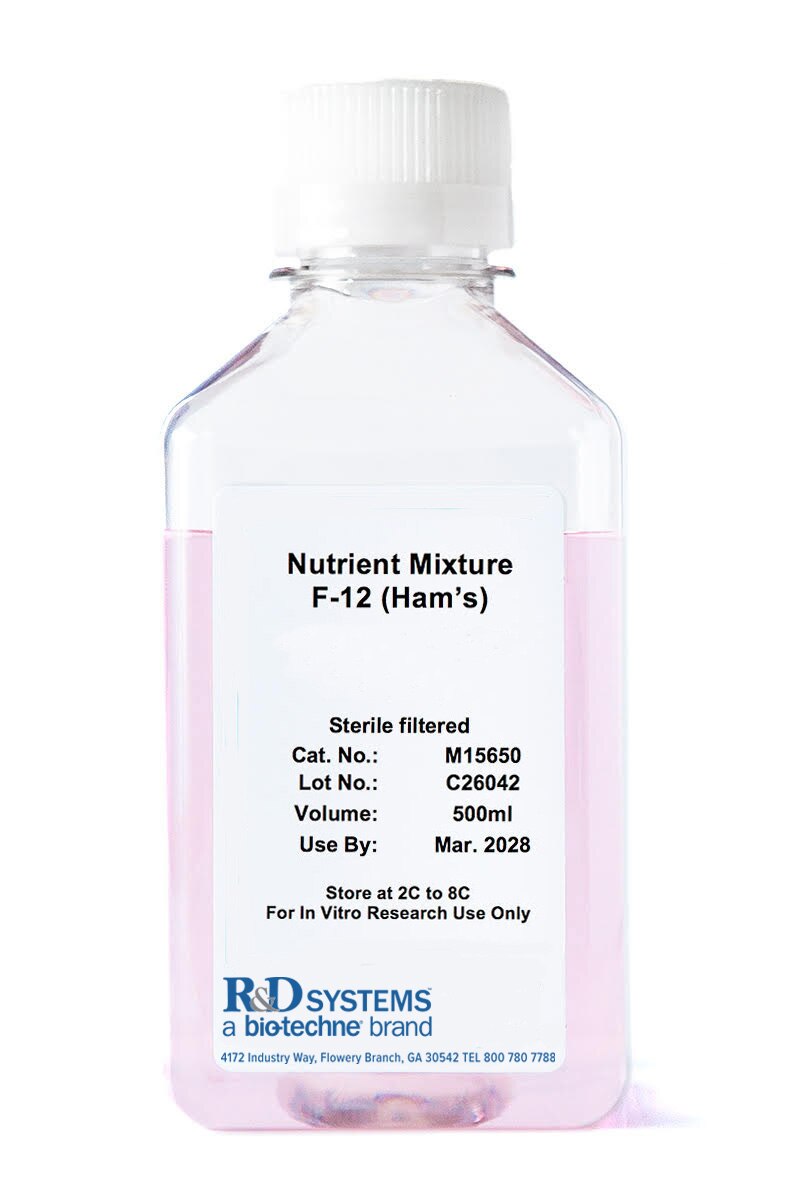
Key Product Details
Features
Applications
Product Summary for F-12, 25 mM HEPES, GlutaminePlus, no phenol red
Each lot of F-12 is prepared from powdered base medium, tissue culture-grade water, and is sterile filtered using a 0.2 micron filter. Representative samples of each lot of F-12 are tested to confirm the absence of bacterial or fungal contamination using methods adapted from the current U.S. Pharmacopeia. F-12 is manufactured in our ISO 9001:2015 certified facility.
For the specific media formulation, please refer to the datasheet.
Product Specifications
Sterility Testing
Formulation, Preparation, and Storage
Purification
Shipping
Storage
Product Documents for F-12, 25 mM HEPES, GlutaminePlus, no phenol red
Certificate of Analysis
To download a Certificate of Analysis, please enter a lot or batch number in the search box below.
Note: Certificate of Analysis not available for kit components.
Customer Reviews for F-12, 25 mM HEPES, GlutaminePlus, no phenol red
There are currently no reviews for this product. Be the first to review F-12, 25 mM HEPES, GlutaminePlus, no phenol red and earn rewards!
Have you used F-12, 25 mM HEPES, GlutaminePlus, no phenol red?
Submit a review and receive an Amazon gift card!
$25/€18/£15/$25CAN/¥2500 Yen for a review with an image
$10/€7/£6/$10CAN/¥1110 Yen for a review without an image
Submit a review
Protocols
Find general support by application which include: protocols, troubleshooting, illustrated assays, videos and webinars.
- A Guide to the Colony Forming Cell Assay: Methods and Tips
- Cultrex UltiMatrix BME Protocol
- Culture of Mouse Enteric Organoids using Cultrex Basement Membrane Extract
- Culturing BG01V Human Embryonic Stem Cells with Mouse Embryonic Fibroblast (MEF)-Conditioned Media
- Culturing Mouse Cortical Stem Cells: Expansion using the Neurosphere System
- Culturing Rat Cortical Stem Cells: Expansion using the Monolayer System
- Culturing Rat Cortical Stem Cells: Expansion using the Neurosphere System
- Definitive Endoderm Differentiation of BG01V Human Embryonic Stem Cells
- General Support Buffers
- Immunofluorescence of Organoids Embedded in Cultrex Basement Membrane Extract
- Protocol for CEPT Cocktail Kit
- Protocol for Cell Counting Kit-8
- Protocol for Culturing Embryonic Chick Dorsal Root Ganglion Neurons
- Protocol for Culturing Embryonic Rat Spinal Motor Neurons
- Protocol for Culturing Rat Hippocampal Neurons
- Protocol for Culturing Rat Microglia
- Protocol for MortaLIVE™ Non-Toxic Dye
- Protocol for the Differentiation and Characterization of Human Th1 Cells
- Rat Cortical Stem Cell Culture Expansion Protocol
- The Human Colony Forming Cell (CFC) Assay using Methylcellulose-based Media
- The Mouse Colony Forming Cell (CFC) Assay using Methylcellulose-based Media
- The Mouse Pre-B Colony Forming Cell (CFC) Assay Using Methylcellulose-based Media
- Use of Cultrex Basement Membrane Extract to Improve Take and Growth of Xenografts in Mice
- View all Protocols, Troubleshooting, Illustrated assays and Webinars
FAQs for F-12, 25 mM HEPES, GlutaminePlus, no phenol red
-
Q: Why is HEPES used in cell culture?
A: HEPES (N-2-hydroxyethylpiperazine-N’-2-ethanesulfonic acid, pKa@37oC=7.3, useful range pH 6.6 – 8.0) is one of several biological buffers that can be used to stabilize the pH of cell culture medium. As cells grow and metabolize the cell culture medium nutrients, they typically produce excess acid – that lowers the pH of the medium. This lowering of pH can be detrimental to the continued growth of cells in culture. HEPES provides more “buffering” capacity than the bicarbonate normally found in cell culture medium – thus slowing the decline in pH as cells metabolize the nutrient medium. For some cell lines this extends the time between “feedings” and promotes healthier cell growth. HEPES can show toxicity with some cell lines, so it is not a universal panacea. Other useful biological buffers include MOPS (pKa@37oC=7.0), TRIS (pKa@37oC=7.8), and PIPES (pKa@37oC=6.7).