
Human CCL26/Eotaxin-3 Quantikine ELISA Kit

Discontinued Product

DCC260 has been discontinued.
View all CCL26/Eotaxin-3 products.
4 Images
Product Details
Procedure
Citations (15)
FAQs
Reviews

Human CCL26/Eotaxin-3 Quantikine ELISA Kit Summary

Assay Type
Solid Phase Sandwich ELISA
Format
96-well strip plate
Assay Length
4.5 hours
Sample Type & Volume Required Per Well
Cell Culture Supernates (100 uL), Serum (100 uL), EDTA Plasma (100 uL), Heparin Plasma (100 uL)
Sensitivity
5.2 pg/mL
Assay Range
7.8 - 500 pg/mL (Cell Culture Supernates, Serum, EDTA Plasma, Heparin Plasma)
Specificity
Natural and recombinant human Eotaxin-3
Cross-reactivity
Cross-reactivity observed with 1 or more available related molecules.Cross-species reactivity not tested.
Interference
No significant interference observed with available related molecules.

Product Summary

The Quantikine Human Eotaxin-3 Immunoassay is a 4.5 hour solid phase ELISA designed to measure Eotaxin-3 levels in cell culture supernates, serum, and plasma. It contains E. coli-expressed, recombinant human Eotaxin-3 and antibodies raised against the recombinant factor. Results obtained for naturally occuring human Eotaxin-3 showed linear curves that were parallel to the standard curves obtained using the kit standards. These results indicate that this immunoassay can be used to determine relative mass values for natural human Eotaxin-3.

Precision

Intra-Assay Precision (Precision within an assay) Three samples of known concentration were tested on one plate to assess intra-assay precision
Inter-Assay Precision (Precision between assays) Three samples of known concentration were tested in separate assays to assess inter-assay precision

Cell Culture Supernates, Serum, EDTA Plasma, Heparin Plasma

Intra-Assay Precision Inter-Assay Precision
Sample 1 2 3 1 2 3
n 20 20 20 40 40 40
Mean (pg/mL) 42.4 114 291 50.3 126 293
Standard Deviation 2.37 4.23 9.62 3.78 5.53 18.8
CV% 5.6 3.7 3.3 7.5 4.4 6.4

Recovery

The recovery of human Eotaxin-3 spiked to three different levels throughout the range of the assay in various matrices was evaluated.

Sample Type Average % Recovery Range %
Cell Culture Media (n=4) 100 92-112
EDTA Plasma (n=5) 92 85-101
Heparin Plasma (n=5) 92 86-100
Serum (n=5) 91 86-98

Linearity

To assess the linearity of the assay, samples spiked with high concentrations of recombinant human or natural Eotaxin-3 in various matrices were diluted with Calibrator Diluent to produce samples with values within the dynamic range of the assay.
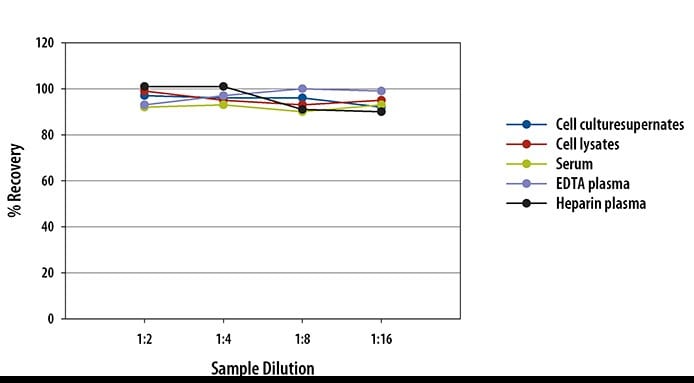
Human Eotaxin-3 ELISA Linearity

Scientific Data

Human Eotaxin-3 ELISA Standard Curve

Product Datasheets

You must select a language.

x

Preparation and Storage

Shipping
The product is shipped at ambient temperature. Upon receipt, store it immediately at the temperature recommended below.
Storage
Store the unopened product at 2 - 8 °C. Do not use past expiration date.

Assay Procedure

Refer to the product for complete assay procedure.

Bring all reagents and samples to room temperature before use. It is recommended that all samples, standards, and controls be assayed in duplicate.
  1.   Prepare all reagents, standard dilutions, and samples as directed in the product insert.
  2.   Remove excess microplate strips from the plate frame, return them to the foil pouch containing the desiccant pack, and reseal.

  3. 100 µL Assay Diluent
  4.   Add 100 µL of Assay Diluent to each well.

  5. 100 µL Standard, Control, or Sample
  6.   Add 100 µL of Standard, control, or sample to each well. Cover with a plate sealer, and incubate at room temperature for 2 hours on a horizontal orbital microplate shaker.
  7.   Aspirate each well and wash, repeating the process 3 times for a total of 4 washes.

  8. 200 µL Conjugate
  9.   Add 200 µL of Conjugate to each well. Cover with a new plate sealer, and incubate at room temperature for 2 hours on the shaker.
  10.   Aspirate and wash 4 times.

  11. 200 µL Substrate Solution
  12.   Add 200 µL Substrate Solution to each well. Incubate at room temperature for 30 minutes on the benchtop. PROTECT FROM LIGHT.

  13. 50 µL Stop Solution
  14.   Add 50 µL of Stop Solution to each well. Read at 450 nm within 30 minutes. Set wavelength correction to 540 nm or 570 nm.

Citations for Human CCL26/Eotaxin-3 Quantikine ELISA Kit

R&D Systems personnel manually curate a database that contains references using R&D Systems products. The data collected includes not only links to publications in PubMed, but also provides information about sample types, species, and experimental conditions.

15 Citations: Showing 1 - 10
Filter your results:

Filter by:

  1. Proton pump inhibitors decrease eotaxin-3 expression in the proximal esophagus of children with esophageal eosinophilia.
    Authors: Park, Jason Y, Zhang, Xi, Nguyen, Nathalie, Souza, Rhonda F, Spechler, Stuart J, Cheng, Edaire
    PLoS ONE, 2014-07-02;9(7):e101391.
    Species: Human
    Sample Types: Whole Cells
  2. Hydroxycarbamide reduces eosinophil adhesion and degranulation in sickle cell anaemia patients.
    Authors: Pallis F, Conran N, Fertrin K, Olalla Saad S, Costa F, Franco-Penteado C
    Br J Haematol, 2013-10-28;164(2):286-95.
    Species: Human
    Sample Types: Plasma
  3. Leukotriene D4 and interleukin-13 cooperate to increase the release of eotaxin-3 by airway epithelial cells.
    Authors: Provost V, Langlois A, Chouinard F, Rola-Pleszczynski M, Chakir J, Flamand N, Laviolette M
    PLoS ONE, 2012-08-31;7(8):e43544.
    Species: Human
    Sample Types: Cell Culture Supernates
  4. High Levels of CCL26 in Blister Fluid and Sera of Patients with Bullous Pemphigoid.
    Authors: Kagami S, Kai H, Kakinuma T
    J. Invest. Dermatol., 2011-09-01;132(1):249-51.
    Species: Human
    Sample Types: Serum
  5. Eotaxins and CCR3 interaction regulates the Th2 environment of cutaneous T-cell lymphoma.
    Authors: Miyagaki T, Sugaya M, Fujita H
    J. Invest. Dermatol., 2010-05-27;130(9):2304-11.
    Species: Human
    Sample Types: Serum
  6. Post-transcriptional silencing of CCR3 downregulates IL-4 stimulated release of eotaxin-3 (CCL26) and other CCR3 ligands in alveolar type II cells.
    Authors: Taka E, Errahali YJ, Abonyo BO, Bauer DM, Heiman AS
    Cytokine, 2008-11-26;44(3):342-51.
    Species: Human
    Sample Types: Cell Culture Supernates
  7. Systemic responses after bronchial aspirin challenge in sensitive patients with asthma.
    Authors: Makowska JS, Grzegorczyk J, Bienkiewicz B, Wozniak M, Kowalski ML
    J. Allergy Clin. Immunol., 2007-12-20;121(2):348-54.
    Species: Human
    Sample Types: Serum
  8. Computed tomographic scan-diagnosed chronic obstructive pulmonary disease-emphysema: eotaxin-1 is associated with bronchodilator response and extent of emphysema.
    Authors: Miller M, Ramsdell J, Friedman PJ, Cho JY, Renvall M, Broide DH
    J. Allergy Clin. Immunol., 2007-11-01;120(5):1118-25.
    Species: Human
    Sample Types: BALF
  9. Modulation of eotaxin-3 (CCL26) in alveolar type II epithelial cells.
    Authors: Abonyo BO, Lebby KD, Tonry JH, Ahmad M, Heiman AS
    Cytokine, 2007-03-09;36(5):237-44.
    Species: Human
    Sample Types: Cell Culture Supernates
  10. Regulatory mechanisms of galectin-9 and eotaxin-3 synthesis in epidermal keratinocytes: possible involvement of galectin-9 in dermal eosinophilia of Th1-polarized skin inflammation.
    Authors: Igawa K, Satoh T, Hirashima M, Yokozeki H
    Allergy, 2006-12-01;61(12):1385-91.
    Species: Human
    Sample Types: Cell Culture Supernates
  11. Anti-IL-5 (mepolizumab) therapy for eosinophilic esophagitis.
    Authors: Stein ML, Collins MH, Villanueva JM, Kushner JP, Putnam PE, Buckmeier BK, Filipovich AH, Assa'ad AH, Rothenberg ME
    J. Allergy Clin. Immunol., 2006-11-07;118(6):1312-9.
    Species: Human
    Sample Types: Plasma
  12. Membrane-bound eotaxin-3 mediates eosinophil transepithelial migration in IL-4-stimulated epithelial cells.
    Authors: Yuan Q, Campanella GS, Colvin RA, Hamilos DL, Jones KJ, Mathew A, Means TK, Luster AD
    Eur. J. Immunol., 2006-10-01;36(10):2700-14.
    Species: Human
    Sample Types: Cell Culture Supernates
  13. Markers of eosinophilic inflammation and risk prediction in patients with coronary artery disease.
    Authors: Falcone C, Minoretti P, D'Angelo A, Buzzi MP, Coen E, Emanuele E, Aldeghi A, Olivieri V, Geroldi D
    Eur. J. Clin. Invest., 2006-04-01;36(4):211-7.
    Species: Human
    Sample Types: Plasma
  14. Eotaxin-3 and a uniquely conserved gene-expression profile in eosinophilic esophagitis.
    Authors: Assa'ad AH
    J. Clin. Invest., 2006-02-01;116(2):536-47.
    Species: Human
    Sample Types: Plasma
  15. Eotaxin-3 and interleukin-5 pleural fluid levels are associated with pleural fluid eosinophilia in post-coronary artery bypass grafting pleural effusions.
    Authors: Kalomenidis I, Stathopoulos GT, Barnette R, Guo Y, Peebles RS, Blackwell TS, Light RW
    Chest, 2005-06-01;127(6):2094-100.
    Species: Human
    Sample Types: Pleural Effusion

FAQs

No product specific FAQs exist for this product, however you may

View all ELISA FAQs

Reviews for Human CCL26/Eotaxin-3 Quantikine ELISA Kit

There are currently no reviews for this product. Be the first to review Human CCL26/Eotaxin-3 Quantikine ELISA Kit and earn rewards!

Have you used Human CCL26/Eotaxin-3 Quantikine ELISA Kit?

Submit a review and receive an Amazon gift card.

$25/€18/£15/$25CAN/¥75 Yuan/¥2500 Yen for a review with an image

$10/€7/£6/$10 CAD/¥70 Yuan/¥1110 Yen for a review without an image

Submit a Review

