

Human CCL3/MIP-1 alpha Antibody Summary
Ala27-Ala92
Accession # P10147
Applications
Please Note: Optimal dilutions should be determined by each laboratory for each application. General Protocols are available in the Technical Information section on our website.
Scientific Data
View Larger
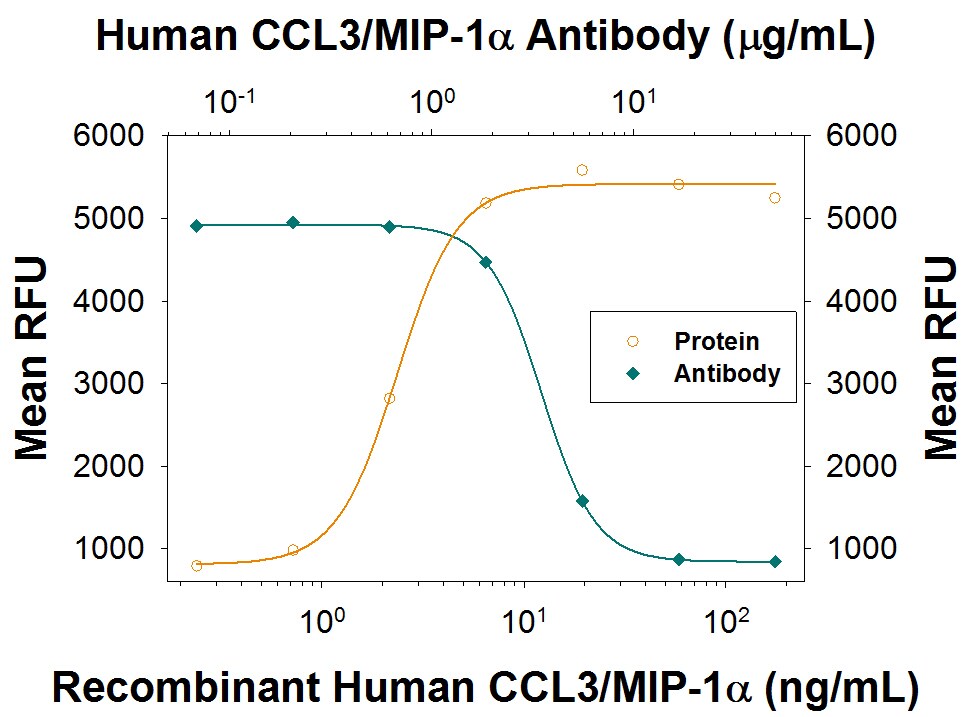
Chemotaxis Induced by CCL3/MIP‑1 alpha and Neutralization by Human CCL3/MIP‑1 alpha Antibody. Recombinant Human CCL3/MIP-1a (Catalog # 270-LD) chemoattracts the BaF3 mouse pro-B cell line transfected with human CCR5 in a dose-dependent manner (orange line). The amount of cells that migrated through to the lower chemotaxis chamber was measured by Resazurin (Catalog # AR002). Chemotaxis elicited by Recombinant HumanCCL3/MIP-1a (5 ng/mL) is neutralized (green line) by increasing concentrations of Goat Anti-Human CCL3/MIP-1a Polyclonal Antibody (Catalog # AB-270-NA). The ND50 is typically ≤ 6 µg/mL.
Reconstitution Calculator
Preparation and Storage
- 12 months from date of receipt, -20 to -70 °C as supplied.
- 1 month, 2 to 8 °C under sterile conditions after reconstitution.
- 6 months, -20 to -70 °C under sterile conditions after reconstitution.
Background: CCL3/MIP-1 alpha
The macrophage inflammatory proteins -1 alpha and -1 beta were originally co-purified from medium conditioned by an LPS-stimulated murine macrophage cell line. Human MIP-1 alpha refers to the products of several independently cloned cDNAs, including LD78, pL78, pAT464, and GOS19. These cDNAs all code for the same human protein that is a homologue of the murine MIP-1 alpha. Mature MIP-1 alpha and MIP-1 beta in both human and mouse share approximately 70% homology at the amino acid level.
The MIP‑1 proteins are members of the beta (C-C) subfamily of chemokines.
Both MIP-1 alpha and MIP-1 beta are monocyte chemoattractants in vitro. Additionally, the MIP-1 proteins have been reported to have chemoattractant and adhesive effects on lymphocytes, with MIP-1 alpha and MIP-1 beta preferentially attracting CD8+ and CD4+ T cells, respectively. MIP-1 alpha has also been shown to attract B cells as well as eosinophils. MIP-1 proteins have been reported to have multiple effects on hematopoietic precursor cells and MIP-1 alpha has been identified as a stem cell inhibitory factor that can inhibit the proliferation of hematopoietic stem cells in vitro as well as in vivo. The functional receptor for MIP-1 alpha has been identified as CCR1 and CCR5.
Product Datasheets
Citation for Human CCL3/MIP-1 alpha Antibody
R&D Systems personnel manually curate a database that contains references using R&D Systems products. The data collected includes not only links to publications in PubMed, but also provides information about sample types, species, and experimental conditions.
1 Citation: Showing 1 - 1
-
Serum amyloid A chemoattracts immature dendritic cells and indirectly provokes monocyte chemotaxis by induction of cooperating CC and CXC chemokines.
Authors: Gouwy M, De Buck M, Portner N, Opdenakker G, Proost P, Struyf S, Van Damme J
Eur J Immunol, 2014-12-01;45(1):101-12.
Species: Human
Sample Types: Whole Cells
Applications: Neutralization
FAQs
No product specific FAQs exist for this product, however you may
View all Antibody FAQsReviews for Human CCL3/MIP-1 alpha Antibody
There are currently no reviews for this product. Be the first to review Human CCL3/MIP-1 alpha Antibody and earn rewards!
Have you used Human CCL3/MIP-1 alpha Antibody?
Submit a review and receive an Amazon gift card.
$25/€18/£15/$25CAN/¥75 Yuan/¥2500 Yen for a review with an image
$10/€7/£6/$10 CAD/¥70 Yuan/¥1110 Yen for a review without an image
