

Human CCL7/MCP-3/MARC Antibody Summary
Gln24-109
Accession # P80098
Applications
Please Note: Optimal dilutions should be determined by each laboratory for each application. General Protocols are available in the Technical Information section on our website.
Scientific Data
View Larger
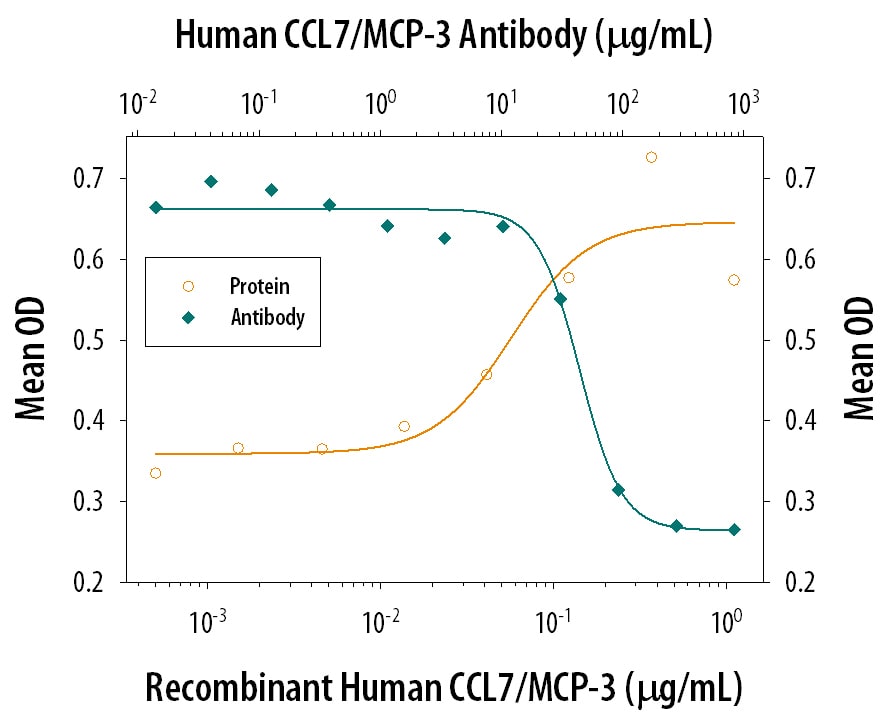
Chemotaxis Induced by CCL7/MCP‑3 and Neutral-ization by Human CCL7/MCP‑3 Antibody. Recombinant Human CCL7/ MCP-3 (Catalog # 282-P3) chemoattracts human monocytes in a dose-dependent manner (orange line). The amount of cells that migrated through to the lower chemotaxis chamber was measured by LeukoStat™ staining (Fisher Scientific). Chemotaxis elicited by Recombinant Human CCL7/MCP-3 (0.1 µg/mL) is neutralized (green line) by increasing concentrations of Goat Anti-Human CCL7/ MCP-3 Polyclonal Antibody (Catalog # AB-282-NA). The ND50 is typically 30-60 µg/mL.
Reconstitution Calculator
Preparation and Storage
- 12 months from date of receipt, -20 to -70 °C as supplied.
- 1 month, 2 to 8 °C under sterile conditions after reconstitution.
- 6 months, -20 to -70 °C under sterile conditions after reconstitution.
Background: CCL7/MCP-3/MARC
MCP-2 and CCL7 are two monocyte chemotactic proteins produced by human MG-63 osteosarcoma cells. Both MCP-2 and CCL7 are members of the C-C family of chemokines and share 62% and 71% amino acid sequence identity, respectively, with MCP-1. CCL7 also shares 58% amino acid identity with MCP-2.
CCL7 cDNA encodes a 99 amino acid residue precursor protein from which the N-terminal 23 amino acid residues are cleaved to generate the 76 amino acid residue mature CCL7. Mature CCL7 contains a potential N-linked and several possible O-linked glycosylation sites.
Similar to other C-C chemokines, all three MCP proteins are monocyte chemoattractants. In addition, the three MCPs can chemoattract activated NK cells as well as CD4+ and CD8+ T lymphocytes. All three cytokines have also been shown to attract eosinophils and induce histamine secretion from basophils.
Product Datasheets
Citation for Human CCL7/MCP-3/MARC Antibody
R&D Systems personnel manually curate a database that contains references using R&D Systems products. The data collected includes not only links to publications in PubMed, but also provides information about sample types, species, and experimental conditions.
1 Citation: Showing 1 - 1
-
Let-7d suppresses growth, metastasis, and tumor macrophage infiltration in renal cell carcinoma by targeting COL3A1 and CCL7.
Authors: Su, Boxing, Zhao, Wei, Shi, Bentao, Zhang, Zhongyua, Yu, Xi, Xie, Feng, Guo, Zhongqia, Zhang, Xiaoyu, Liu, Jin, Shen, Qi, Wang, Jinghua, Li, Xuesong, Zhang, Zhiqian, Zhou, Liqun
Mol Cancer, 2014-09-06;13(0):206.
Species: Human
Sample Types: Whole Cells
Applications: Neutralization
FAQs
No product specific FAQs exist for this product, however you may
View all Antibody FAQsReviews for Human CCL7/MCP-3/MARC Antibody
Average Rating: 5 (Based on 1 Review)
Have you used Human CCL7/MCP-3/MARC Antibody?
Submit a review and receive an Amazon gift card.
$25/€18/£15/$25CAN/¥75 Yuan/¥2500 Yen for a review with an image
$10/€7/£6/$10 CAD/¥70 Yuan/¥1110 Yen for a review without an image
Filter by:

