
Chymases are a group of chymotrypsin-like serine proteases secreted by mast cells (1). They are synthesized as inactive precursors containing a 2-residue propeptide, which needs to be removed by dipeptidyl peptidase I/cathepsin C for the enzymatic activity (2). Human Chymase encoded by the CMA1 gene is known to be involved in hypertention and heart failure through its ability to convert angiotensin I (Ang I) to angiotensin II (Ang II), which plays a key role in the regulation of arterial pressure (3). In addition, it is also important in physiological and pathological conditions including inflammation, fibrosis and processing of cytokines (4). Therefore, designing a specific inhibitor for Chymase activity has been a pharmacologic strategy to develop therapeutic agents.

Scientific images may be resized, cropped, or adjusted for brightness or contrast for presentation purposes. These updates are limited to presentation and do not affect the underlying scientific interpretation of the data. Where available, additional source data may be provided upon request.
Key Product Details
Species Reactivity
Applications
Label
Antibody Source
Product Specifications
Immunogen
Gly20-Asn247
Accession # P23946
Specificity
Clonality
Host
Isotype
Scientific Data Images for Human Chymase/CMA1 Antibody
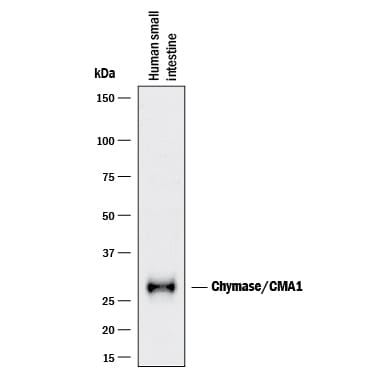
Detection of Human Chymase/CMA1 by Western Blot.
Western blot shows lysates of human small intestine tissue. PVDF membrane was probed with 1 µg/mL of Sheep Anti-Human Chymase/CMA1 Antigen Affinity-purified Polyclonal Antibody (Catalog # AF4099) followed by HRP-conjugated Anti-Goat IgG Secondary Antibody (Catalog # HAF017). A specific band was detected for Chymase/CMA1 at approximately 28 kDa (as indicated). This experiment was conducted under reducing conditions and using Immunoblot Buffer Group 1.Applications for Human Chymase/CMA1 Antibody
Immunoprecipitation
Sample: Conditioned cell culture medium spiked with Recombinant Human Chymase/CMA1 (Catalog # 4099-SE), see our available Western blot detection antibodies
Western Blot
Sample: Lysate of human small intestine tissue
Formulation, Preparation, and Storage
Purification
Reconstitution
Reconstitute at 0.2 mg/mL in sterile PBS. For liquid material, refer to CoA for concentration.
Formulation
Shipping
Stability & Storage
- 12 months from date of receipt, -20 to -70 °C as supplied.
- 1 month, 2 to 8 °C under sterile conditions after reconstitution.
- 6 months, -20 to -70 °C under sterile conditions after reconstitution.
Calculators
Background: Chymase/CMA1
References
- Caughey, G.H. (2004) in Handbook of Proteolytic Enzymes. Barrett, A.J. et al. ed. p. 1531, Academic Press, San Diego.
- Murakami, M. et al. (1995) J. Biol. Chem. 270:2218.
- Miyazaki, M. and S. Takai (2006) J. Pharmacol. Sci. 100:391.
- Nakajima, M. and N. Naya (2002) Jpn. J. Pharmacol. 90:206.
Alternate Names
Gene Symbol
UniProt
Additional Chymase/CMA1 Products
Product Documents for Human Chymase/CMA1 Antibody
Certificate of Analysis
To download a Certificate of Analysis, please enter a lot or batch number in the search box below.
Note: Certificate of Analysis not available for kit components.
Product Specific Notices for Human Chymase/CMA1 Antibody
For research use only
Related Research Areas
Customer Reviews for Human Chymase/CMA1 Antibody
There are currently no reviews for this product. Be the first to review Human Chymase/CMA1 Antibody and earn rewards!
Have you used Human Chymase/CMA1 Antibody?
Submit a review and receive an Amazon gift card!
$25/€18/£15/$25CAN/¥2500 for a review with an image
$10/€7/£6/$10CAN/¥1110 for a review without an image
Submit a review
Protocols
Find general support by application which include: protocols, troubleshooting, illustrated assays, videos and webinars.
- Cellular Response to Hypoxia Protocols
- Immunoprecipitation Protocol
- R&D Systems Quality Control Western Blot Protocol
- Troubleshooting Guide: Western Blot Figures
- Western Blot Conditions
- Western Blot Protocol
- Western Blot Protocol for Cell Lysates
- Western Blot Troubleshooting
- Western Blot Troubleshooting Guide
- View all Protocols, Troubleshooting, Illustrated assays and Webinars