

Human G-CSFR/CD114 Antibody Summary
Glu25-Pro621
Accession # Q99062
Applications
Please Note: Optimal dilutions should be determined by each laboratory for each application. General Protocols are available in the Technical Information section on our website.
Scientific Data
View Larger
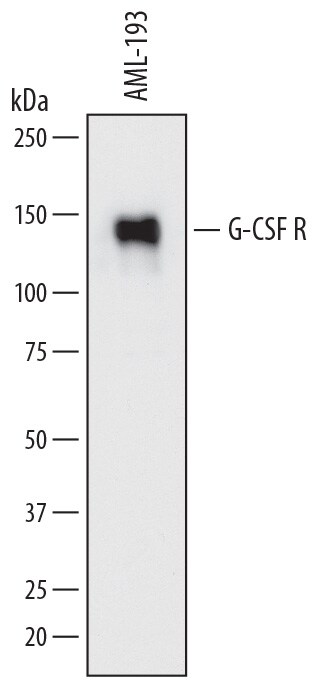
Detection of Human G‑CSF R/CD114 by Western Blot. Western blot shows lysates of AML-193 human acute monocytic leukemia cell line. PVDF membrane was probed with 0.5 µg/mL of Goat Anti-Human G-CSF R/CD114 Antigen Affinity-purified Polyclonal Antibody (Catalog # AF-381-PB) followed by HRP-conjugated Anti-Goat IgG Secondary Antibody (Catalog # HAF017). A specific band was detected for G-CSF R/CD114 at approximately 145 kDa (as indicated). This experiment was conducted under reducing conditions using Immunoblot Buffer Group 1.
Reconstitution Calculator
Preparation and Storage
- 12 months from date of receipt, -20 to -70 °C as supplied.
- 1 month, 2 to 8 °C under sterile conditions after reconstitution.
- 6 months, -20 to -70 °C under sterile conditions after reconstitution.
Background: G-CSFR/CD114
Granulocyte Colony Stimulating Factor (G-CSF) is a pleiotropic cytokine best known for its specific effects on the proliferation, differentiation, and activation of hematopoietic cells of the neutrophilic granulocyte lineage. G-CSF plays an important role in defense against infection, in inflammation and repair, and in the maintenance of steady state hematopoiesis. Recombinant human G-CSF has been approved for the amelioration of chemotherapy induced neutropenia as well as for severe chronic neutropenia following marrow transplant.
Cell activation by G-CSF is mediated by a type I membrane protein belonging to the cytokine receptor superfamily. Human G-CSF R is 863 amino acids (aa) in length, with a 604 aa extracellular domain, a 26 aa transmembrane domain, and a 183 aa cytoplasmic domain that include a 23 amino acid signal sequence. As a result of alternative splicing, at least four isoforms of G-CSF R that differ in their C-terminal region exist. Isoform 2 lacks the transmembrane region and may represent a soluble form of the receptor; however the existence of soluble G-CSF R in human serum has not been reported (1). Mutations have been found in the gene encoding G-CSF R in some patients with severe congenital neutropenia. These mutations typically led to a truncation in the cytoplasmic domain of the G-CSF R leading to maturation arrest of neutrophil precursors in the bone marrow and neutropenia in peripheral blood (2). Human and mouse G-CSF R have a homology of 62.5%.
G-CSF R is expressed in mature neutrophils, neutrophilic precursors, myeloid leukemia cells, and placenta. Binding of G-CSF to its receptor induces dimerization or oligomerization of the receptor activating cytoplasmic tyrosine kinases. Signal transduction from pathways that involve Janus tyrosine kinases/signal transducer and activator of transcription proteins (Jak1, Jak2, and Tyk2/STAT3, STAT3, and STATG), src-related protein tyrosine kinases (Lyn and Syk), Ras/MAP kinase, and phosphatidylinositol have been reported to be activated upon G-CSF stimulation (1).
- Nicola, N.A., in Cytokine Reference, (2001) Oppenhiem, J.J. and M. Feldmann, eds. Academic Press p. 1935.
- Mitsui, T. et al. (2003) Blood. 101:2990.
Product Datasheets
Citations for Human G-CSFR/CD114 Antibody
R&D Systems personnel manually curate a database that contains references using R&D Systems products. The data collected includes not only links to publications in PubMed, but also provides information about sample types, species, and experimental conditions.
3
Citations: Showing 1 - 3
Filter your results:
Filter by:
-
Most purported antibodies to the human granulocyte colony-stimulating factor receptor are not specific.
Authors: deBruin C, Lincoln P, Hartley C, Shehabeldin A, Van G, Szilvassy S
Exp Hematol, 2010-08-07;38(11):1022-35.
Species: Human
Sample Types: Cell Lysates, Whole Cells
Applications: Flow Cytometry, Western Blot -
The Integrin alpha9beta1 contributes to granulopoiesis by enhancing granulocyte colony-stimulating factor receptor signaling.
Authors: Atakilit A, Zhu QS, Corey SJ, Sheppard D
Immunity, 2006-11-30;25(6):895-906.
Species: Mouse
Sample Types: Whole Cells
Applications: Immunoprecipitation -
A t(1;9) translocation involving CSF3R as a novel mechanism in unclassifiable chronic myeloproliferative neoplasm
Authors: Jesús Gutiérrez-Abril, Iñigo Santamaría, Ana S. Pitiot, Ana Gutiérrez-Fernández, Ángel Alvarez-Eguiluz, José M. Vicente et al.
Haematologica
FAQs
No product specific FAQs exist for this product, however you may
View all Antibody FAQsReviews for Human G-CSFR/CD114 Antibody
There are currently no reviews for this product. Be the first to review Human G-CSFR/CD114 Antibody and earn rewards!
Have you used Human G-CSFR/CD114 Antibody?
Submit a review and receive an Amazon gift card.
$25/€18/£15/$25CAN/¥75 Yuan/¥2500 Yen for a review with an image
$10/€7/£6/$10 CAD/¥70 Yuan/¥1110 Yen for a review without an image
