
Vascular endothelial growth factor B (VEGF-B), also known as vascular endothelial growth factor-related factor (VRF), is a member of the VEGF family of growth factors that share structural and functional similarity (1, 2). Five mammalian members, including VEGF-A, -B, -C, -D and PlGF, have been identified. VEGF family members are disulfide-linked dimeric proteins that are important regulators of physiological and pathological vasculogenesis, angiogenesis and lymphangiogenesis. VEGF-B is expressed in most tissues, especially in heart, skeletal muscle and pancreas. In many tissues, VEGF-B is co-expressed and can heterodimerize with VEGF (3). By alternative splicing, two isoforms of mature VEGF-B containing 167 or 186 amino acid (aa) residues exist (3, 4). The two VEGF-B isoforms have identical amino-terminal cysteine-knot VEGF homology domains but the carboxyl end of VEGF-B167 differs from that of VEGF-B186 by the presence of a highly basic cysteine-rich heparin binding domain. Whereas VEGF-B186 is a secreted diffusible protein, VEGF-B167 is sequestered into the cell matrix after secretion. Both VEGF-B isoforms bind VEGF receptor 1 (VEGF R1), but not VEGF R2 or VEGF R3 (5). On endothelial cells, ligation of VEGF R1 by VEGF-B has been shown to regulate the expression and activity of urokinase type plasminogen activator and plasminogen activator inhibitor 1. VEGF-B167 and a proteolytically processed form of VEGF-B186 (VEGF-B127) also bind neuropilin-1 (NP-1), a type I transmembrane receptor for semaphorins/collapsins, ligands involved in neuron guidance (6). Besides VEGF-B, NP-1 has been shown to bind PLGF-2, VEGF165 and VEGF R1 (6, 7). The many interactions of NP-1 with VEGF ligands and receptor suggests that NP-1 may function as a regulator of angiogenesis (7).
Human VEGF-B 167/186 Antibody
R&D Systems | Catalog # AF751

Scientific images may be resized, cropped, or adjusted for brightness or contrast for presentation purposes. These updates are limited to presentation and do not affect the underlying scientific interpretation of the data. Where available, additional source data may be provided upon request.
Key Product Details
Validated by
Species Reactivity
Validated:
Cited:
Applications
Validated:
Cited:
Label
Antibody Source
Product Specifications
Immunogen
Specificity
Clonality
Host
Isotype
Scientific Data Images for Human VEGF-B 167/186 Antibody
Detection of Mouse VEGF-B by Western Blot
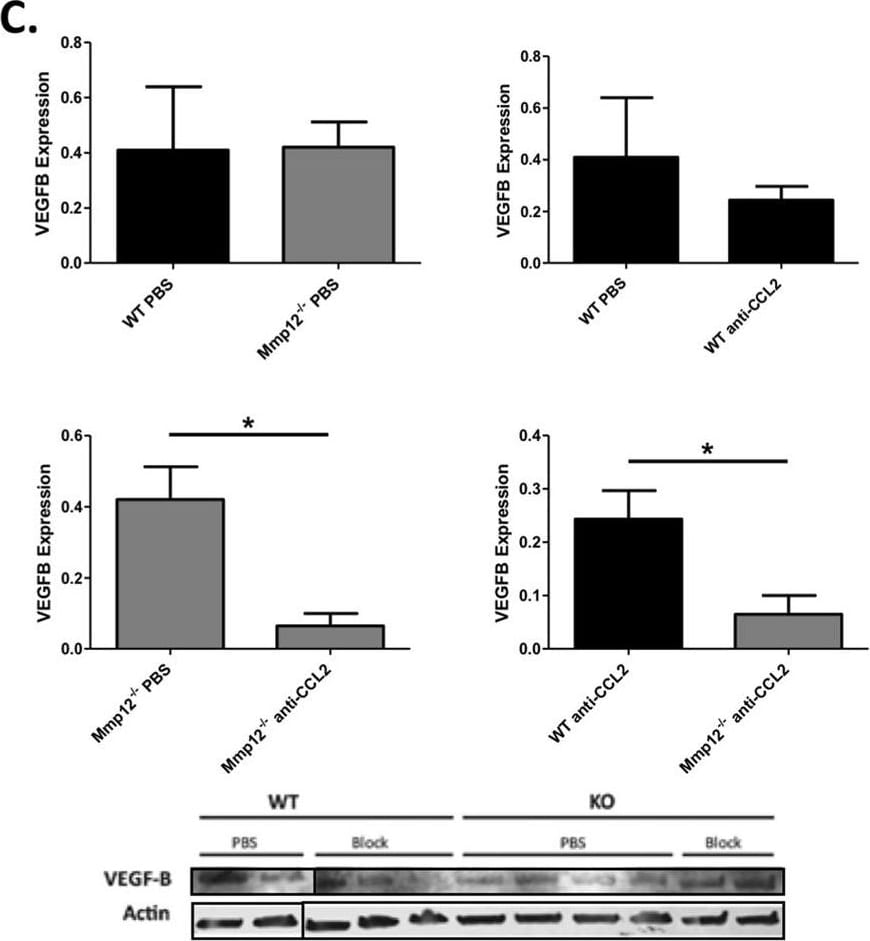
Expression patterns of CCR2, VEGFA, and VEGFB protein in wounded corneas of WT and MMP12 KO mice. (A) Protein expression levels of CCR2 and actin in unwounded and wounded corneas of WT (N = 8 per lane) and Mmp12−/− (N = 8 per lane) mice 1 and 6 days post-chemical injury, as determined by Western blot analysis. Full-length blots are presented in Supplementary Fig. 1A. (B,C) The effect of CCL2 neutralization on VEGFA and VEGFB protein expression in WT and Mmp12−/− mice at 7 days post-chemical injury. Treatment of WT and Mmp12−/− mice with PBS or anti-CCL2 antibody had no significant effect on VEGFA expression. Treatment of Mmp12−/− mice with anti-CCL2 significantly decreased VEGFB protein expression compared with PBS-treated Mmp12−/− mice (0.42 versus 0.065 respectively). VEGFB expression was decreased more in WT mice compared with Mmp12−/− mice following treatment with anti-CCL2 (0.24 versus 0.065 respectively). *P < 0.05. Full-length blots are presented in Supplementary Fig. 1B,C. While we had to use several gels to fit all samples, they all derive from the same experiment and gels/blots were processed in parallel. Image collected and cropped by CiteAb from the following open publication (https://pubmed.ncbi.nlm.nih.gov/31399604), licensed under a CC-BY license. Not internally tested by R&D Systems.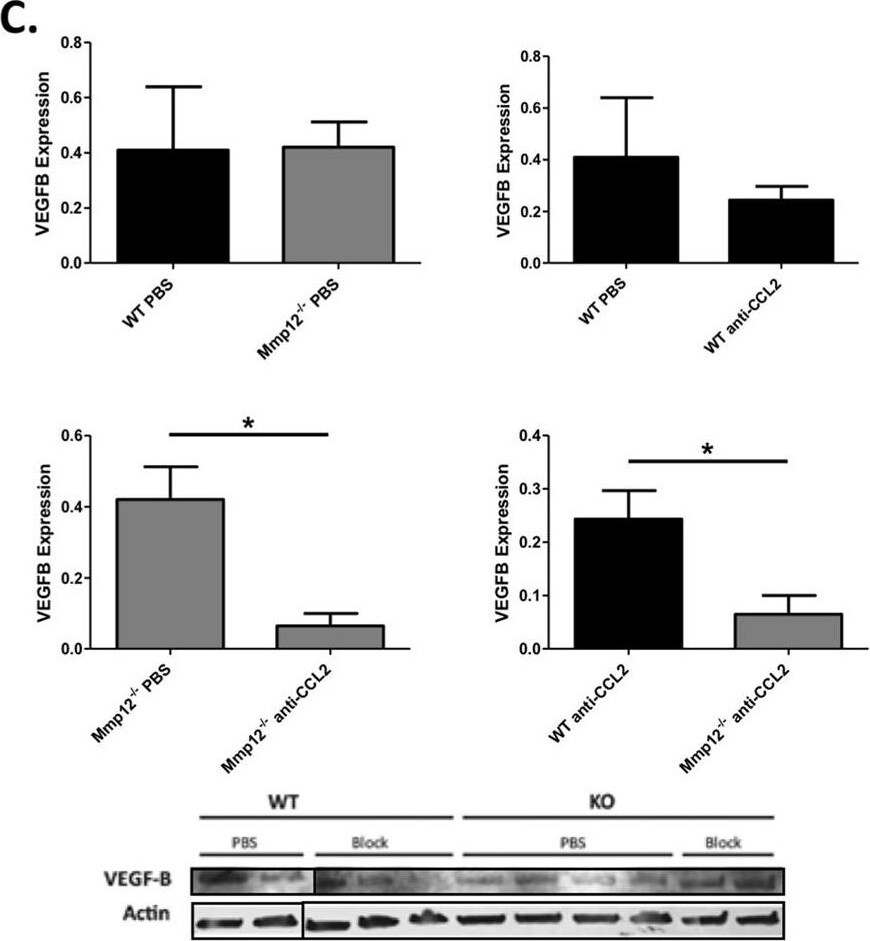
Detection of Mouse VEGF-B by Western Blot
Expression patterns of CCR2, VEGFA, and VEGFB protein in wounded corneas of WT and MMP12 KO mice. (A) Protein expression levels of CCR2 and actin in unwounded and wounded corneas of WT (N = 8 per lane) and Mmp12−/− (N = 8 per lane) mice 1 and 6 days post-chemical injury, as determined by Western blot analysis. Full-length blots are presented in Supplementary Fig. 1A. (B,C) The effect of CCL2 neutralization on VEGFA and VEGFB protein expression in WT and Mmp12−/− mice at 7 days post-chemical injury. Treatment of WT and Mmp12−/− mice with PBS or anti-CCL2 antibody had no significant effect on VEGFA expression. Treatment of Mmp12−/− mice with anti-CCL2 significantly decreased VEGFB protein expression compared with PBS-treated Mmp12−/− mice (0.42 versus 0.065 respectively). VEGFB expression was decreased more in WT mice compared with Mmp12−/− mice following treatment with anti-CCL2 (0.24 versus 0.065 respectively). *P < 0.05. Full-length blots are presented in Supplementary Fig. 1B,C. While we had to use several gels to fit all samples, they all derive from the same experiment and gels/blots were processed in parallel. Image collected and cropped by CiteAb from the following open publication (https://pubmed.ncbi.nlm.nih.gov/31399604), licensed under a CC-BY license. Not internally tested by R&D Systems.Applications for Human VEGF-B 167/186 Antibody
Western Blot
Sample: Recombinant Human VEGF-B167 (Catalog # 751-VE) and Recombinant Human VEGF-B186
Formulation, Preparation, and Storage
Purification
Reconstitution
Reconstitute at 0.2 mg/mL in sterile PBS. For liquid material, refer to CoA for concentration.
Formulation
Shipping
Stability & Storage
- 12 months from date of receipt, -20 to -70 °C as supplied.
- 1 month, 2 to 8 °C under sterile conditions after reconstitution.
- 6 months, -20 to -70 °C under sterile conditions after reconstitution.
Calculators
Background: VEGF-B
References
- Li, X. and U. Eriksson (2001) Int. J. Biochem Cell Biol. 33:421.
- Olofsson, B. et al. (1999) Curr. Opin. Biotechnol. 10:528.
- Olofsson, B. et al. (1996) Proc. Nat. Acad. Sci. USA 93:2576.
- Grimmond, S. et al. (1996) Benome Res. 6:124.
- Olofsson, B. et al. (1998) Proc. Nat. Acad. Sci. USA 95:11709.
- Makinen, T. et al. (1999) J. Biol. Chem. 274:21217.
- Fuh, G. et al. (2000) J. Biol. Chem. 275:26690.
Long Name
Alternate Names
Gene Symbol
Additional VEGF-B Products
Product Documents for Human VEGF-B 167/186 Antibody
Certificate of Analysis
To download a Certificate of Analysis, please enter a lot or batch number in the search box below.
Note: Certificate of Analysis not available for kit components.
Product Specific Notices for Human VEGF-B 167/186 Antibody
For research use only
Citations for Human VEGF-B 167/186 Antibody
 Powered by Bioz
Customer Reviews for Human VEGF-B 167/186 Antibody
There are currently no reviews for this product. Be the first to review Human VEGF-B 167/186 Antibody and earn rewards!
Have you used Human VEGF-B 167/186 Antibody?
Submit a review and receive an Amazon gift card!
$25/€18/£15/$25CAN/¥2500 for a review with an image
$10/€7/£6/$10CAN/¥1110 for a review without an image
Submit a review
Protocols
Find general support by application which include: protocols, troubleshooting, illustrated assays, videos and webinars.
- Cellular Response to Hypoxia Protocols
- R&D Systems Quality Control Western Blot Protocol
- Troubleshooting Guide: Western Blot Figures
- Western Blot Conditions
- Western Blot Protocol
- Western Blot Protocol for Cell Lysates
- Western Blot Troubleshooting
- Western Blot Troubleshooting Guide
- View all Protocols, Troubleshooting, Illustrated assays and Webinars