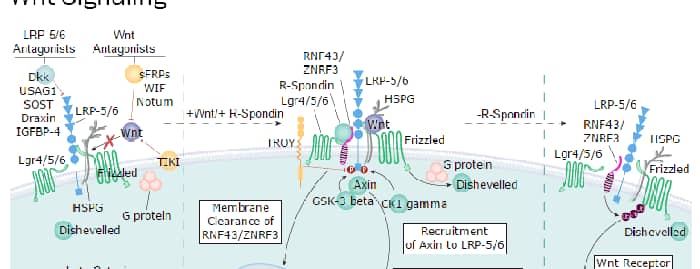
Wnt-10b (also known as Wnt-12) is a 42‑44 kDa member of the Wnt family of secreted, highly conserved, cysteine-rich glycoproteins that play important roles in vertebrate pattern formation, cell fate decision, axon guidance, and tumor formation (1‑3). Human Wnt-10b cDNA encodes a 389 amino acid (aa) precursor that contains a 28 aa signal sequence plus a 361 aa mature protein that contains two glycosylation sites, three potential phosphorylation sites, and a potential palmitoylation site (3, 4). Human Wnt-10b shares 97‑99% aa identity with mouse, rat, equine, porcine, and canine Wnt-10b. Wnt-10b plays a critical role in maintaining mesenchymal stem cells and determining whether they differentiate to adipocytes or osteoblasts (5‑7). Mouse Wnt-10b deletion produces age‑dependent loss of bone mass due to defective production of osteoblasts, while transgenic over‑expression increases postnatal osteoblast differentiation and inhibits adipocyte differentiation (5‑7). Ectopic expression of Wnt-10b in an obesity and diabetes‑prone background, such as the ob/ob mouse, inhibits obesity (8). In mouse skeletal muscle, Wnt-10b is expressed inversely with SREBP1c and increases insulin sensitivity (9). In humans, a missense polymorphism is responsible for a malformation of hands and feet, while a C256Y inactivating mutation is associated with severe early-onset obesity (10, 11). Wnt-10b is mainly produced by stem cells and pre-osteoblasts, but also by adult bone marrow CD8+ T lymphocytes stimulated with parathyroid hormone (12). In some hepatocellular carcinomas, Wnt-10b can inhibit cancer cell growth, but in others, it can act synergistically with FGFs to stimulate cell growth (13). Several Wnts, including Wnt-10b, are expressed in both normal and/or malignant colon tissues (14).
Human Wnt-10b Antibody (793127)
R&D Systems | Catalog # MAB7196

Scientific images may be resized, cropped, or adjusted for brightness or contrast for presentation purposes. These updates are limited to presentation and do not affect the underlying scientific interpretation of the data. Where available, additional source data may be provided upon request.
Key Product Details
Species Reactivity
Applications
Label
Antibody Source
Product Specifications
Immunogen
Asn29-Lys389
Accession # O00744
Specificity
Clonality
Host
Isotype
Scientific Data Images for Human Wnt-10b Antibody (793127)
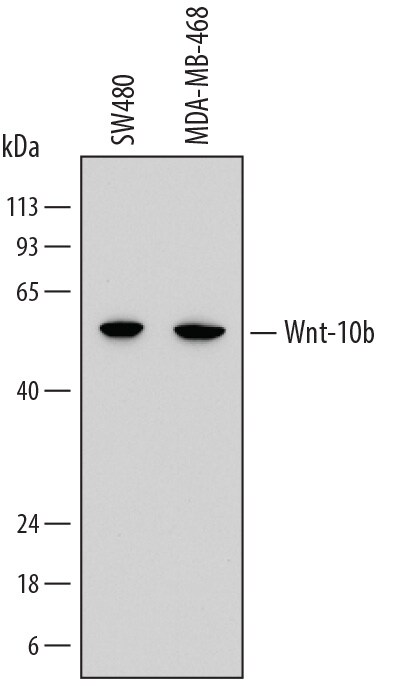
Detection of Human Wnt‑10b by Western Blot.
Western blot shows lysates of SW480 human colorectal adenocarcinoma cell line and MDA-MB-468 human breast cancer cell line. PVDF membrane was probed with 0.5 µg/mL of Mouse Anti-Human Wnt-10b Monoclonal Antibody (Catalog # MAB7196) followed by HRP-conjugated Anti-Mouse IgG Secondary Antibody (Catalog # HAF018). A specific band was detected for Wnt-10b at approximately 50 kDa (as indicated). This experiment was conducted under reducing conditions and using Immunoblot Buffer Group 1.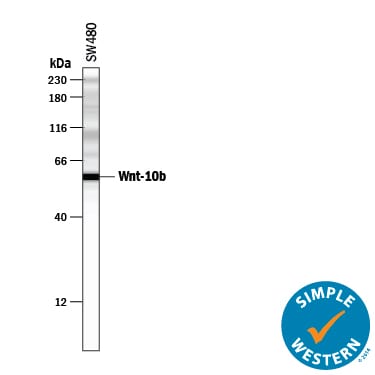
Detection of Human Wnt‑10b by Simple WesternTM.
Simple Western lane view shows lysate of SW480 human colorectal adenocarcinoma cell line, loaded at 0.5 mg/mL. A specific band was detected for Wnt‑10b at approximately 58 kDa (as indicated) using 5 µg/mL of Mouse Anti-Human Wnt‑10b Monoclonal Antibody (Catalog # MAB7196). This experiment was conducted under reducing conditions and using the 12-230 kDa separation system. Non-specific interaction with the 230 kDa Simple Western standard may be seen with this antibody.Applications for Human Wnt-10b Antibody (793127)
Simple Western
Sample: SW480 human colorectal adenocarcinoma cell line
Western Blot
Sample: SW480 human colorectal adenocarcinoma cell line and MDA‑MB‑468 human breast cancer cell line
Formulation, Preparation, and Storage
Purification
Reconstitution
Sterile PBS to a final concentration of 0.5 mg/mL. For liquid material, refer to CoA for concentration.
Formulation
Shipping
Stability & Storage
- 12 months from date of receipt, -20 to -70 °C as supplied.
- 1 month, 2 to 8 °C under sterile conditions after reconstitution.
- 6 months, -20 to -70 °C under sterile conditions after reconstitution.
Calculators
Background: Wnt-10b
References
- Hardiman, G. et al. (1997) Cytogenet. Cell Genet. 77:278.
- Katoh, M. (2008) Curr. Drug Targets 9:565.
- Hausmann, G. et al. (2007) Nat. Rev. Mol. Cell Biol. 8:331.
- Swiss Prot Accession # O00744.
- Stevens, J.R. et al. (2010) J. Bone Miner. Res. 25:2138.
- Bennett, C.N. et al. (2007) J. Bone Miner. Res. 22:1924.
- Bennett, C.N. et al. (2005) Proc. Natl. Acad. Sci. USA 102:3324.
- Wright, W.S. et al. (2007) Diabetes 56:295.
- Abiola, M. et al. (2009) PLoS ONE 4:e8509.
- Ugur, S.A. and A. Tolun (2008) Hum. Mol. Genet. 17:2644.
- Christodoulides, C. et al. (2006) Diabetologia 49:678.
- Terauchi, M. et al. (2009) Cell Metab. 10:229.
- Yoshikawa, H. et al. (2007) Mol. Biol. Cell 18:4292.
- Holcombe, R.F. et al. (2002) J. Clin. Pathol: Mol. Pathol. 55:220.
Long Name
Alternate Names
Gene Symbol
UniProt
Additional Wnt-10b Products
Product Documents for Human Wnt-10b Antibody (793127)
Certificate of Analysis
To download a Certificate of Analysis, please enter a lot or batch number in the search box below.
Note: Certificate of Analysis not available for kit components.
Product Specific Notices for Human Wnt-10b Antibody (793127)
For research use only
Related Research Areas
Citations for Human Wnt-10b Antibody (793127)
 Powered by Bioz
Customer Reviews for Human Wnt-10b Antibody (793127)
There are currently no reviews for this product. Be the first to review Human Wnt-10b Antibody (793127) and earn rewards!
Have you used Human Wnt-10b Antibody (793127)?
Submit a review and receive an Amazon gift card!
$25/€18/£15/$25CAN/¥2500 for a review with an image
$10/€7/£6/$10CAN/¥1110 for a review without an image
Submit a review
Protocols
Find general support by application which include: protocols, troubleshooting, illustrated assays, videos and webinars.
- Cellular Response to Hypoxia Protocols
- R&D Systems Quality Control Western Blot Protocol
- Troubleshooting Guide: Western Blot Figures
- Western Blot Conditions
- Western Blot Protocol
- Western Blot Protocol for Cell Lysates
- Western Blot Troubleshooting
- Western Blot Troubleshooting Guide
- View all Protocols, Troubleshooting, Illustrated assays and Webinars