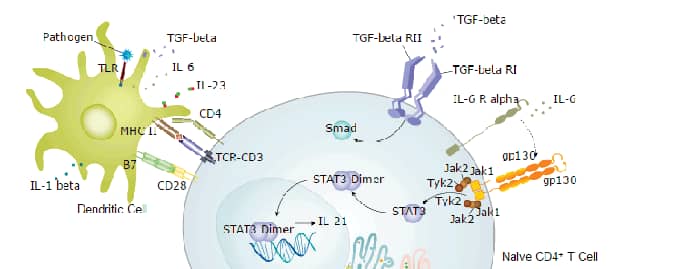
CD28 and CTLA-4, together with their ligands B7-1 and B7-2, constitute one of the dominant costimulatory pathways that regulate T and B cell responses. CD28 and CTLA-4 are structurally homologous molecules that are members of the immunoglobulin (Ig) gene superfamily. Both CD28 and CTLA-4 are composed of a single Ig V‑like extracellular domain, a transmembrane domain and an intracellular domain. CD28 and CTLA-4 are both expressed on the cell surface as disulfide-linked homodimers or as monomers. The genes encoding these two molecules are closely linked on human chromosome 2 and mouse chromosome 1. Mouse CD28 is expressed constitutively on virtually 100% of mouse T cells and on developing thymocytes. Cell surface expression of mouse CD28 is down-regulated upon ligation of CD28 in the presence of PMA or PHA. In contrast, CTLA-4 is not expressed constitutively but is upregulated rapidly following T cell activation and CD28 ligation. Cell surface expression of CTLA-4 peaks approximately 48 hours after activation. Although both CTLA-4 and CD28 can bind to the same ligands, CTLA-4 binds to B7‑1 and B7‑2 with a 20-100 fold higher affinity than CD28. CD28/B7 interaction has been shown to prevent apoptosis of activated T cells via the up‑regulation of Bcl‑xL. CD28 ligation has also been shown to regulate Th1/Th2 differentiation. Agonist activity has been reported using MAB4831 (4,5).
Mouse CD28 Antibody (61109)
R&D Systems | Catalog # MAB4831


Key Product Details
Species Reactivity
Validated:
Mouse
Cited:
Mouse
Applications
Validated:
Western Blot
Cited:
Functional Assay
Label
Unconjugated
Antibody Source
Monoclonal Rat IgG2C Clone # 61109
Loading...
Product Specifications
Immunogen
S. frugiperda insect ovarian cell line Sf 21-derived recombinant mouse CD28
Lys21-Lys149
Accession # P31041
Lys21-Lys149
Accession # P31041
Specificity
Detects mouse CD28 in direct ELISAs and Western blots. Does not cross-react with recombinant human CD28, recombinant mouse (rm) CTLA-4, rmICOS, or rmPD-1.
Clonality
Monoclonal
Host
Rat
Isotype
IgG2C
Applications for Mouse CD28 Antibody (61109)
Application
Recommended Usage
Western Blot
1 µg/mL
Sample: Recombinant Mouse CD28 Fc Chimera (Catalog # 483-CD)
Sample: Recombinant Mouse CD28 Fc Chimera (Catalog # 483-CD)
Formulation, Preparation, and Storage
Purification
Protein A or G purified from hybridoma culture supernatant
Reconstitution
Reconstitute at 0.5 mg/mL in sterile PBS. For liquid material, refer to CoA for concentration.
Loading...
Formulation
Lyophilized from a 0.2 μm filtered solution in PBS with Trehalose. *Small pack size (SP) is supplied either lyophilized or as a 0.2 µm filtered solution in PBS.
Shipping
Lyophilized product is shipped at ambient temperature. Liquid small pack size (-SP) is shipped with polar packs. Upon receipt, store immediately at the temperature recommended below.
Stability & Storage
Use a manual defrost freezer and avoid repeated freeze-thaw cycles.
- 12 months from date of receipt, -20 to -70 °C as supplied.
- 1 month, 2 to 8 °C under sterile conditions after reconstitution.
- 6 months, -20 to -70 °C under sterile conditions after reconstitution.
Calculators
Background: CD28
References
- Lenschow, D.J. et al. (1996) Annu. Rev. Immunol. 14:233.
- Hathcock, K.S. and R.J. Hodes (1996) Advances in Immunol. 62:131.
- Ward, S.G. (1996) Biochem. J. 318:361.
- Nguyen, P. et al. (2003) Blood 13:4320.
- Orbach, A. et al. (2007) J. Immunol. 179:7287.
Alternate Names
CD28
Gene Symbol
CD28
UniProt
Additional CD28 Products
Product Documents for Mouse CD28 Antibody (61109)
Certificate of Analysis
To download a Certificate of Analysis, please enter a lot or batch number in the search box below.
Note: Certificate of Analysis not available for kit components.
Product Specific Notices for Mouse CD28 Antibody (61109)
For research use only
Citations for Mouse CD28 Antibody (61109)
 Powered by Bioz
Customer Reviews for Mouse CD28 Antibody (61109)
There are currently no reviews for this product. Be the first to review Mouse CD28 Antibody (61109) and earn rewards!
Have you used Mouse CD28 Antibody (61109)?
Submit a review and receive an Amazon gift card!
$25/€18/£15/$25CAN/¥2500 for a review with an image
$10/€7/£6/$10CAN/¥1110 for a review without an image
Submit a review
Protocols
Find general support by application which include: protocols, troubleshooting, illustrated assays, videos and webinars.
- Cellular Response to Hypoxia Protocols
- R&D Systems Quality Control Western Blot Protocol
- Troubleshooting Guide: Western Blot Figures
- Western Blot Conditions
- Western Blot Protocol
- Western Blot Protocol for Cell Lysates
- Western Blot Troubleshooting
- Western Blot Troubleshooting Guide
- View all Protocols, Troubleshooting, Illustrated assays and Webinars