
Lectin-like oxidized low-density-lipoprotein receptor-1 (LOX-1), also known as oxidized low-density-lipoprotein receptor-1 (OLR-1), is a type II transmembrane receptor belonging to the C-type lectin family (1). It also belongs to the functionally defined scavenger receptor (SR) superfamily, whose members share the common ability to bind and internalize modified forms of Low Density Lipoproteins (LDL) (2 - 4). LOX-1 is the first member of the class E scavenger receptor subfamily (SR-E). It binds and supports the internalization of multiple structurally unrelated macromolecules including oxidized LDL, advanced glycation end products (AGE), activated platelets, bacteria, apoptotic or aged cells, and heat shock proteins (5 - 7). LOX-1 has also been implicated as an intestinal receptor involved in the transcytosis of pancreatic bile salt-dependent lipase (8). The mouse LOX-1 gene encodes a 363 amino acid (aa) residue protein with a short N-terminal intracellular domain, a transmembrane domain, triple repeats of an extracellular stalk/neck region followed by a C-type lectin-like domain (CTLD) (11). The CTLD, which is required for ligand recognition, contains the six conserved cysteine residues present in all C-type lectins, but lacks the Ca2+-binding residues found in classical C-type lectins. LOX-1 can be detected on activated endothelial cells, vascular smooth muscle cells, macrophages, intestinal cells and dendritic cells (6 - 8). The expression of LOX-1 is induced by proinflammatory or proatherogenic stimuli, as well as by oxidized LDL itself and hemodynamic or oxidative stress. LOX-1 exists on the cell surface as covalent homodimers, which can further associate into non-covalent-linked oligomers (9). Cell surface LOX-1 can also be cleaved by yet unidentified proteases to release the soluble LOX-1 extracellular domain (6). Binding and endocytosis of oxidized LDL by LOX-1 induces oxidative stress, activates NF kappa B, and upregulates the expression of monocyte chemoattractant protein-1 and matrix metalloproteases (5 - 9). LOX-1-dependent oxidized LDL uptake also induces apoptosis by inducing the expression of the pro-apoptotic Bax and downregulation of the anti-apoptotic Bcl-2 (10). Oxidized LDL plays a key role in the pathogenesis of atherosclerosis and endothelial dysfunction. Blockade of LOX-1 functions may turn out to be a suitable target for the therapeutic intervention of atherosclerosis.
Mouse LOX-1/OLR1 Antibody
R&D Systems | Catalog # AF1564

Scientific images may be resized, cropped, or adjusted for brightness or contrast for presentation purposes. These updates are limited to presentation and do not affect the underlying scientific interpretation of the data. Where available, additional source data may be provided upon request.
Key Product Details
Species Reactivity
Validated:
Cited:
Applications
Validated:
Cited:
Label
Antibody Source
Product Specifications
Immunogen
Arg60-Ile363
Accession # AAG44998
Specificity
Clonality
Host
Isotype
Endotoxin Level
Scientific Data Images for Mouse LOX-1/OLR1 Antibody
Detection of Mouse LOX-1/OLR1 by Western Blot
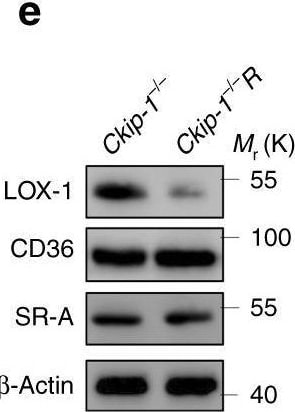
CKIP-1 diminishes Oct-1-mediated LOX-1 expression. e Expression of LOX-1, CD36, and SR-A in Ckip-1−/− and Ckip-1−/−R BMDMs Image collected and cropped by CiteAb from the following open publication (https://pubmed.ncbi.nlm.nih.gov/30683852), licensed under a CC-BY license. Not internally tested by R&D Systems.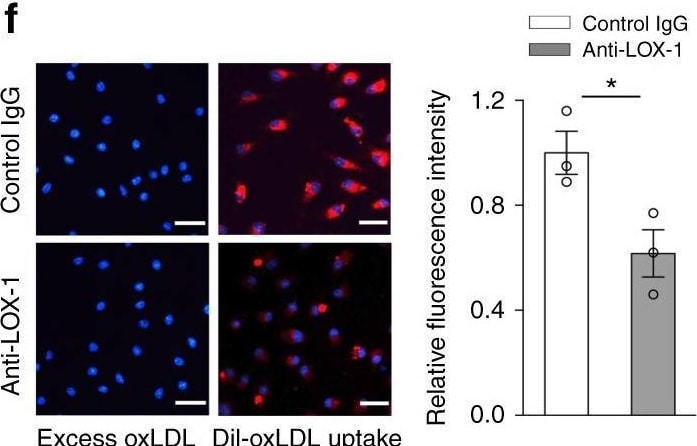
Detection of Mouse LOX-1/OLR1 by Immunocytochemistry/ Immunofluorescence
CKIP-1 diminishes Oct-1-mediated LOX-1 expression. fCkip-1−/− macrophages were incubated with anti-LOX-1 antibody (10 μg per ml) or control goat IgG for 1 h prior to the addition of Dil-oxLDL or excess unlabeled oxLDL. Total uptake of Dil-oxLDL in each group was quantified. Scale bar, 25 μm. Image collected and cropped by CiteAb from the following open publication (https://pubmed.ncbi.nlm.nih.gov/30683852), licensed under a CC-BY license. Not internally tested by R&D Systems.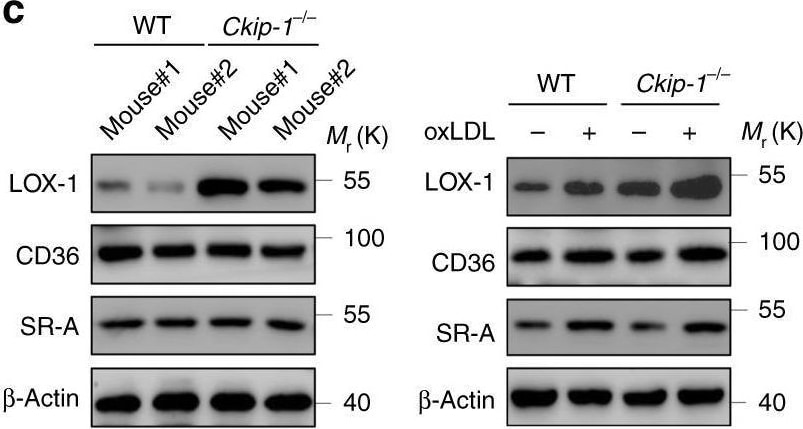
Detection of Mouse LOX-1/OLR1 by Western Blot
CKIP-1 diminishes Oct-1-mediated LOX-1 expression. c Expression of LOX-1, CD36, and SR-A in WT and Ckip-1−/− BMDMs after 24 h incubation with or without 20 μg per ml oxLDL. Image collected and cropped by CiteAb from the following open publication (https://pubmed.ncbi.nlm.nih.gov/30683852), licensed under a CC-BY license. Not internally tested by R&D Systems.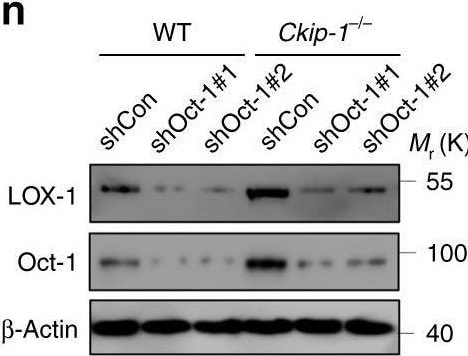
Detection of Mouse LOX-1/OLR1 by Western Blot
CKIP-1 diminishes Oct-1-mediated LOX-1 expression. n Knockdown of Oct-1 expression in WT and Ckip-1−/− macrophages transfected with Oct-1-shRNA #1, #2 by lentivirus and proteins were analyzed by western blot. Image collected and cropped by CiteAb from the following open publication (https://pubmed.ncbi.nlm.nih.gov/30683852), licensed under a CC-BY license. Not internally tested by R&D Systems.
Mouse LOX-1 / OLR1 ELISA Standard Curve
Recombinant Mouse LOX‑1/OLR1 (Catalog # 1564-LX) was serially diluted and captured by Rat Anti-Mouse LOX‑1/OLR1 Monoclonal Antibody (Catalog # MAB15641) coated on a Clear Polystyrene Microplate (Catalog # DY990). Goat Anti-Mouse LOX‑1/OLR1 Antigen Affinity-purified Polyclonal Antibody (Catalog # AF1564) was biotinylated and incubated with the protein captured on the plate. Detection of the standard curve was achieved by incubating Streptavidin-HRP (Catalog # DY998)Applications for Mouse LOX-1/OLR1 Antibody
Blockade of Receptor-ligand Interaction
Western Blot
Sample: Recombinant Mouse LOX‑1/OLR1 (Catalog # 1564-LX)
Formulation, Preparation, and Storage
Purification
Reconstitution
Reconstitute at 0.2 mg/mL in sterile PBS. For liquid material, refer to CoA for concentration.
Formulation
Shipping
Stability & Storage
- 12 months from date of receipt, -20 to -70 °C as supplied.
- 1 month, 2 to 8 °C under sterile conditions after reconstitution.
- 6 months, -20 to -70 °C under sterile conditions after reconstitution.
Calculators
Background: LOX-1/OLR1
References
- Sawamura, T. et al. (1997) Nature 386:73.
- Daugherty, A. (2000) Curr. Opin. Cardiovasc. Pulm. Ren. Invest. Drugs. 2:223.
- Platt, N. and S. Gordon (2001) J. Clin. Invest. 108:649.
- Platt, N. and S. Gordon (1998) Chem. Biol. 5:R193.
- Jono, T. et al. (2002) FEBS Lett. 511:170.
- Kume, N. et al. (2001) Curr. Opin. Lipidol. 12:419.
- Delneste, Y. et al. (2002) Immunity 17:353.
- Bruneau, N. et al. (2003) Mol. Biol. Cell 14:2861.
- Xie, Q. et al. (2004) DNA and Cell Biol. 23:111.
- Chen, J. et al. (2003) Circ. Res. 94:370.
- Hoshikawa, H. et al. (1998) Biochem. Biophys. Res. Comm. 245:841.
Long Name
Alternate Names
Gene Symbol
UniProt
Additional LOX-1/OLR1 Products
Product Documents for Mouse LOX-1/OLR1 Antibody
Certificate of Analysis
To download a Certificate of Analysis, please enter a lot or batch number in the search box below.
Note: Certificate of Analysis not available for kit components.
Product Specific Notices for Mouse LOX-1/OLR1 Antibody
For research use only
Related Research Areas
Citations for Mouse LOX-1/OLR1 Antibody
 Powered by Bioz
Customer Reviews for Mouse LOX-1/OLR1 Antibody
There are currently no reviews for this product. Be the first to review Mouse LOX-1/OLR1 Antibody and earn rewards!
Have you used Mouse LOX-1/OLR1 Antibody?
Submit a review and receive an Amazon gift card!
$25/€18/£15/$25CAN/¥2500 for a review with an image
$10/€7/£6/$10CAN/¥1110 for a review without an image
Submit a review
Protocols
Find general support by application which include: protocols, troubleshooting, illustrated assays, videos and webinars.
- Cellular Response to Hypoxia Protocols
- R&D Systems Quality Control Western Blot Protocol
- Troubleshooting Guide: Western Blot Figures
- Western Blot Conditions
- Western Blot Protocol
- Western Blot Protocol for Cell Lysates
- Western Blot Troubleshooting
- Western Blot Troubleshooting Guide
- View all Protocols, Troubleshooting, Illustrated assays and Webinars