

Rat CXCL2/GRO beta /MIP-2/CINC-3 Antibody Summary
Ser32-Asn100
Accession # P30348
Applications
Please Note: Optimal dilutions should be determined by each laboratory for each application. General Protocols are available in the Technical Information section on our website.
Scientific Data
View Larger
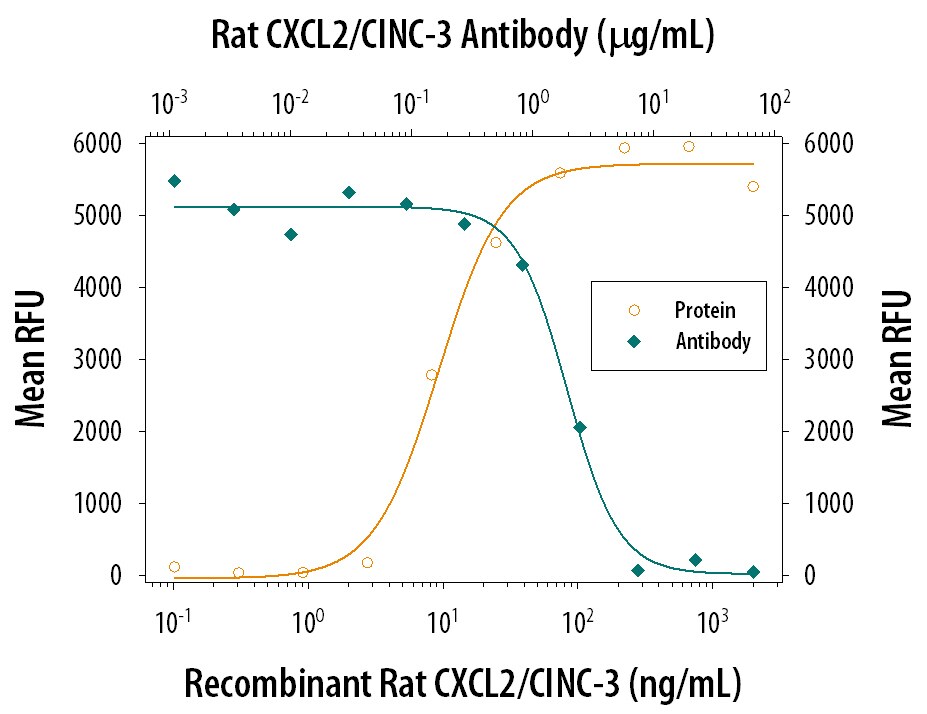
Chemotaxis Induced by CXCL2/CINC‑3 and Neutralization by Rat CXCL2/CINC‑3 Antibody. Recombinant Rat CXCL2/CINC-3 (Catalog # 525-C3) chemoattracts the BaF3 mouse pro-B cell line transfected with human CXCR2 in a dose-dependent manner (orange line). The amount of cells that migrated through to the lower chemotaxis chamber was measured by Resazurin (Catalog # AR002). Chemotaxis elicited by Recombinant Rat CXCL2/CINC-3 (0.1 µg/mL) is neutralized (green line) by increasing concentrations of Rat CXCL2/CINC-3 Antigen Affinity-purified Polyclonal Antibody (Catalog # AF525). The ND50 is typically 0.5-2.5 µg/mL.
Reconstitution Calculator
Preparation and Storage
- 12 months from date of receipt, -20 to -70 °C as supplied.
- 1 month, 2 to 8 °C under sterile conditions after reconstitution.
- 6 months, -20 to -70 °C under sterile conditions after reconstitution.
Background: CXCL2/GRO beta/MIP-2/CINC-3
Cytokine-induced neutrophil chemoattractant 3 (CINC-3) has been found to be expressed by cytokine-stimulated rat alveolar macrophages and fibroblasts. Based on its protein and DNA sequences, CINC-3 (also known as rat MIP-2, GRO beta and CXCL2) is a member of the alpha (CXC) subfamily of chemokines.
CINC-3 cDNA encodes a 100 amino acid (aa) residue precursor protein with a 31 aa signal peptide that is cleaved to yield a 69 aa mature secreted protein. The protein sequence of rat CINC-3 shares approximately 88% identity with murine MIP-2. Characteristic of ELR containing CXC chemokines, CINC-3 is known to be a potent chemotactic factor for rat neutrophils in vitro and in vivo. On the basis of cross-desensitization results of the various CINC proteins, it has been postulated that rat neutrophils have at least two classes of CINC receptors: a class of CINC-3 specific receptors as well as a second common receptor shared by all CINCs.
- Nakagawa, H. et al. (1994) Biochem. J. 301:545.
- Huang, S. et al. (1992) Am. J. Pathol. 141:981.
Product Datasheets
Citation for Rat CXCL2/GRO beta /MIP-2/CINC-3 Antibody
R&D Systems personnel manually curate a database that contains references using R&D Systems products. The data collected includes not only links to publications in PubMed, but also provides information about sample types, species, and experimental conditions.
1 Citation: Showing 1 - 1
-
Rat coronaviruses infect rat alveolar type I epithelial cells and induce expression of CXC chemokines.
Authors: Miura TA, Wang J, Holmes KV, Mason RJ
Virology, 2007-09-05;369(2):288-98.
Species: Rat
Sample Types: Whole Cells
Applications: ICC
FAQs
No product specific FAQs exist for this product, however you may
View all Antibody FAQsReviews for Rat CXCL2/GRO beta /MIP-2/CINC-3 Antibody
There are currently no reviews for this product. Be the first to review Rat CXCL2/GRO beta /MIP-2/CINC-3 Antibody and earn rewards!
Have you used Rat CXCL2/GRO beta /MIP-2/CINC-3 Antibody?
Submit a review and receive an Amazon gift card.
$25/€18/£15/$25CAN/¥75 Yuan/¥2500 Yen for a review with an image
$10/€7/£6/$10 CAD/¥70 Yuan/¥1110 Yen for a review without an image
