
Growth Differentiation Factor 8 (GDF-8), also known as myostatin, is a member of the TGF-beta superfamily that is expressed specifically in developing and adult skeletal muscle. GDF-8 cDNA encodes a 376 amino acid (aa) prepropeptide with a 24 aa residue signal peptide, a 223 aa residue amino-terminal propeptide, and a 109 aa residue carboxy-terminal mature protein. Mature GDF-8 contains the canonical 7-cysteine motif common to other TGF-beta superfamily members. Similar to the TGF‑ beta s, activins and BMP-11, GDF-8 also contains one extra pair of cysteine residues that is not found in other family members. The bioactive form of GDF-8 is a homodimer with an apparent molecular weight of approximately 25 kDa. GDF-8 is highly conserved across species. At the amino acid sequence level, mature human, mouse, rat and cow GDF-8 are 100% identical. Within the TGF-beta superfamily, GDF-8 is most closely related to BMP-11, a mammalian protein that acts as a dorsal mesoderm and neural inducer in Xenopus explants. The two proteins share 90% amino acid sequence identity within their mature chain. A targeted disruption of GDF-8 in mouse results in large mice with a widespread increase in skeletal muscle mass, indicating that GDF-8 is a negative regulator of skeletal muscle growth. A mutation in the bovine GDF-8 gene has been shown to be responsible for the double-muscled phenotype in cattle breeds such as Belgian Blue cattle that is characterized by an increase in muscle mass. GDF-8 has also been shown to inhibit preadipocyte differentiation to adipocytes. Mature GDF-8 binds to activin type II receptors and the binding is antagonized by the activin-binding protein, follistatin. R&D Systems recombinant GDF-8 preparations have been shown to act similarly to Activin A in both the Xenopus animal cap and the K562 assays.
Recombinant Human/Mouse/Rat GDF-8/Myostatin Protein, CF
R&D Systems | Catalog # 11658-G8

Loading...
Key Product Details
- R&D Systems CHO-derived Recombinant Human/Mouse/Rat GDF-8/Myostatin Protein (11658-G8)
- Quality control testing to verify active proteins with lot specific assays by in-house scientists
- All R&D Systems proteins are covered with a 100% guarantee
Source
CHO
Accession Number
Structure / Form
Disulfide linked homodimer
Applications
Bioactivity
Loading...
Product Specifications
Source
Chinese Hamster Ovary cell line, CHO-derived GDF-8/Myostatin protein
Asp267-Ser375
Asp267-Ser375
Purity
>95%, by SDS-PAGE under reducing conditions and visualized by silver stain.
Endotoxin Level
<0.10 EU per 1 μg of the protein by the LAL method.
N-terminal Sequence Analysis
Asp267
Predicted Molecular Mass
12 kDa
SDS-PAGE
10-14 kDa, under reducing conditions.
Activity
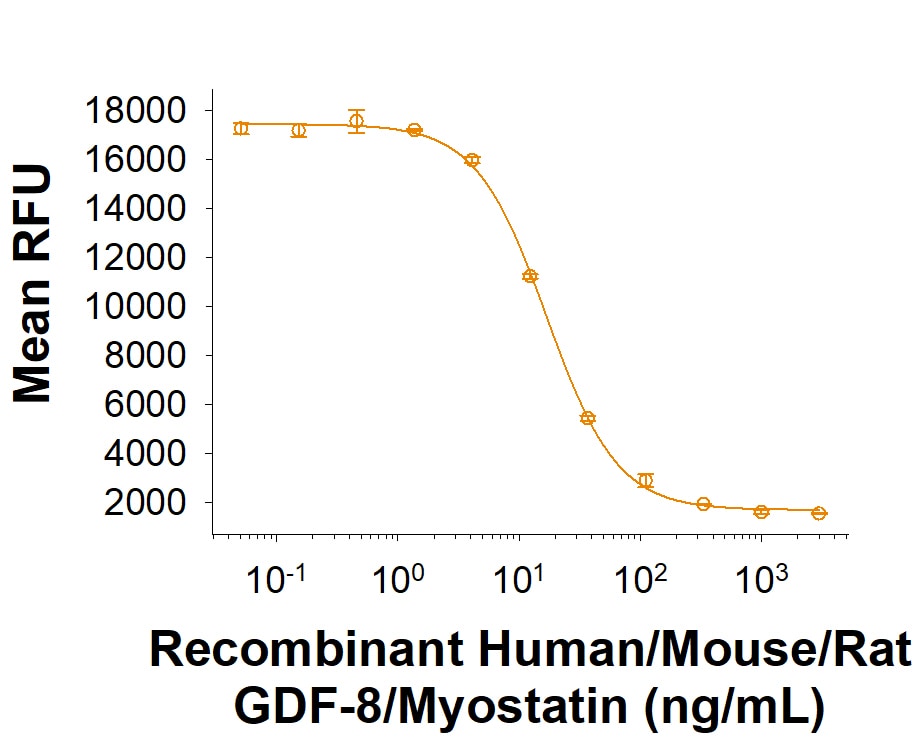
Measured by its ability to induce cytotoxicity using MPC-11 mouse B lymphocyte cells.
The ED50 for this effect is 4.00-40.0 ng/mL.
The ED50 for this effect is 4.00-40.0 ng/mL.
Scientific Data Images for Recombinant Human/Mouse/Rat GDF-8/Myostatin Protein, CF
Recombinant Human/Mouse/Rat GDF‑8/Myostatin Protein Bioactivity.
Recombinant Human/Mouse/Rat GDF-8/Myostatin Protein (Catalog # 11658-G8) induces cytotoxicity on MCP-11 cells. The ED50 for this effect is 4.00-40.0 ng/mL.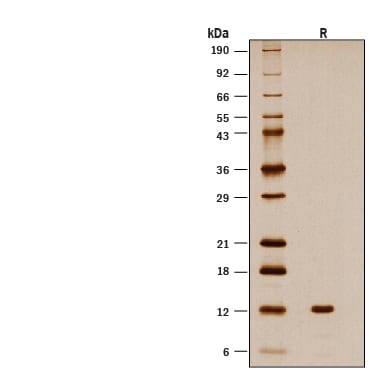
Recombinant Human/Mouse/Rat GDF‑8/Myostatin Protein SDS-PAGE.
1 μg/lane of Recombinant Human/Mouse/Rat GDF‑8/Myostatin Protein (Catalog # 11658-G8) was resolved with SDS-PAGE under reducing (R) condition and visualized by silver staining, showing bands at 10-14 kDa.Formulation, Preparation, and Storage
11658-G8
| Formulation | Lyophilized from a 0.2 μm filtered solution in Acetonitrile and TFA with Trehalose. |
| Reconstitution | Reconstitute at 250 μg/mL in water. |
| Shipping | The product is shipped at ambient temperature. Upon receipt, store it immediately at the temperature recommended below. |
| Stability & Storage | Use a manual defrost freezer and avoid repeated freeze-thaw cycles.
|
Calculators
Background: GDF-8/Myostatin
References
- Storm, E.E. et al. (1994) Nature 368:639.
- Sharma, M. et al. (1999) J. Cell Physiol. 180:1.
- McPherron, A.C. et al. (1997) Nature 387:83.
- Lee, S.J. et al. (2001) Proc. Natl. Acad. Sci. USA 98:9306.
- Kim, H.S. et al. (2001) Biochem. Biophys. Res. Commun. 281:902.
Long Name
Growth Differentiation Factor 8
Alternate Names
GDF8, MSLHP, MSTN, Myostatin
Gene Symbol
MSTN
UniProt
Additional GDF-8/Myostatin Products
Product Documents for Recombinant Human/Mouse/Rat GDF-8/Myostatin Protein, CF
Certificate of Analysis
To download a Certificate of Analysis, please enter a lot or batch number in the search box below.
Note: Certificate of Analysis not available for kit components.
Product Specific Notices for Recombinant Human/Mouse/Rat GDF-8/Myostatin Protein, CF
For research use only
Related Research Areas
Customer Reviews for Recombinant Human/Mouse/Rat GDF-8/Myostatin Protein, CF
There are currently no reviews for this product. Be the first to review Recombinant Human/Mouse/Rat GDF-8/Myostatin Protein, CF and earn rewards!
Have you used Recombinant Human/Mouse/Rat GDF-8/Myostatin Protein, CF?
Submit a review and receive an Amazon gift card!
$25/€18/£15/$25CAN/¥2500 for a review with an image
$10/€7/£6/$10CAN/¥1110 for a review without an image
Submit a review
Loading...