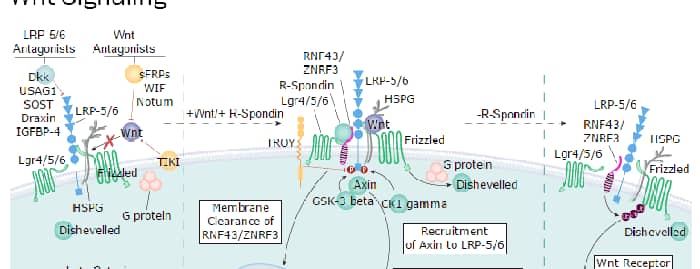
R-Spondin 3 (RSPO3, roof plate-specific spondin 3), also called cysteine-rich and single thrombospondin domain containing-1 (Cristin 1), is an ~31 kDa secreted protein that shares ~40% amino acid (aa) identity with the other three R-Spondin family members (1, 2). All are positive modulators of Wnt/ beta -catenin signaling, but each has a distinct expression pattern (1-4). Like other R-spondins,R-Spondin 3 contains two adjacent cysteine-rich furin-like domains (aa 35-135) with one potential N-glycosylation site (aa 36), followed by a thrombospondin (TSP-1) motif (aa 147-207) and a region rich in basic residues (aa 211-269). Only the furin-like domains are needed for beta -catenin stabilization (2). Within aa 21-209, human R-Spondin 3 shares 93%, 92%, 97%, 96% and 92% aa identity with mouse, rat, equine, bovine and canine R-Spondin 3, respectively. Potential isoforms of 279 and 297 aa diverge at aa 210 and 276, respectively (5). Mouse R-Spondin 3 is critical for development of the placental labyrinthine layer, probably by promoting VEGF expression and thus vascular development (6, 7). It is also essential for expression of the placenta-specific transcription factor, Gcm1. In the mouse embryo, R-Spondin 3 is often expressed by or located near endothelial cells (6). It is found in the roof plate, tail, somites, otic vesicles, cephalic mesoderm, truncus arteriosus, atrioventricular canal of the developing heart, and strongly but transiently in developing limbs (4, 7). R-Spondins regulate Wnt/ beta -catenin by competing with the Wnt antagonist DKK-1 for binding to the Wnt co-receptors LRP-6 and Kremen, reducing their DKK-1-mediated internalization (8, 9). Reports differ on whether R-Spondins bind LRP-6 directly (8-10). R-Spondin 3 has also been identified as an oncogene (11).
Recombinant Human R-spondin 3, Animal-Free Protein
R&D Systems | Catalog # Qk032

Key Product Details
Source
Accession Number
Applications
Product Specifications
Source
Purity
Endotoxin Level
Predicted Molecular Mass
SDS-PAGE
Activity
Mycoplasma
Scientific Data Images for Recombinant Human R-spondin 3, Animal-Free Protein
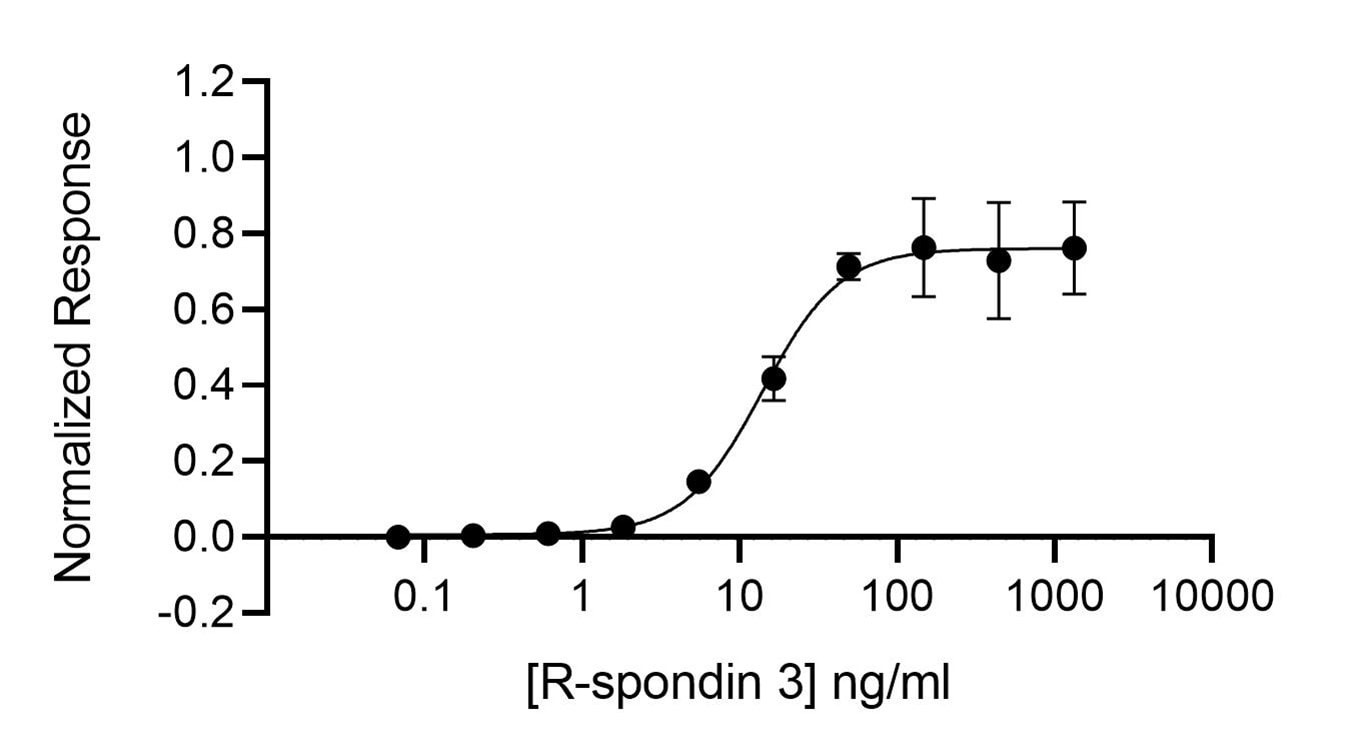
Recombinant Human R-spondin 3, Animal-Free Protein Bioactivity
Cells transfected with reporter TOP-FLASH are treated in triplicate with increasing concentration of R-spondin 3 in the presence of Wnt-conditioned media (1:8 dilution). RSP1 enhances Wnt-beta catenin signaling in HEK239T cells. Cells are grown overnight, and luciferase activity is measured and normalized.EC50 = 14 ng/ml (0.8 nM).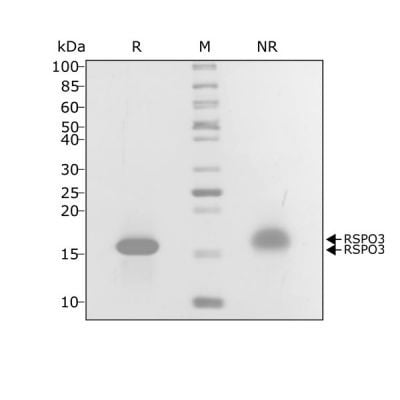
Recombinant Human R-spondin 3, Animal-Free Protein SDS-PAGE
R-spondin 3 bioactive domain migrates at 17 kDa in non-reducing (-beta ME) conditions and upon reduction (+ beta ME).Purified recombinant protein (7 µg) was resolved using 15% w/v SDS-PAGE in reduced (+ beta -mercaptoethanol, R) and non-reduced conditions (NR) and stained with Coomassie Brilliant Blue R250.Formulation, Preparation, and Storage
Qk032
| Formulation | Lyophilized from acetonitrile/TFA |
| Reconstitution | Resuspend in 10 mM HCl at >100 µg/ml, prepare single use aliquots, add carrier protein if desired. |
| Shipping | The product is shipped lyophilized at ambient temperture, on ice blocks or dry ice. Shipping at ambient temperture does not affect the bioactivity or stability of the protein. Upon reciept, store immediately at the conditions stated below. |
| Stability & Storage | Store lyophilized protein between -20 and -80 °C until the date of expiry. Avoid freeze-thaw cycles. |
Calculators
Background: R-Spondin 3
References
- Chen, J-Z. et al. (2002) Mol. Biol. Rep. 29:287.
- Kim, K.-A. et al. (2008) Mol. Biol. Cell 19:2588.
- Hendrickx, M. and L. Leyns (2008) Develop. Growth Differ. 50:229.
- Nam, J.-S. et al. (2007) Gene Expr. Patterns 7:306.
- Entrez Accession # EAW48114 and EAW48116.
- Kazanskaya, O. et al. (2008) Development 135:3655.
- Aoki, M. et al. (2007) Dev. Biol. 301:218.
- Binnerts, M.E. et al. (2007) Proc. Natl. Acad. Sci. USA 104:14700.
- Nam, J.-S. et al. (2006) J. Biol. Chem. 281:13247.
- Wei, Q. et al. (2007) J. Biol. Chem. 282:15903.
- Theodorou, V. et al. (2007) Nat. Genet. 6:759.
Long Name
Alternate Names
Gene Symbol
UniProt
Additional R-Spondin 3 Products
Product Documents for Recombinant Human R-spondin 3, Animal-Free Protein
Certificate of Analysis
To download a Certificate of Analysis, please enter a lot or batch number in the search box below.
Note: Certificate of Analysis not available for kit components.
Product Specific Notices for Recombinant Human R-spondin 3, Animal-Free Protein
The above product was manufactured, tested and released by R&D System's contract manufacturer, Qkine Ltd, at 1 Murdoch House, Cambridge, UK, CB5 8HW. The product is for research use only and not for the diagnostic or theraputic use.
For research use only
Related Research Areas
Customer Reviews for Recombinant Human R-spondin 3, Animal-Free Protein
There are currently no reviews for this product. Be the first to review Recombinant Human R-spondin 3, Animal-Free Protein and earn rewards!
Have you used Recombinant Human R-spondin 3, Animal-Free Protein?
Submit a review and receive an Amazon gift card!
$25/€18/£15/$25CAN/¥2500 for a review with an image
$10/€7/£6/$10CAN/¥1110 for a review without an image
Submit a review
Associated Pathways