
Ubiquitin Carboxyl-terminal Esterase L1 (UCH-L1), also known as PGP 9.5, is a deubiquitinating enzyme with a predicted molecular weight of 25 kDa (1). The human protein shares 95% amino acid sequence identity with its mouse and rat orthologs. UCH-L1 is expressed abundantly in neurons, accounting for 1-2% of total soluble proteins in the brain (2). It localizes primarily to the cytoplasm, but a subpopulation has been shown to be transiently nuclear (3,4). UCH-L1 contains two catalytic residues, Cys90 and His161, which are required for isopeptide bond cleavage at the C-terminal glycine residue of Ubiquitin (5). The levels of free Ubiquitin appear to be partially regulated by UCH-L1 through the hydrolysis of small Ubiquitin chains and the stabilization of monomeric Ubiquitin (6). Mice lacking functional UCH-L1 show neuronal dysfunction and neurodegeneration, and mutations in this enzyme have been linked to Parkinson's disease, suggesting that it is important for proper central nervous system function (7,8). UCH-L1 also likely plays a complex role in cancer. It has been reported to function as an oncogene in lymphoma, colorectal cancer, and nonsmall cell lung carcinoma (9-11). In contrast, it is thought to function as a tumor suppressor protein in nasopharyngeal and breast cancers (12,13).
Recombinant Human UCH-L1/PGP9.5 Protein, CF
R&D Systems | Catalog # E-340


Discontinued Product
E-340 has been discontinued.
View all UCH-L1/PGP9.5 products.
Key Product Details
Source
E. coli
Accession Number
Applications
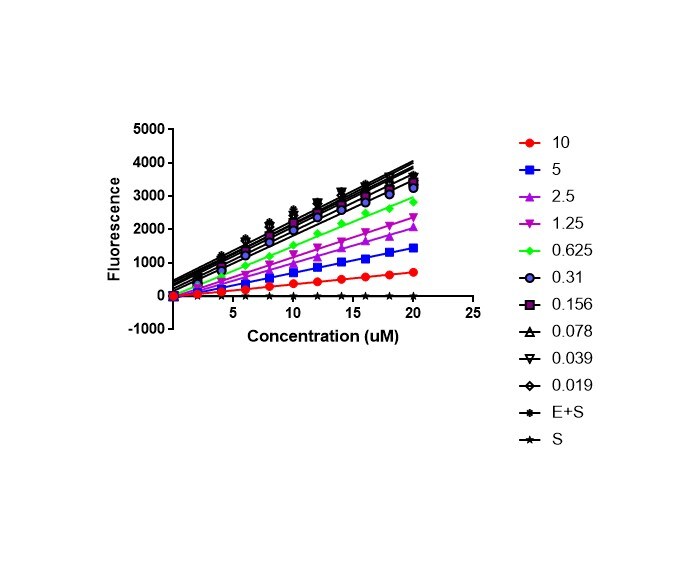
Enzyme Activity
Loading...
Product Specifications
Source
E. coli-derived human UCH-L1/PGP9.5 protein
Purity
>95%, by SDS-PAGE under reducing conditions and visualized by Colloidal Coomassie® Blue stain.
Predicted Molecular Mass
25 kDa
Activity
Recombinant Human UCH-L1 is a Ubiquitin-specific deconjugating enzyme. Reaction conditions will need to be optimized for each specific application. We recommend an initial Recombinant Human UCH-L1 concentration of 10-50 nM. A 15 minute pre-incubation with 10 mM DTT is recommended to achieve maximum activity.
Reviewed Applications
Read 1 review rated 5 using E-340 in the following applications:
Formulation, Preparation, and Storage
E-340
| Formulation | X mg/ml (X μM) in 50 mM HEPES pH 8.0, 100 mM NaCl, 1 mM EDTA, 2 mM DTT |
| Shipping | The product is shipped with dry ice or equivalent. Upon receipt, store it immediately at the temperature recommended below. |
| Stability & Storage | Use a manual defrost freezer and avoid repeated freeze-thaw cycles.
|
Background: UCH-L1/PGP9.5
References
- Wilkinson, K.D. et al. (1989) Science 246:670.
- Solano, S.M. et al. (2000) Ann. Neurol. 47:201.
- Henderson, M.J. et al. (2010) J. Biol. Chem. 285:11314.
- Bheda, A. et al. (2010) Cell Cycle 9:980.
- Larsen, C.N. et al. (1996) Biochemistry 35:6735.
- Walters, B.J. et al. (2008) Mol. Cell. Neurosci. 39:539.
- Sakurai, M. et al. (2008) Eur. J. Neurosci. 27:691.
- Andersson, F.I. et al. (2011) J. Mol. Biol. 407:261.
- Hussain, S. et al. (2010) Leukemia 24:1641.
- Akishima-Fukasawa, Y. et al. (2010) Am. J. Clin. Pathol. 134:71.
- Kim, H.J. et al. (2009) Oncogene 28:117.
- Li, L. et al. (2010) Clin. Cancer Res. 16:2949.
- Xiang, T. et al. (2012) PLoS One 7:e29783.
Long Name
Ubiquitin C-terminal Hydrolase L1
Alternate Names
PARK5, PGP9.5, UCHL1
Gene Symbol
UCHL1
UniProt
Additional UCH-L1/PGP9.5 Products
Product Documents for Recombinant Human UCH-L1/PGP9.5 Protein, CF
Certificate of Analysis
To download a Certificate of Analysis, please enter a lot or batch number in the search box below.
Note: Certificate of Analysis not available for kit components.
Product Specific Notices for Recombinant Human UCH-L1/PGP9.5 Protein, CF
For research use only
Related Research Areas
Citations for Recombinant Human UCH-L1/PGP9.5 Protein, CF
 Powered by Bioz
Customer Reviews for Recombinant Human UCH-L1/PGP9.5 Protein, CF (1)
5 out of 5
1 Customer Rating
Have you used Recombinant Human UCH-L1/PGP9.5 Protein, CF?
Submit a review and receive an Amazon gift card!
$25/€18/£15/$25CAN/¥2500 for a review with an image
$10/€7/£6/$10CAN/¥1110 for a review without an image
Submit a review
Customer Images
Showing
1
-
1 的
1 review
Showing All
Filter By:
-
Application: Enzymatic activity in vitroVerified Customer | Posted 03/18/2019

There are no reviews that match your criteria.
Loading...