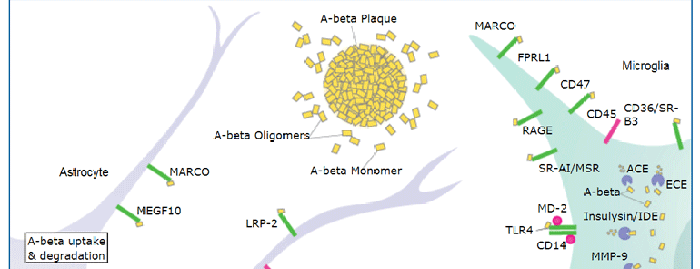
CD36 (alternatively known as platelet membrane glycoprotein IV (GPIV), thrombospondin receptor, fatty acid translocase (FAT), and scavenger receptor class B, member 3 (SR-B3)) is an 88 kDa, integral membrane glycoprotein that belongs to the class B scavenger receptor family (1, 2). The molecule is described as being ditopic, with two transmembrane segments connected by an extracellular loop (3). Mouse CD36 is synthesized as a 472 amino acid (aa) protein that contains a 6 aa N-terminal cytoplasmic domain, a 22 aa N-terminal transmembrane segment, a 420 aa extracellular “loop”, a 22 aa C-terminal transmembrane segment, and a 9 aa C-terminal cytoplasmic tail (4). Both cytoplasmic tails are palmitoylated, with the C-terminal tail involved in oxidized LDL binding (5, 6). With respect to the extracellular loop, the N-terminal region is believed to bind both thrombospondin-1 and Plasmodium-infected erythrocytes. Other ligands for CD36 include long-chain fatty acids, collagen, phospholipids and apoptotic cells (1). The extracellular loop of mouse CD36 is 94%, 92%, 84% and 84% aa identical to the extracellular loops of rat, hamster, human and bovine CD36, respectively. Cells known to express CD36 include capillary endothelium, adipocytes, skeletal muscle cells, intestinal epithelium, smooth muscle cells and hematopoietic cells such as RBC’s, platelets and monocytes (1). On the surface of cells, CD36 is suggested to exist as a dimer in response to ligation (7). CD36 is reported to regulate fatty uptake, act as an angiogenic with TSP-1, and participate in the clearance of apoptotic phagocytes (1, 8).
Recombinant Mouse CD36/SR-B3 Fc Chimera Protein, CF
R&D Systems | Catalog # 2519-CD

Loading...
Key Product Details
- R&D Systems CHO-derived Recombinant Mouse CD36/SR-B3 Fc Chimera Protein (2519-CD)
- Quality control testing to verify active proteins with lot specific assays by in-house scientists
- All R&D Systems proteins are covered with a 100% guarantee
Source
CHO
Accession Number
Structure / Form
Disulfide-linked homodimer
Applications
Binding Activity
Loading...
Product Specifications
Source
Chinese Hamster Ovary cell line, CHO-derived mouse CD36/SR-B3 protein
| Mouse CD36 (Gly30-Lys439) Accession # Q3UAI3 |
IEGRMD | Human IgG1 (Pro100-Lys330) |
| N-terminus | C-terminus |
Purity
>90%, by SDS-PAGE visualized with Silver Staining and quantitative densitometry by Coomassie® Blue Staining.
Endotoxin Level
<0.10 EU per 1 μg of the protein by the LAL method.
N-terminal Sequence Analysis
Gly30
Predicted Molecular Mass
72.9 kDa (monomer)
SDS-PAGE
100-130 kDa, reducing conditions
Scientific Data Images for Recombinant Mouse CD36/SR-B3 Fc Chimera Protein, CF
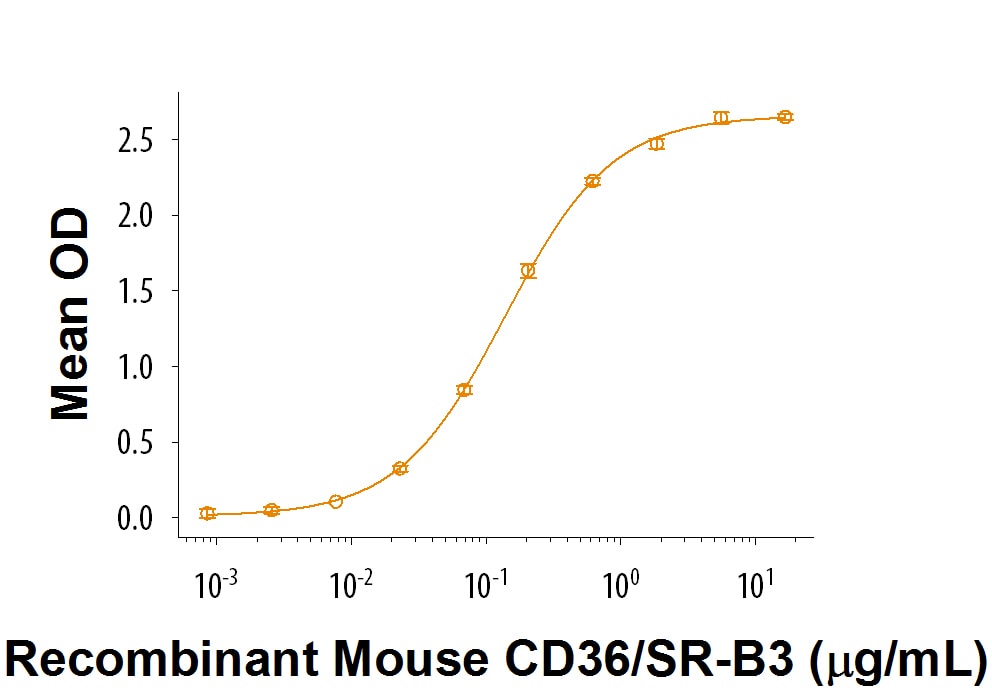
Recombinant Mouse CD36/SR-B3 Fc Chimera Protein Binding Activity
Recombinant Mouse CD36/SR-B3 Fc Chimera (Catalog # 2519-CD) is used at 1 µg/mL, Recombinant Human Thrombospondin-2 (Catalog # 1635-T2) binds with an ED50 of 0.06-0.6 µg/mL.Formulation, Preparation, and Storage
2519-CD
| Formulation | Lyophilized from a 0.2 μm filtered solution in PBS. |
| Reconstitution | Reconstitute at 100 μg/mL in sterile PBS.
Loading...
|
| Shipping | The product is shipped at ambient temperature. Upon receipt, store it immediately at the temperature recommended below. |
| Stability & Storage | Use a manual defrost freezer and avoid repeated freeze-thaw cycles.
|
Calculators
Background: CD36/SR-B3
References
- Febbraio, M. et al. (2001) J. Clin. Invest. 108:795.
- Silverstein, R.L. and M. Febbraio (2000) Curr. Opin. Lipid. 11:483.
- Gruarin, P. et al. (2000) Biochem. Biophys. Res. Commun. 275:446.
- Endemann, G. et al. (1993) J. Biol. Chem. 268:11811.
- Malaud, E. et al. (2002) Biochem. J. 364:507.
- Tao, N. et al. (1996) J. Biol. Chem. 271:22315.
- Daviet, L. et al. (1997) Thromb. Haemost. 78:897.
- Simantov, R. and R.L. Silverstein (2003) Front. Biosci. 8:s874.
Long Name
Scavenger Receptor Class B, Member 3
Alternate Names
CD36, Collagen R, FAT, GPIIIb, GPIV, SCARB3, SR-B3, SRB3, Thrombospondin R
Gene Symbol
CD36
UniProt
Additional CD36/SR-B3 Products
Product Documents for Recombinant Mouse CD36/SR-B3 Fc Chimera Protein, CF
Certificate of Analysis
To download a Certificate of Analysis, please enter a lot or batch number in the search box below.
Note: Certificate of Analysis not available for kit components.
Product Specific Notices for Recombinant Mouse CD36/SR-B3 Fc Chimera Protein, CF
For research use only
Citations for Recombinant Mouse CD36/SR-B3 Fc Chimera Protein, CF
 Powered by Bioz
Customer Reviews for Recombinant Mouse CD36/SR-B3 Fc Chimera Protein, CF
There are currently no reviews for this product. Be the first to review Recombinant Mouse CD36/SR-B3 Fc Chimera Protein, CF and earn rewards!
Have you used Recombinant Mouse CD36/SR-B3 Fc Chimera Protein, CF?
Submit a review and receive an Amazon gift card!
$25/€18/£15/$25CAN/¥2500 for a review with an image
$10/€7/£6/$10CAN/¥1110 for a review without an image
Submit a review