
Abeta 40 Antibody (3D7) - Chimeric
Novus Biologicals | Catalog # NBP3-48386
Recombinant Monoclonal Antibody

Scientific images may be resized, cropped, or adjusted for brightness or contrast for presentation purposes. These updates are limited to presentation and do not affect the underlying scientific interpretation of the data. Where available, additional source data may be provided upon request.
Loading...
Key Product Details
Species Reactivity
Human
Applications
Flow Cytometry
Label
Unconjugated
Antibody Source
Recombinant Monoclonal Human IgG1 Clone # 3D7
Loading...
Product Specifications
Immunogen
Abeta 40 recombinant protein expressed in mammalian cells (Accession# P05067). The exact amino acid sequence is proprietary.
Clonality
Monoclonal
Host
Human
Isotype
IgG1
Description
This product is shipped at ambient temperature. Store at -20C to -80C for 12 months in lyophilized form. After reconstitution, if not intended for use within a month, aliquot and store at -80C (Avoid repeated freezing and thawing).
Scientific Data Images for Abeta 40 Antibody (3D7) - Chimeric
Flow Cytometry: Abeta 40 Antibody (3D7) - Chimeric [NBP3-48386]
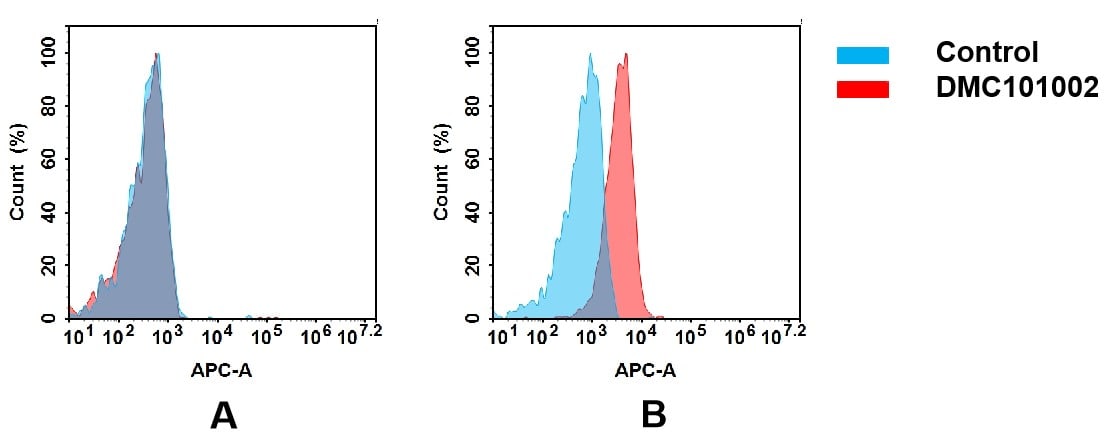
Flow cytometry analysis of antigen binding of anti-human APP mAb(NBP3-48386). (A) NBP3-48386 does not bind to CHO-S cells that do not express APP. (B) A clear peak shift of NBP3-48386 was seen compared to the control when incubated with APP-expressing Siha cells, indicating strong binding of NBP3-48386 to APP. Antibodies were incubated at 5 ug/mL.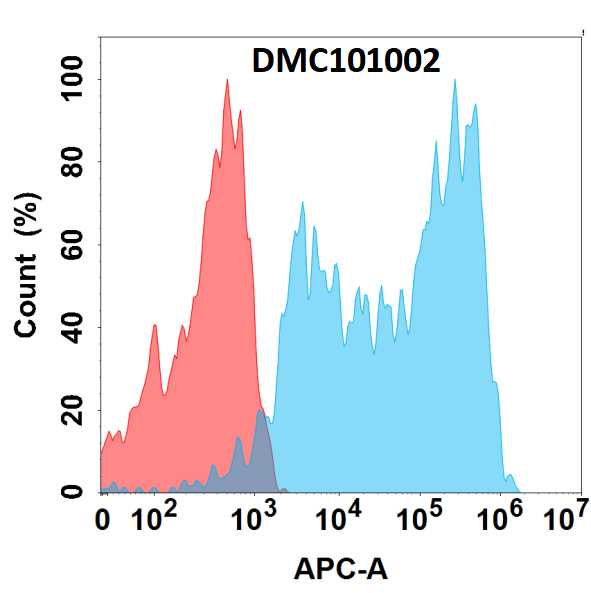
Flow Cytometry: Abeta 40 Antibody (3D7) - Chimeric [NBP3-48386]
Flow cytometry analysis with Anti-Abeta 40 (3D7) mAb on HEK293 cells transfected with human Abeta 40 (Blue histogram) or HEK293 transfected with irrelevant protein (Red histogram).Applications for Abeta 40 Antibody (3D7) - Chimeric
Application
Recommended Usage
Flow Cytometry
1:100
Flow Cytometry Panel Builder
Bio-Techne Knows Flow Cytometry
Save time and reduce costly mistakes by quickly finding compatible reagents using the Panel Builder Tool.
Advanced Features
- Spectra Viewer - Custom analysis of spectra from multiple fluorochromes
- Spillover Popups - Visualize the spectra of individual fluorochromes
- Antigen Density Selector - Match fluorochrome brightness with antigen density

Formulation, Preparation, and Storage
Purification
Antigen Affinity-purified from cell culture supernatant
Reconstitution
Dissolve the lyophilized antibody in sterile and low endotoxin water. The recommend volume of water is lot specific. Please refer to the instructions printed on the product vial or contact technical support.
Formulation
PBS, pH 7.4, 5-8% Trehalose
Preservative
Trehalose
Concentration
LYOPH mg/ml
Shipping
The product is shipped at ambient temperature. Upon receipt, store it immediately at the temperature recommended below.
Stability & Storage
Store at -20C in powder form. Store at -80C once reconstituted.
Calculators
Background: Abeta 40
The Amyloid beta A4 protein (Abeta40) is the more common isoform and is the main components of amyloid plaques. Abeta-40 is produced by cleavage of the Amyloid Precursor Protein (APP) that occurs in the endoplasmic reticulum.
The Amyloid beta proteins function as a cell surface receptor and supports neurite growth, neuronal adhesion and axonogenesis on the surface of neurons. Amyloid betas are also involved in cell mobility functions and transcription regulation via various protein-protein interactions.
Abeta40 antibodies are useful tools for Alzheimer's studies and research on amyloid plaques.
Alternate Names
amyloid beta 40, Beta-amyloid protein 40
Gene Symbol
APP
Additional Abeta 40 Products
Product Documents for Abeta 40 Antibody (3D7) - Chimeric
Certificate of Analysis
To download a Certificate of Analysis, please enter a lot or batch number in the search box below.
Product Specific Notices for Abeta 40 Antibody (3D7) - Chimeric
This product is for research use only and is not approved for use in humans or in clinical diagnosis. Primary Antibodies are guaranteed for 1 year from date of receipt.
Customer Reviews for Abeta 40 Antibody (3D7) - Chimeric
There are currently no reviews for this product. Be the first to review Abeta 40 Antibody (3D7) - Chimeric and earn rewards!
Have you used Abeta 40 Antibody (3D7) - Chimeric?
Submit a review and receive an Amazon gift card!
$25/€18/£15/$25CAN/¥2500 for a review with an image
$10/€7/£6/$10CAN/¥1110 for a review without an image
Submit a review
Protocols
Find general support by application which include: protocols, troubleshooting, illustrated assays, videos and webinars.
- 7-Amino Actinomycin D (7-AAD) Cell Viability Flow Cytometry Protocol
- Extracellular Membrane Flow Cytometry Protocol
- Flow Cytometry Protocol for Cell Surface Markers
- Flow Cytometry Protocol for Staining Membrane Associated Proteins
- Flow Cytometry Staining Protocols
- Flow Cytometry Troubleshooting Guide
- Intracellular Flow Cytometry Protocol Using Alcohol (Methanol)
- Intracellular Flow Cytometry Protocol Using Detergents
- Intracellular Nuclear Staining Flow Cytometry Protocol Using Detergents
- Intracellular Staining Flow Cytometry Protocol Using Alcohol Permeabilization
- Intracellular Staining Flow Cytometry Protocol Using Detergents to Permeabilize Cells
- Propidium Iodide Cell Viability Flow Cytometry Protocol
- Protocol for Liperfluo
- Protocol for the Characterization of Human Th22 Cells
- Protocol for the Characterization of Human Th9 Cells
- Protocol: Annexin V and PI Staining by Flow Cytometry
- Protocol: Annexin V and PI Staining for Apoptosis by Flow Cytometry
- Troubleshooting Guide: Fluorokine Flow Cytometry Kits
- View all Protocols, Troubleshooting, Illustrated assays and Webinars
Loading...