
EphB3 (Erythropoietin-producing Hepatocellular Carcinoma-3), also known as Cek10, Tyro6, Sek4, Hek2, and Mdk5, is a 110-130 kDa type I transmembrane glycoprotein member of the Ephrin receptor subfamily, tyrosine protein kinase family of molecules. The Eph proteins have an A and B class that are distinguished by Ephrin ligand binding preference and a common structural organization. Eph-Ephrin interactions are widely involved in the regulation of cell migration, tissue morphogenesis, and inflammation. The 526 amino acid (aa) extracellular domain (ECD) of mature human EphB3 contains a ligand binding domain followed by a cysteine rich region and two fibronectin type III domains. The 418 aa cytoplasmic domain contains a tyrosine kinase domain, a sterile alpha motif (SAM), and a PDZ binding motif. Within the ECD, human EphB3 shares 96% aa sequence identity with mouse and rat EphB3. Binding of EphB3 to its ligands Ephrin-B1, B2, and B3 triggers forward signaling through EphB3 as well as reverse signaling through the Ephrin. EphB3 also interacts in cis with the receptor tyrosine kinase Ryk. Activation of its kinase domain is required for some but not all of the effects of EphB3 on cellular adhesion, motility, and morphology. EphB3 is widely expressed during development and in the adult where it shows a complementary tissue distribution to the Ephrin-B ligands. Cells known to express EphB3 constitutively or inducibly include Langerhans cells, osteoblasts, oligodendroglia, astrocytes, neural stem cell progenitors, cortical thymic epithelium, duodenal Brunner's gland epithelium and gastric parietal cells. EphB3 function is important in vascular, nervous system, thymocyte, and palate development. It directs embyronic neuronal axon pathfinding, and its upregulation on local macrophages following neuronal injury promotes the growth of regenerating axons. Notably, during pancreas development, EphB3 is reportedly a definitive biomarker for fetal islet precursor cells.
Human EphB3 PE‑conjugated Antibody
R&D Systems | Catalog # FAB56671P

Key Product Details
Species Reactivity
Applications
Label
Antibody Source
Product Specifications
Immunogen
Leu38-Ala550
Accession # P54753
Specificity
Clonality
Host
Isotype
Scientific Data Images for Human EphB3 PE‑conjugated Antibody
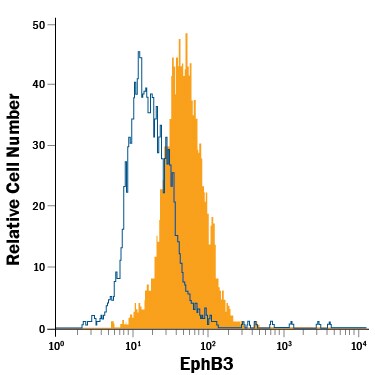
Detection of EphB3 in SH‑SY5Y Human Cell Line by Flow Cytometry.
SH-SY5Y human neuroblastoma cell line was stained with Mouse Anti-Human EphB3 PE-conjugated Monoclonal Antibody (Catalog # FAB56671P, filled histogram) or isotype control antibody (Catalog # IC003P, open histogram). View our protocol for Staining Membrane-associated Proteins.Applications for Human EphB3 PE‑conjugated Antibody
Flow Cytometry
Sample: SH‑SY5Y human neuroblastoma cell line
Spectra Viewer
Plan Your Experiments
Use our spectra viewer to interactively plan your experiments, assessing multiplexing options. View the excitation and emission spectra for our fluorescent dye range and other commonly used dyes.
Spectra Viewer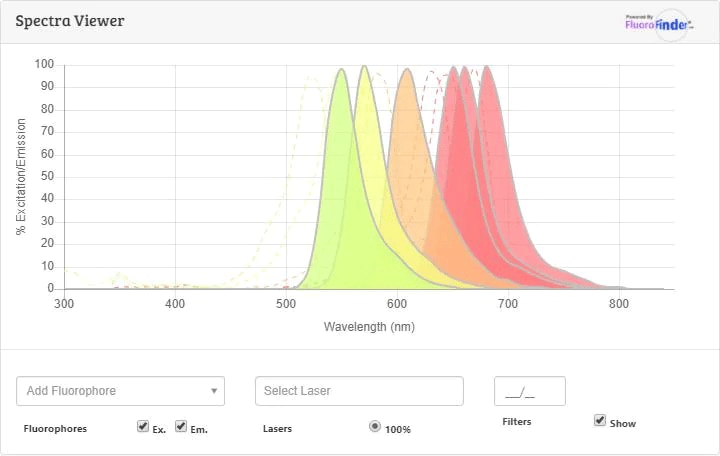
Flow Cytometry Panel Builder
Bio-Techne Knows Flow Cytometry
Save time and reduce costly mistakes by quickly finding compatible reagents using the Panel Builder Tool.
Advanced Features
- Spectra Viewer - Custom analysis of spectra from multiple fluorochromes
- Spillover Popups - Visualize the spectra of individual fluorochromes
- Antigen Density Selector - Match fluorochrome brightness with antigen density

Formulation, Preparation, and Storage
Purification
Formulation
Shipping
Stability & Storage
Background: EphB3
Long Name
Alternate Names
Gene Symbol
UniProt
Additional EphB3 Products
Product Documents for Human EphB3 PE‑conjugated Antibody
Certificate of Analysis
To download a Certificate of Analysis, please enter a lot or batch number in the search box below.
Note: Certificate of Analysis not available for kit components.
Product Specific Notices for Human EphB3 PE‑conjugated Antibody
For research use only
Related Research Areas
Customer Reviews for Human EphB3 PE‑conjugated Antibody
There are currently no reviews for this product. Be the first to review Human EphB3 PE‑conjugated Antibody and earn rewards!
Have you used Human EphB3 PE‑conjugated Antibody?
Submit a review and receive an Amazon gift card!
$25/€18/£15/$25CAN/¥2500 Yen for a review with an image
$10/€7/£6/$10CAN/¥1110 Yen for a review without an image
Submit a review
Protocols
Find general support by application which include: protocols, troubleshooting, illustrated assays, videos and webinars.
- 7-Amino Actinomycin D (7-AAD) Cell Viability Flow Cytometry Protocol
- Extracellular Membrane Flow Cytometry Protocol
- Flow Cytometry Protocol for Cell Surface Markers
- Flow Cytometry Protocol for Staining Membrane Associated Proteins
- Flow Cytometry Staining Protocols
- Flow Cytometry Troubleshooting Guide
- Intracellular Flow Cytometry Protocol Using Alcohol (Methanol)
- Intracellular Flow Cytometry Protocol Using Detergents
- Intracellular Nuclear Staining Flow Cytometry Protocol Using Detergents
- Intracellular Staining Flow Cytometry Protocol Using Alcohol Permeabilization
- Intracellular Staining Flow Cytometry Protocol Using Detergents to Permeabilize Cells
- Propidium Iodide Cell Viability Flow Cytometry Protocol
- Protocol for Liperfluo
- Protocol for the Characterization of Human Th22 Cells
- Protocol for the Characterization of Human Th9 Cells
- Protocol: Annexin V and PI Staining by Flow Cytometry
- Protocol: Annexin V and PI Staining for Apoptosis by Flow Cytometry
- Troubleshooting Guide: Fluorokine Flow Cytometry Kits
- View all Protocols, Troubleshooting, Illustrated assays and Webinars