
Epiregulin is a member of the EGF family of growth factors which includes, among others, epidermal growth factor (EGF), transforming growth factor (TGF)-alpha, amphiregulin (ARG), HB (heparin-binding)-EGF, betacellulin, and the various heregulins. All EGF family members are synthesized as transmembrane precursors and are converted to soluble forms by proteolytic cleavage. Epiregulin was originally purified from the mouse fibroblast-derived tumor cell line NIH3T3/T7 (1). The human epiregulin cDNA encodes a 169 amino acid (aa) residues transmembrane precursor with a 29 aa signal peptide, a 21 aa transmembrane domain and a 21 aa cytoplasmic domain. The putative soluble mature Epiregulin comprising the EGF-like domain (aa residues 64‑104) is formed by proteolytic removal of the propeptide regions (2). There is 85% aa sequence homology between human and mouse epiregulins. Epiregulin is expressed primarily in the placenta and macrophages (3). High level expression has also been detected in various carcinomas. Epiregulin specifically binds EGFR (ErbB1) and ErbB4 but not ErbB2 and ErbB3. It activates the homodimers of both ErbB1 and ErbB4. In addition, epiregulin can also activate all possible heteromeric combinations of the four ErbB family members (4). Epiregulin stimulates the proliferation of fibroblasts, smooth muscle cells and hepatocytes. It has been shown to be an autocrine growth factor for epidermal keratinocytes as well as mesangial cells (5, 6). Epiregulin has also been shown to inhibit growth of several epithelial tumor cells. In addition, Epiregulin has been implicated in the implantation process during pregnancy (7).
Human Epiregulin PE‑conjugated Antibody
R&D Systems | Catalog # IC14251P

Key Product Details
Species Reactivity
Applications
Label
Antibody Source
Product Specifications
Immunogen
Val63-Leu108
Accession # O14944
Specificity
Clonality
Host
Isotype
Scientific Data Images for Human Epiregulin PE‑conjugated Antibody
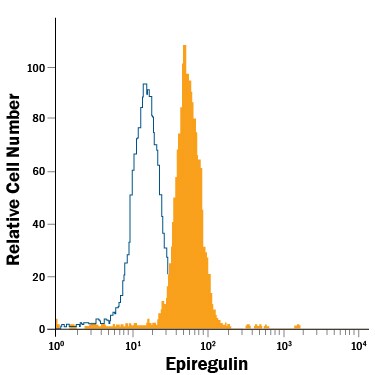
Detection of Epiregulin in A549 Human Cell Line by Flow Cytometry.
A549 human lung carcinoma cell line was stained with Mouse Anti-Human Epiregulin PE-conjugated Monoclonal Antibody (Catalog # IC14251P, filled histogram) or isotype control antibody (Catalog # IC0041P, open histogram). To facilitate intracellular staining, cells were fixed with Flow Cytometry Fixation Buffer (Catalog # FC004) and permeabilized with Flow Cytometry Permeabilization/Wash Buffer I (Catalog # FC005). View our protocol for Staining Intracellular Molecules.Applications for Human Epiregulin PE‑conjugated Antibody
Intracellular Staining by Flow Cytometry
Sample: A549 human lung carcinoma cell line fixed with Flow Cytometry Fixation Buffer (Catalog # FC004) and permeabilized with Flow Cytometry Permeabilization/Wash Buffer I (Catalog # FC005)
Spectra Viewer
Plan Your Experiments
Use our spectra viewer to interactively plan your experiments, assessing multiplexing options. View the excitation and emission spectra for our fluorescent dye range and other commonly used dyes.
Spectra Viewer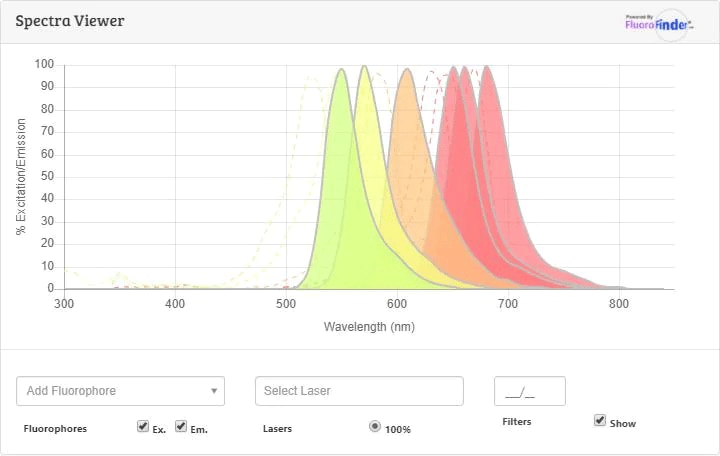
Flow Cytometry Panel Builder
Bio-Techne Knows Flow Cytometry
Save time and reduce costly mistakes by quickly finding compatible reagents using the Panel Builder Tool.
Advanced Features
- Spectra Viewer - Custom analysis of spectra from multiple fluorochromes
- Spillover Popups - Visualize the spectra of individual fluorochromes
- Antigen Density Selector - Match fluorochrome brightness with antigen density

Formulation, Preparation, and Storage
Purification
Formulation
Shipping
Stability & Storage
Background: Epiregulin
References
- Toyoda, H. et al. (1995) J. Biol. Chem. 270:7495.
- Toyoda, H. et al. (1997) Biochem. J. 326:69.
- Komurasaki, T. et al. (1997) Oncogene 15:2841.
- Shelly, M. et al. (1998) J. Biol. Chem. 273:10496.
- Shirakata, Y. et al. (2000) J. Biol. Chem. 275:5748.
- Mishre, R. et al. (2002) Am. J. Physiol. Renal. Physiol. 283:F1151.
- Das, S.K. et al. (1997) Dev. Biol. 190:178.
Alternate Names
Gene Symbol
UniProt
Additional Epiregulin Products
Product Documents for Human Epiregulin PE‑conjugated Antibody
Certificate of Analysis
To download a Certificate of Analysis, please enter a lot or batch number in the search box below.
Note: Certificate of Analysis not available for kit components.
Product Specific Notices for Human Epiregulin PE‑conjugated Antibody
For research use only
Related Research Areas
Customer Reviews for Human Epiregulin PE‑conjugated Antibody
There are currently no reviews for this product. Be the first to review Human Epiregulin PE‑conjugated Antibody and earn rewards!
Have you used Human Epiregulin PE‑conjugated Antibody?
Submit a review and receive an Amazon gift card!
$25/€18/£15/$25CAN/¥2500 Yen for a review with an image
$10/€7/£6/$10CAN/¥1110 Yen for a review without an image
Submit a review
Protocols
Find general support by application which include: protocols, troubleshooting, illustrated assays, videos and webinars.
- 7-Amino Actinomycin D (7-AAD) Cell Viability Flow Cytometry Protocol
- Extracellular Membrane Flow Cytometry Protocol
- Flow Cytometry Protocol for Cell Surface Markers
- Flow Cytometry Protocol for Staining Membrane Associated Proteins
- Flow Cytometry Staining Protocols
- Flow Cytometry Troubleshooting Guide
- Intracellular Flow Cytometry Protocol Using Alcohol (Methanol)
- Intracellular Flow Cytometry Protocol Using Detergents
- Intracellular Nuclear Staining Flow Cytometry Protocol Using Detergents
- Intracellular Staining Flow Cytometry Protocol Using Alcohol Permeabilization
- Intracellular Staining Flow Cytometry Protocol Using Detergents to Permeabilize Cells
- Propidium Iodide Cell Viability Flow Cytometry Protocol
- Protocol for Liperfluo
- Protocol for the Characterization of Human Th22 Cells
- Protocol for the Characterization of Human Th9 Cells
- Protocol: Annexin V and PI Staining by Flow Cytometry
- Protocol: Annexin V and PI Staining for Apoptosis by Flow Cytometry
- Troubleshooting Guide: Fluorokine Flow Cytometry Kits
- View all Protocols, Troubleshooting, Illustrated assays and Webinars