
Semaphorin 3E (Sema3E; previously SemaH) is a 90-95 kDa member of the Class 3 (secreted) semaphorins which, in human, share 40-50% amino acid (aa) sequence identity. Class 3 semaphorins are potent chemorepellents that function in axon guidance and/or vascular tip cell guidance during development (1). Sema3E is highly expressed in developing somites, where it acts as a repulsive cue for PlexinD1-expressing endothelial cells of adjacent intersomitic vessels (2, 3). Crystal structures of semaphorins reveal that the 500 aa N-terminal Sema domain forms a seven-blade beta -propeller similar to that found in integrin molecules. This is accompanied by 14 conserved cysteine residues and one or more N-glycosylation sites are thought critical for forming the secondary structure (4). C-terminal to the Sema domain, Sema3E has a consensus sequence for furin cleavage which, when used, creates a 61 kDa form that does not dimerize, and is highly expressed in tumor cell lines with metastatic potential (5, 6). Further C-terminal are a cysteine-knot plexin/semaphorin/integrin (PSI) domain, an Ig-like domain, a cysteine for dimerization and a basic domain containing another furin cleavage site. Dimerization and cleavage at the C-terminal site are required for repulsing activity of class 3 semaphorins (7). Human Sema3E shares 90%, 85% and 57% aa sequence identity with mouse, bovine and canine Sema3E, respectively. Like other semaphorins, Sema3E signaling is transduced by a transmembrane Plexin dimer, which also has a Sema domain and is coupled to kinase pathways. Unlike other Class 3 semaphorins, Sema3E binds directly to its plexin and does not require interaction with a neuropilin for activity (7). Genetic disruption of either Sema3E or PlexinD1 creates mouse mutants with excessive and disorganized vascular growth and branching, indicating the importance of this ligand-receptor pair for vascular guidance (3, 8).
Human Semaphorin 3E APC‑conjugated Antibody
R&D Systems | Catalog # IC32391A

Key Product Details
Species Reactivity
Applications
Label
Antibody Source
Product Specifications
Immunogen
Thr25-Ser775 (Arg557Ala and Arg560Ala)
Accession # O15041
Specificity
Clonality
Host
Isotype
Scientific Data Images for Human Semaphorin 3E APC‑conjugated Antibody
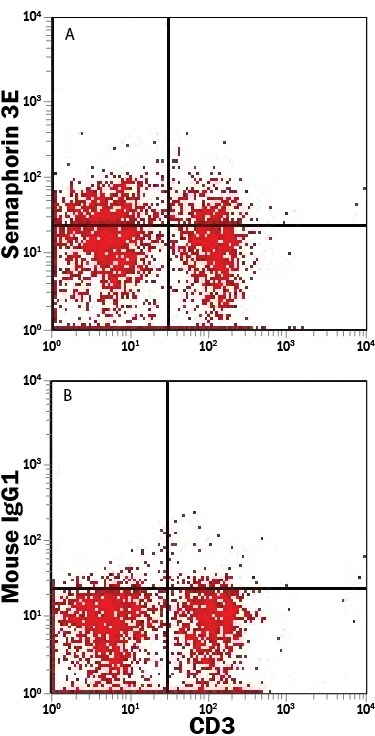
Detection of Semaphorin 3E in Mouse Splenocytes by Flow Cytometry.
Mouse splenocytes stimulated with PHA were stained with Rat Anti-Mouse CD3 PE-conjugated Monoclonal Antibody (Catalog # FAB4841P) and either (A) Mouse Anti-Human Semaphorin 3E APC-conjugated Monoclonal Antibody (Catalog # IC32391A) or (B) Mouse IgG1Allophycocyanin Isotype Control (Catalog # IC002A). To facilitate intracellular staining, cells were fixed with Flow Cytometry Fixation Buffer (Catalog # FC004) and permeabilized with Flow Cytometry Permeabilization/Wash Buffer I (Catalog # FC005). View our protocol for Staining Intracellular Molecules.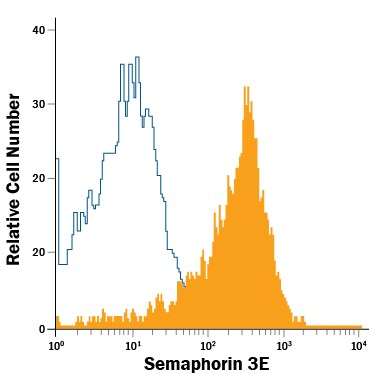
Detection of Semaphorin 3E in Human PBMCs by Flow Cytometry.
Human peripheral blood mononuclear cells stimulated with PHA were stained with Mouse Anti-Human Semaphorin 3E APC-conjugated Monoclonal Antibody (Catalog # IC32391A, filled histogram) or isotype control antibody (Catalog # IC002A, open histogram). To facilitate intracellular staining, cells were fixed with Flow Cytometry Fixation Buffer (Catalog # FC004) and permeabilized with Flow Cytometry Permeabilization/Wash Buffer I (Catalog # FC005). View our protocol for Staining Intracellular Molecules.Applications for Human Semaphorin 3E APC‑conjugated Antibody
Intracellular Staining by Flow Cytometry
Sample: Mouse splenocytes and human peripheral blood mononuclear cells stimulated with PHA were fixed with Flow Cytometry Fixation Buffer (Catalog # FC004) and permeabilized with Flow Cytometry Permeabilization/Wash Buffer I (Catalog # FC005).
Spectra Viewer
Plan Your Experiments
Use our spectra viewer to interactively plan your experiments, assessing multiplexing options. View the excitation and emission spectra for our fluorescent dye range and other commonly used dyes.
Spectra Viewer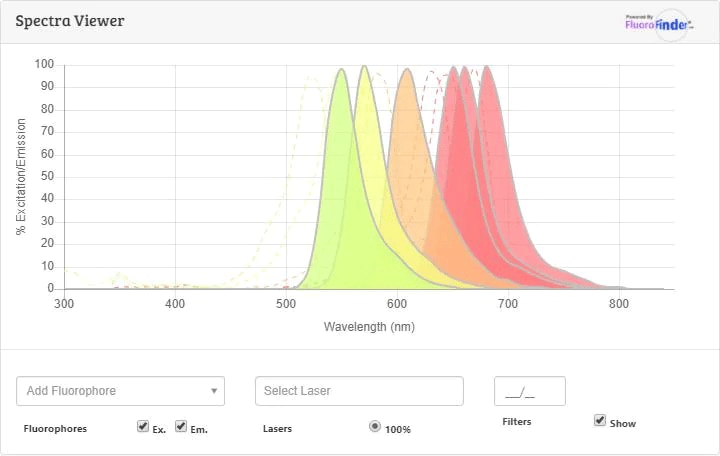
Flow Cytometry Panel Builder
Bio-Techne Knows Flow Cytometry
Save time and reduce costly mistakes by quickly finding compatible reagents using the Panel Builder Tool.
Advanced Features
- Spectra Viewer - Custom analysis of spectra from multiple fluorochromes
- Spillover Popups - Visualize the spectra of individual fluorochromes
- Antigen Density Selector - Match fluorochrome brightness with antigen density

Formulation, Preparation, and Storage
Purification
Formulation
Shipping
Stability & Storage
Background: Semaphorin 3E
References
- Eichmann, A. et al. (2005) Genes Dev. 19:1013.
- Cohen, S. et al. (2005) Eur. J. Neurosci. 21:1767.
- Gu, C. et al. (2005) Science 307:265.
- Gherardi, E. et al. (2004) Curr. Opin. Struct. Biol. 14:669.
- Christensen, C. et al. (1998) Cancer Res. 58:1238.
- Christensen, C. et al. (2005) Cancer Res. 65:6167.
- Adams, R. H. et al. (1997) EMBO J. 16:6077.
- Gitler, A. D. et al. (2004) Dev. Cell 7:107.
Alternate Names
Gene Symbol
UniProt
Additional Semaphorin 3E Products
Product Documents for Human Semaphorin 3E APC‑conjugated Antibody
Certificate of Analysis
To download a Certificate of Analysis, please enter a lot or batch number in the search box below.
Note: Certificate of Analysis not available for kit components.
Product Specific Notices for Human Semaphorin 3E APC‑conjugated Antibody
For research use only
Related Research Areas
Customer Reviews for Human Semaphorin 3E APC‑conjugated Antibody
There are currently no reviews for this product. Be the first to review Human Semaphorin 3E APC‑conjugated Antibody and earn rewards!
Have you used Human Semaphorin 3E APC‑conjugated Antibody?
Submit a review and receive an Amazon gift card!
$25/€18/£15/$25CAN/¥2500 Yen for a review with an image
$10/€7/£6/$10CAN/¥1110 Yen for a review without an image
Submit a review
Protocols
Find general support by application which include: protocols, troubleshooting, illustrated assays, videos and webinars.
- 7-Amino Actinomycin D (7-AAD) Cell Viability Flow Cytometry Protocol
- Extracellular Membrane Flow Cytometry Protocol
- Flow Cytometry Protocol for Cell Surface Markers
- Flow Cytometry Protocol for Staining Membrane Associated Proteins
- Flow Cytometry Staining Protocols
- Flow Cytometry Troubleshooting Guide
- Intracellular Flow Cytometry Protocol Using Alcohol (Methanol)
- Intracellular Flow Cytometry Protocol Using Detergents
- Intracellular Nuclear Staining Flow Cytometry Protocol Using Detergents
- Intracellular Staining Flow Cytometry Protocol Using Alcohol Permeabilization
- Intracellular Staining Flow Cytometry Protocol Using Detergents to Permeabilize Cells
- Propidium Iodide Cell Viability Flow Cytometry Protocol
- Protocol for Liperfluo
- Protocol for the Characterization of Human Th22 Cells
- Protocol for the Characterization of Human Th9 Cells
- Protocol: Annexin V and PI Staining by Flow Cytometry
- Protocol: Annexin V and PI Staining for Apoptosis by Flow Cytometry
- Troubleshooting Guide: Fluorokine Flow Cytometry Kits
- View all Protocols, Troubleshooting, Illustrated assays and Webinars