
Human STARD10 (NP_006636.2) VersaClone cDNA
R&D Systems | Catalog # RDC3614

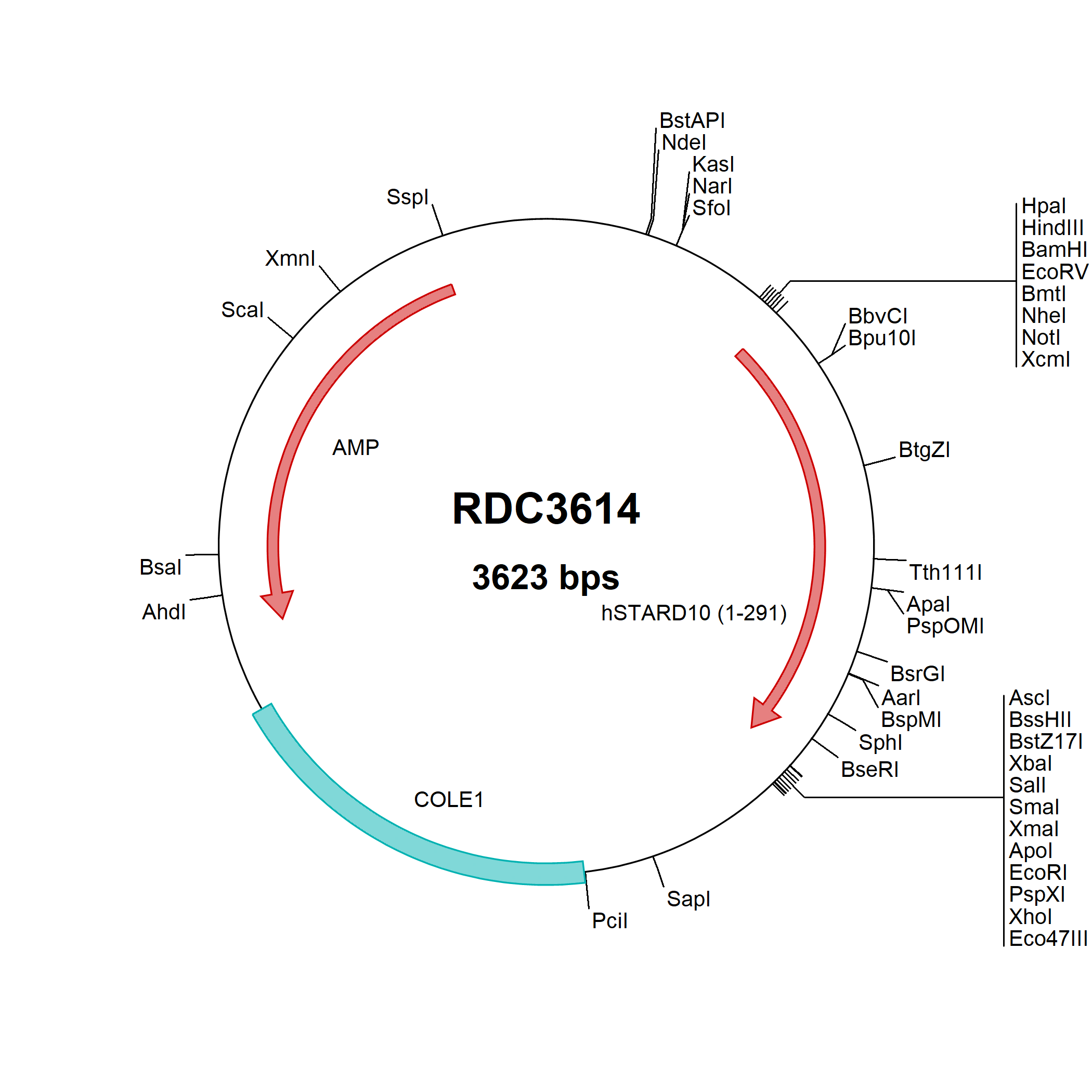
Loading...
Loading...
Formulation, Preparation, and Storage
Shipping
The product is shipped at ambient temperature. Upon receipt, store it immediately at the temperature recommended below.
Storage
Store the unopened product at -20 to -70 °C. Use a manual defrost freezer and avoid repeated freeze-thaw cycles. Do not use past expiration date.
Background: STARD10
STARD10 is broadly expressed in different organs and tissues such as the brain, endocrine tissues, liver, and gastrointestinal tract. STARD10 is regulated by Casein kinase II, which phosphorylates STARD10 at serine 284 leading to decreased lipid transfer activity and reduced membrane association. STARD10 is overexpressed in breast carcinoma cell lines and in primary breast cancers (3). STARD10 has been implicated in the regulation of bile acid homeostasis and more recently in the regulation of insulin secretion from beta-cells (1, 2, 4).
References
1. Alpy, F., & Tomasetto, C. (2005). Give lipids a START: The StAR-related lipid transfer (START) domain in mammals. Journal of Cell Science. https://doi.org/10.1242/jcs.02485
2. Alpy, F., Legueux, F., Tomasetto, C., & Bianchetti, L. (2009). START domain-containing proteins: A review of their role in lipid transport and exchange. Medecine/Sciences. https://doi.org/10.1051/medsci/2009252181
3. Olayioye, M. A., Hoffmann, P., Pomorski, T., Armes, J., Simpson, R. J., Kemp, B. E.,... Visvader, J. E. (2004). The phosphoprotein StarD10 is overexpressed in breast cancer and cooperates with ErbB receptors in cellular transformation. Cancer Research. https://doi.org/10.1158/0008-5472.CAN-03-3731
4. Carrat, G. R., Hu, M., Nguyen-Tu, M. S., Chabosseau, P., Gaulton, K. J., van de Bunt, M.,... Rutter, G. A. (2017). Decreased STARD10 Expression Is Associated with Defective Insulin Secretion in Humans and Mice. American Journal of Human Genetics. https://doi.org/10.1016/j.ajhg.2017.01.011
Long Name
StAR Related Lipid Transfer Domain Containing 10
Alternate Names
CGI-52, NY-CO-28, PCTP-L, PCTP2, SDCCAG28
Entrez Gene IDs
10809 (Human)
Gene Symbol
STARD10
UniProt
Additional STARD10 Products
Product Documents for Human STARD10 (NP_006636.2) VersaClone cDNA
Certificate of Analysis
To download a Certificate of Analysis, please enter a lot or batch number in the search box below.
Note: Certificate of Analysis not available for kit components.
Product Specific Notices for Human STARD10 (NP_006636.2) VersaClone cDNA
For research use only
Customer Reviews for Human STARD10 (NP_006636.2) VersaClone cDNA
There are currently no reviews for this product. Be the first to review Human STARD10 (NP_006636.2) VersaClone cDNA and earn rewards!
Have you used Human STARD10 (NP_006636.2) VersaClone cDNA?
Submit a review and receive an Amazon gift card!
$25/€18/£15/$25CAN/¥2500 for a review with an image
$10/€7/£6/$10CAN/¥1110 for a review without an image
Submit a review
Loading...