
New Luminex® Analytes for Cell Therapy Protein Secretion

Accelerate Cell Therapy Research with Multiplex Protein Profiling
Cell therapies are set to become the new standard of healthcare, but they must meet complex and stringent regulatory requirements and be thoroughly characterized in vitro before infusion into the patient.
With the addition of 17 new analytes to the R&D Systems™ Human Luminex® Discovery Assay—including CD21/CR2, CRHBP, and Intelectin-1/Omentin-1—three targets not offered elsewhere, you will gain even greater flexibility to design multiplex panels that deliver deeper insight by measuring multiple pathways at once.
Complex Diseases Require Multiplex Answers
The addition of these analytes means cell therapy potency and functionality can be investigated on the scale of entire secretion profiles since these analytes can be plexed with the other ~350 analytes in the menu, enabling you to evaluate related biomarkers together for biologically meaningful insights.
When your research demands complete flexibility, exclusive targets, and trusted assay performance, the Human Luminex Discovery Assay gives you the freedom to build the exact multiplex panel you need—without sacrificing specificity or sample.
Expanded Targets for Comprehensive Cell Therapy Profiling
| Amphiregulin | CD21/CR2 | Clusterin/APOJ | COMP/Thrombospondin-5 |
| CRHBP | FGF-21 | Granulysin | IL-9 |
| IL-20 | IL-22 | Intelectin-1/Omentin-1 | Nectin-2/CD112 |
| PD-L2/B7-DC/CD273 | Perforin | TIMP-2 | TIMP-3 |
| TIMP-4 |
Competitor Comparison of Sensitivity and Sample Linearity Performance
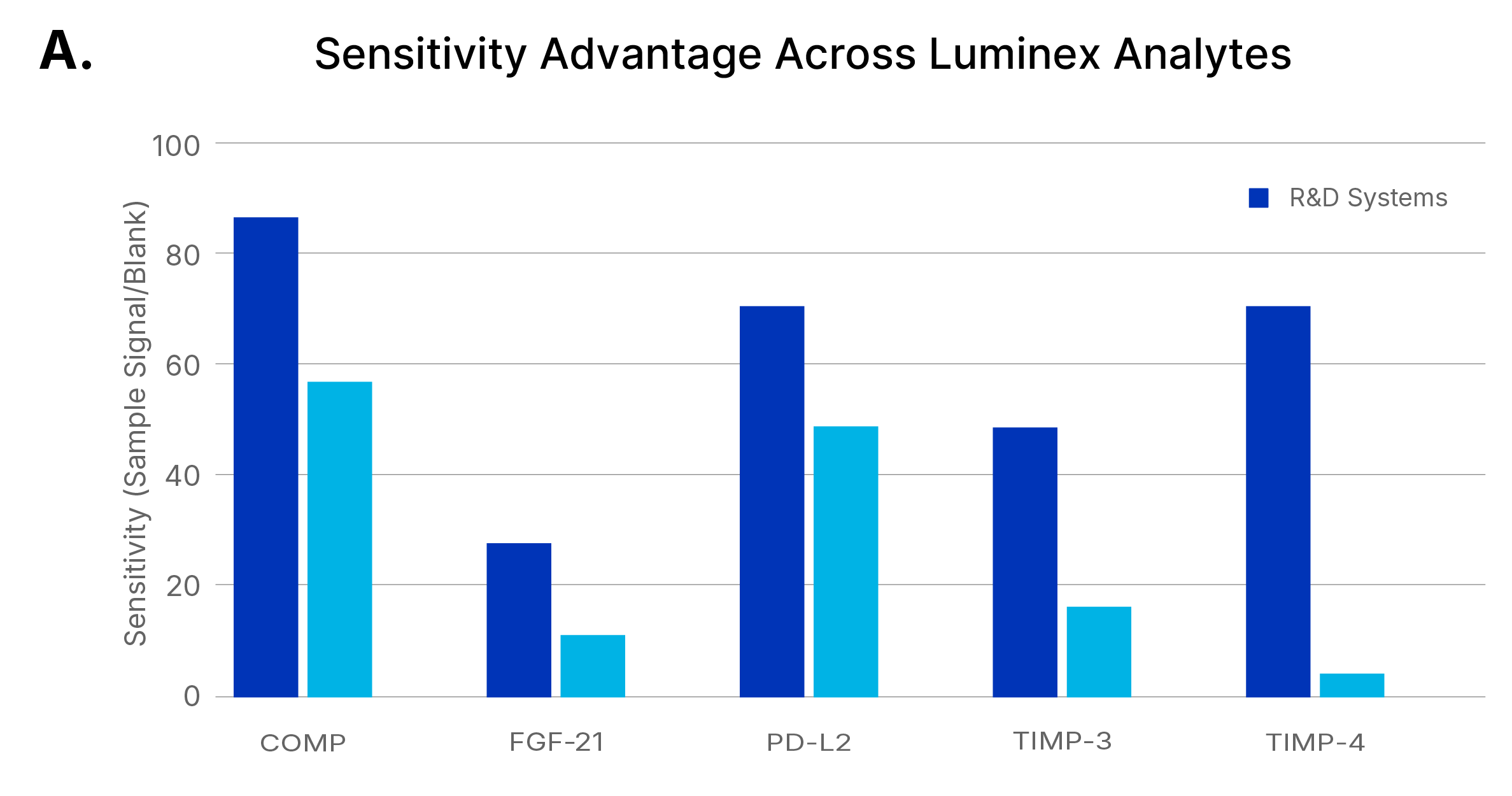
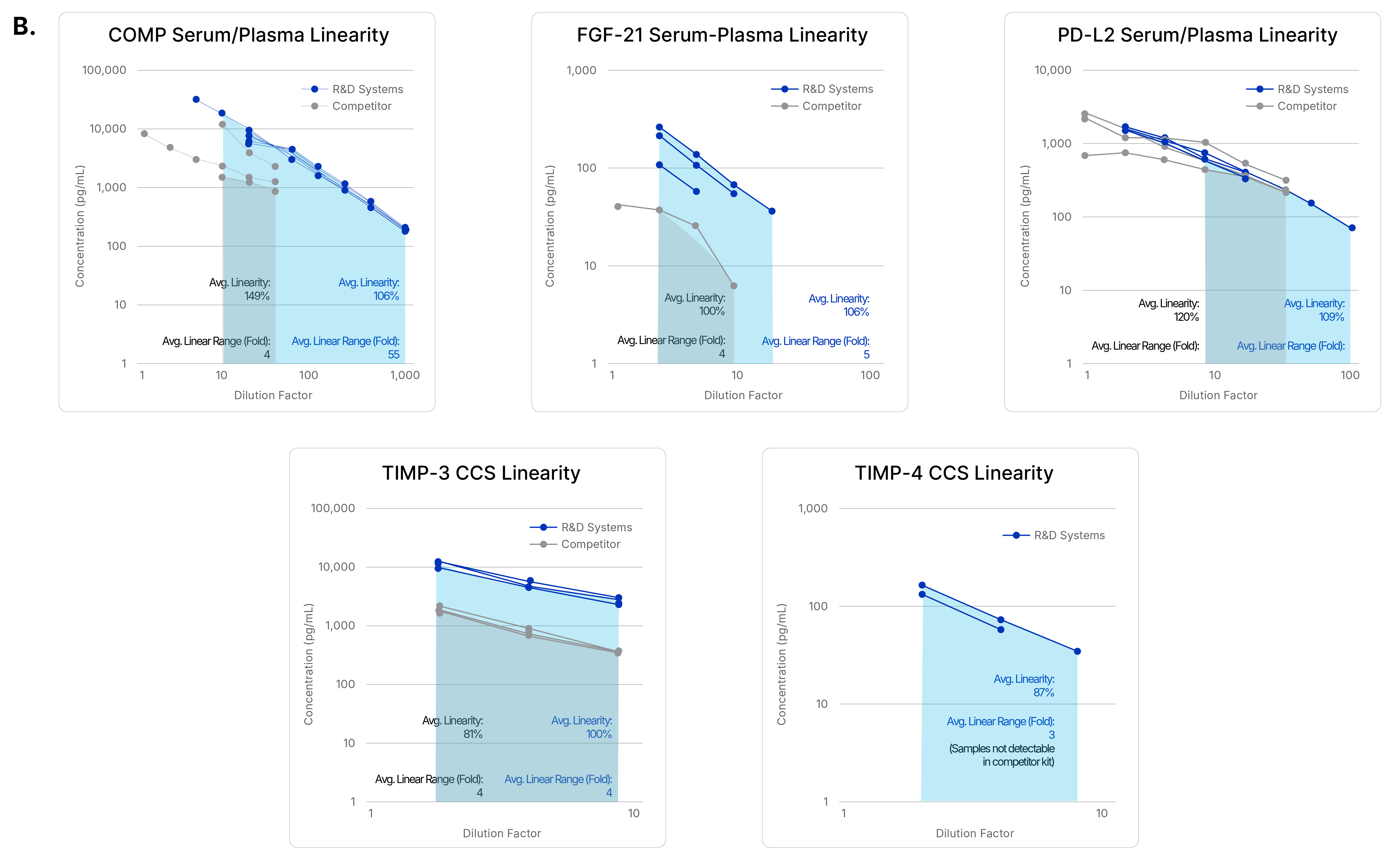
Sensitivity and Sample Linearity Performance of Newly Released Luminex Analytes Compared to Competitor Luminex Assays.
A. (left) Sensitivity enhancement of five analytes, measured by the signal-to-blank ratio for low-level samples, demonstrates superior detection capability over the competitor assays.
B. (below) Improved natural sample dilution linearity and/or extended linear sample range are highlighted for R&D Systems assays (blue) over competitors (gray). The initial and final dilution points defining the linear range (shaded regions) were established based on dilutions yielding signals within an 80–120% linearity range relative to the initial dilution. In cases where sample responses did not fall within this range, the linear range endpoints extend beyond these criteria as appropriate.
Resources
Building a Better Cell Therapy Potency Assay
Reliable potency assessment is essential for CAR-T and CAR-NK therapies, yet most current assays measure only IFN-γ, offering a limited view of engineered cell function. This application note presents a high-throughput workflow that combines R&D Systems™ Luminex Multiplex Assays with Simple Plex™ Immunoassays on the Ella™ platform to profile cytokines, chemokines, and effector proteins during antigen-specific killing.
Luminex Assay User Guide
This guide will help you ensure performance and consistency every time with best practices for sample preparation and data analysis, in addition to multiple techniques, tips, and troubleshooting.
Multiplex Immunoassays in Early Cancer Detection
Multiplexing provides a more comprehensive view of tumor biology than single-analyte approaches can offer. But realizing this potential demands assays that deliver more than high throughput. They must achieve ultra-high sensitivity, reproducibility, and low cross-reactivity, while performing reliably in complex matrices such as serum or plasma.