
Human Moesin - Ready-To-Use ELISA Kit (Colorimetric)
Novus Biologicals | Catalog # NBP3-39494

Key Product Details
Sample Type & Volume Required Per Well
Sensitivity
Assay Range
Product Specifications
Assay Type
Kit Type
Species
Description
Assay Length: 3 hours
Precision
Intra-Assay Precision (Precision within an assay) %CV < 10 (example only; lot dependent)
Inter-Assay Precision (Precision between assays) %CV < 12 (example only; lot dependent)
Scientific Data Images for Human Moesin - Ready-To-Use ELISA Kit (Colorimetric)
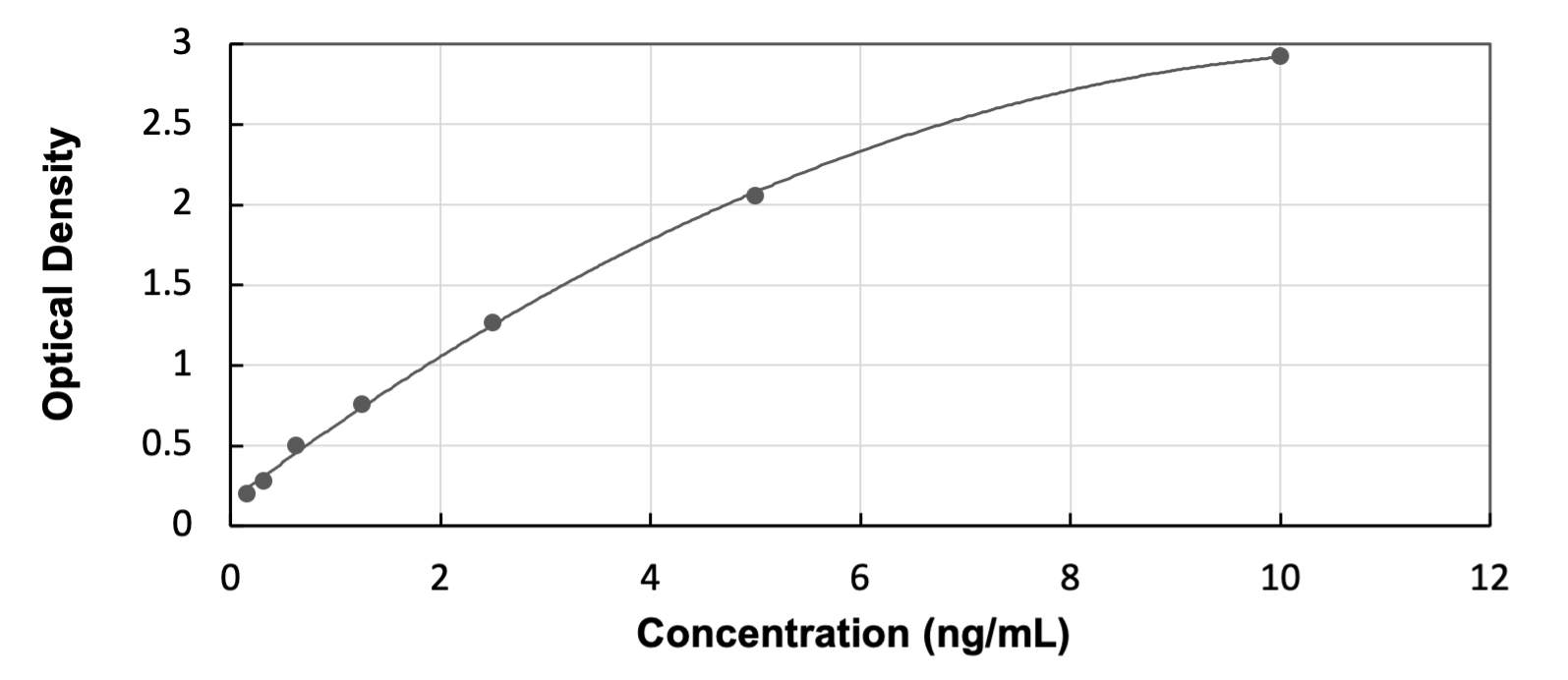
ELISA: Human Moesin - Ready-To-Use ELISA Kit (Colorimetric) [NBP3-39494]
ELISA: Human Moesin - Ready-To-Use ELISA Kit (Colorimetric) [NBP3-39494] - Standard Curve ReferenceKit Contents for Human Moesin - Ready-To-Use ELISA Kit (Colorimetric)
- Detection Solution A
- Detection Solution B
- Instruction manual
- Plate sealer for 96 wells
- Pre-coated 96T strip plate
- Standard
- Standard Diluent
- Stop Solution
- TMB Substrate
- Wash Buffer (30 x concentrate)
Preparation and Storage
Shipping
Stability & Storage
Background: Moesin
Alternate Names
Gene Symbol
Additional Moesin Products
Product Documents for Human Moesin - Ready-To-Use ELISA Kit (Colorimetric)
Certificate of Analysis
To download a Certificate of Analysis, please enter a lot or batch number in the search box below.
Product Specific Notices for Human Moesin - Ready-To-Use ELISA Kit (Colorimetric)
This product is for research use only and is not approved for use in humans or in clinical diagnosis. ELISA Kits are guaranteed for 6 months from date of receipt.
Customer Reviews for Human Moesin - Ready-To-Use ELISA Kit (Colorimetric)
There are currently no reviews for this product. Be the first to review Human Moesin - Ready-To-Use ELISA Kit (Colorimetric) and earn rewards!
Have you used Human Moesin - Ready-To-Use ELISA Kit (Colorimetric)?
Submit a review and receive an Amazon gift card!
$25/€18/£15/$25CAN/¥2500 for a review with an image
$10/€7/£6/$10CAN/¥1110 for a review without an image
Submit a review
Protocols
Find general support by application which include: protocols, troubleshooting, illustrated assays, videos and webinars.
- ELISA Sample Preparation & Collection Guide
- ELISA Troubleshooting Guide
- How to Run an R&D Systems DuoSet ELISA
- How to Run an R&D Systems Quantikine ELISA
- How to Run an R&D Systems Quantikine™ QuicKit™ ELISA
- Quantikine HS ELISA Kit Assay Principle, Alkaline Phosphatase
- Quantikine HS ELISA Kit Principle, Streptavidin-HRP Polymer
- Sandwich ELISA (Colorimetric) – Biotin/Streptavidin Detection Protocol
- Sandwich ELISA (Colorimetric) – Direct Detection Protocol
- Troubleshooting Guide: ELISA
- View all Protocols, Troubleshooting, Illustrated assays and Webinars
FAQs for Human Moesin - Ready-To-Use ELISA Kit (Colorimetric)
-
Q: I am looking to use shRNA to inhibit Moesin expression. I have had people advise me that my initial MOI should be low as 'less is more' and 'a little goes a long way' in terms of siRNA. I was wondering if you could elaborate on this for me and explain why my initial MOI should be low.
A: The reason for a low MOI is most likely because RNAi is a very strong and efficient technique. Wikipedia does a good job of explaining RNA interference. However, I would imagine that in a cell, there will be at most 1-2 copies of the gene mRNA present at any given time, unless you're dealing with a highly expressed protein such as Actin, where I would imagine silencing Actin would be lethal to the cell. I can imagine a few reasons to not use too much siRNA. First, it is expensive, so you don't want to waste it. Second, using too much would cause there to be a lot of non-translatable RNA present in the cell, which could trigger an immune response, as the presence of uncapped RNAs can indicate presence of a virus and one of the TLRs may respond to this.