

Discontinued Product
MAB27881 has been discontinued.
View all CD300f/LMIR3 products.
Key Product Details
Species Reactivity
Validated:
Mouse
Cited:
Mouse, Transgenic Mouse
Applications
Validated:
Western Blot, Flow Cytometry, CyTOF-ready
Cited:
Immunohistochemistry, Flow Cytometry, Immunocytochemistry
Label
Unconjugated
Antibody Source
Monoclonal Rat IgG1 Clone # 305835
Loading...
Product Specifications
Immunogen
Mouse myeloma cell line NS0-derived recombinant mouse CD300f/LMIR3
Cys16-Gly188
Accession # Q6SJQ7
Cys16-Gly188
Accession # Q6SJQ7
Specificity
Detects mouse CD300f/LMIR3 in direct ELISAs and Western blots. In direct ELISAs, no cross-reactivity with recombinant mouse (rm) LMIR4, rmCD300b/LMIR5, recombinant human (rh) CD300a/LMIR1, rhCD300c/LMIR2, rhCD300f/LMIR3, or rhCD300e/LMIR6 is observed.
Clonality
Monoclonal
Host
Rat
Isotype
IgG1
Scientific Data Images for Mouse CD300f/LMIR3 Antibody
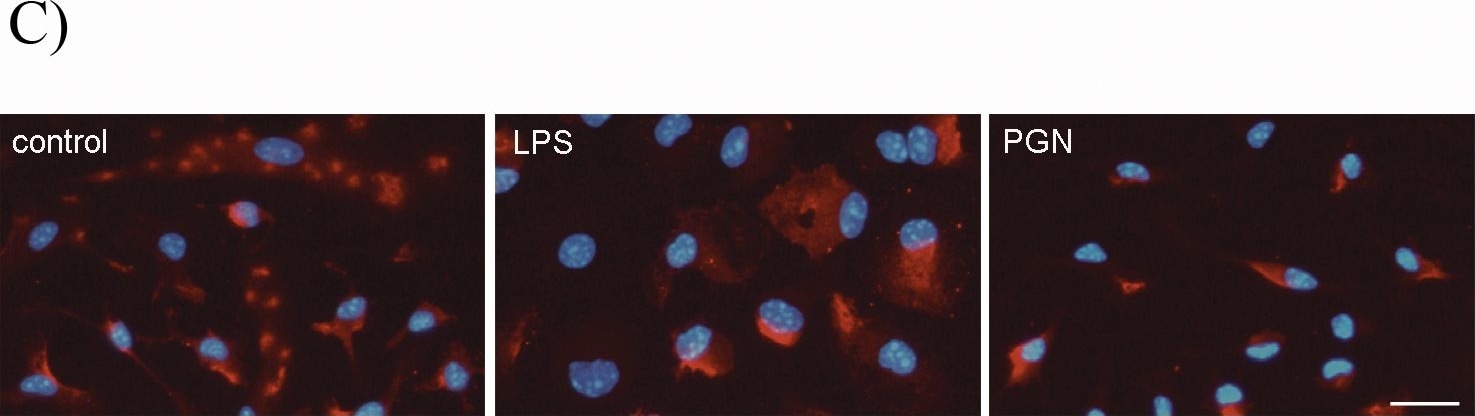
Detection of Monkey CD300f/LMIR3 by Immunocytochemistry/Immunofluorescence
CLM-1 receptor expression levels are modified during microglial activation by TLRs agonists.A) Microglia was treated with LPS (100 ng/mL) at different time points (left) and with TLRs agonists LPS (TLR4 agonist, 100 ng/mL), PGN (TLR2/6 heterodimeragonist, 1 μg/mL) and poly I:C (TLR3 agonist, 10 μg/mL) for 24 hours (right). CLM-1 mRNA levels were quantified by QT-PCR. B) Surface expression of CLM-1 in microglial cells was monitored by flow cytometry 24 and 48 hours after treatment with LPS (100 ng/mL) or PGN (1μg/mL). Isotypic antibody (grey histograms), anti-CLM1 (white histograms). C) Immunostaining with an antibody for CLM-1 of microglia 24 hours after treatment with LPS (100 ng/mL) or PGN (1 μg/mL). Bar, 20 μM. Data are presented as mean ± SEM of 3 independent experiments. Statistically significant differences between treatments were determined by a one-way Anova followed by Newman Keules post-test. *P < 0.05 compared to IgG. Image collected and cropped by CiteAb from the following publication (https://pubmed.ncbi.nlm.nih.gov/25927603), licensed under a CC-BY license. Not internally tested by R&D Systems.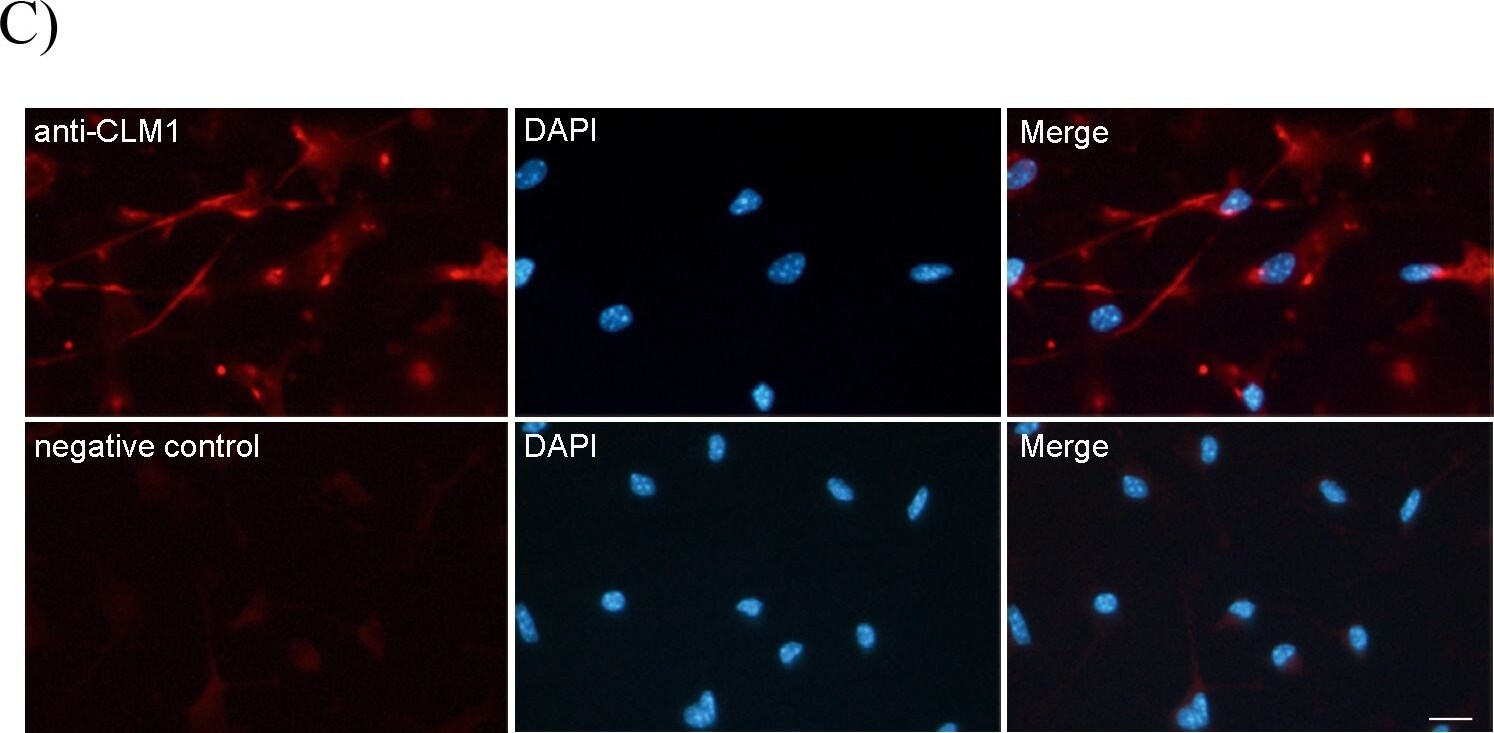
Detection of Monkey CD300f/LMIR3 by Immunocytochemistry/Immunofluorescence
CLM-1 mRNA and protein levels in microglial cells under basal conditions.A) QT-PCR analysis of CLM-1 transcript was performed on primary microglia total RNA. RAW264.7 and NIH3T3 cell lines were used as positive and negative controls respectively. CLM-1 transcript was normalized with 18S RNA levels. B) Surface expression of CLM-1 on primary microglia was monitored by flow cytometry using anti-CLM-1 mAb (white histogram) and an isotypic mAb as a negative control (gray histrogram). C) Immunohistochemistry on microglial primary cultures was performed to analyze the expression of CLM-1 in basal conditions, using an anti-CLM-1 monoclonal antibody. Nuclei were stained with DAPI. No staining was observed in the absence of primary antibody. Scale bar, 20 μM. Image collected and cropped by CiteAb from the following publication (https://pubmed.ncbi.nlm.nih.gov/25927603), licensed under a CC-BY license. Not internally tested by R&D Systems.Applications for Mouse CD300f/LMIR3 Antibody
Application
Recommended Usage
CyTOF-ready
Ready to be labeled using established conjugation methods. No BSA or other carrier proteins that could interfere with conjugation.
Flow Cytometry
0.25 µg/106 cells
Sample: RAW 264.7 mouse monocyte/macrophage cell line
Sample: RAW 264.7 mouse monocyte/macrophage cell line
Western Blot
1 µg/mL
Sample: Recombinant Mouse CD300f/LMIR3
Sample: Recombinant Mouse CD300f/LMIR3
Reviewed Applications
Read 1 review rated 4 using MAB27881 in the following applications:
Flow Cytometry Panel Builder
Bio-Techne Knows Flow Cytometry
Save time and reduce costly mistakes by quickly finding compatible reagents using the Panel Builder Tool.
Advanced Features
- Spectra Viewer - Custom analysis of spectra from multiple fluorochromes
- Spillover Popups - Visualize the spectra of individual fluorochromes
- Antigen Density Selector - Match fluorochrome brightness with antigen density

Formulation, Preparation, and Storage
Purification
Protein A or G purified from hybridoma culture supernatant
Reconstitution
Reconstitute at 0.5 mg/mL in sterile PBS. For liquid material, refer to CoA for concentration.
Formulation
Lyophilized from a 0.2 μm filtered solution in PBS with Trehalose. *Small pack size (SP) is supplied either lyophilized or as a 0.2 µm filtered solution in PBS.
Shipping
Lyophilized product is shipped at ambient temperature. Liquid small pack size (-SP) is shipped with polar packs. Upon receipt, store immediately at the temperature recommended below.
Stability & Storage
Use a manual defrost freezer and avoid repeated freeze-thaw cycles.
- 12 months from date of receipt, -20 to -70 °C as supplied.
- 1 month, 2 to 8 °C under sterile conditions after reconstitution.
- 6 months, -20 to -70 °C under sterile conditions after reconstitution.
Calculators
Background: CD300f/LMIR3
Long Name
Leukocyte Mono Ig-like Receptor 3
Alternate Names
CD300f, CD300LF, CLIM1, CLM1, DIgR2, IGSF13, IREM-1, LMIR3, NKIR, Pigr3
Gene Symbol
CD300LF
UniProt
Additional CD300f/LMIR3 Products
Product Documents for Mouse CD300f/LMIR3 Antibody
Certificate of Analysis
To download a Certificate of Analysis, please enter a lot or batch number in the search box below.
Note: Certificate of Analysis not available for kit components.
Product Specific Notices for Mouse CD300f/LMIR3 Antibody
For research use only
Citations for Mouse CD300f/LMIR3 Antibody
 Powered by Bioz
Customer Reviews for Mouse CD300f/LMIR3 Antibody (1)
4 out of 5
1 Customer Rating
Have you used Mouse CD300f/LMIR3 Antibody?
Submit a review and receive an Amazon gift card!
$25/€18/£15/$25CAN/¥2500 Yen for a review with an image
$10/€7/£6/$10CAN/¥1110 Yen for a review without an image
Submit a review
Showing
1
-
1 of
1 review
Showing All
Filter By:
-
Application: Immunohistochemistry-FrozenSample Tested: See PMID 21951326Species: RatVerified Customer | Posted 02/19/2015
There are no reviews that match your criteria.
Protocols
Find general support by application which include: protocols, troubleshooting, illustrated assays, videos and webinars.
- 7-Amino Actinomycin D (7-AAD) Cell Viability Flow Cytometry Protocol
- Cellular Response to Hypoxia Protocols
- Extracellular Membrane Flow Cytometry Protocol
- Flow Cytometry Protocol for Cell Surface Markers
- Flow Cytometry Protocol for Staining Membrane Associated Proteins
- Flow Cytometry Staining Protocols
- Flow Cytometry Troubleshooting Guide
- Intracellular Flow Cytometry Protocol Using Alcohol (Methanol)
- Intracellular Flow Cytometry Protocol Using Detergents
- Intracellular Nuclear Staining Flow Cytometry Protocol Using Detergents
- Intracellular Staining Flow Cytometry Protocol Using Alcohol Permeabilization
- Intracellular Staining Flow Cytometry Protocol Using Detergents to Permeabilize Cells
- Propidium Iodide Cell Viability Flow Cytometry Protocol
- Protocol for Liperfluo
- Protocol for the Characterization of Human Th22 Cells
- Protocol for the Characterization of Human Th9 Cells
- Protocol: Annexin V and PI Staining by Flow Cytometry
- Protocol: Annexin V and PI Staining for Apoptosis by Flow Cytometry
- R&D Systems Quality Control Western Blot Protocol
- Troubleshooting Guide: Fluorokine Flow Cytometry Kits
- Troubleshooting Guide: Western Blot Figures
- Western Blot Conditions
- Western Blot Protocol
- Western Blot Protocol for Cell Lysates
- Western Blot Troubleshooting
- Western Blot Troubleshooting Guide
- View all Protocols, Troubleshooting, Illustrated assays and Webinars
Loading...