
Betacellulin (BTC) is a new member of the EGF family of cytokines that is comprised of at least ten proteins including EGF, TGF-alpha, amphiregulin, HB-EGF, and the various heregulins. All of these cytokines are synthesized as transmembrane precursors and are characterized by the presence of one or more EGF structural units in their extracellular domain. The soluble forms of these cytokines are released by proteolytic cleavage. BTC, a heparin-binding protein, was originally isolated from the conditioned media of mouse pancreatic beta tumor cells as a 32 kDa glycoprotein composed of 80 amino acid residues. The cDNA encoding human BTC was cloned from a human breast adenocarcinoma cell line (MCF-7) cDNA library. Human and mouse cDNAs encode BTC precursor proteins of 178 and 177 amino acid residues, respectively. At the amino acid sequence level, human BTC precursor protein exhibits 79% identity with that of the mouse BTC precursor. In a mouse cell line transfected with human BTC cDNA, three forms of soluble human BTC have been detected: the glycosylated, intact BTC composed of 80 amino acid residues, a truncated molecule lacking 12 amino acid residues from the amino terminus, and a second truncated molecule lacking 30 amino acid residues from the amino terminus. The biological activities of these BTC forms were shown to be identical. BTC can bind to the EGF receptor and is a potent mitogen for Balb/c 3T3 fibroblasts, retinal pigment epithelial cells and vascular smooth muscle cells.
Recombinant Human Betacellulin Protein
R&D Systems | Catalog # 261-CE

Key Product Details
- R&D Systems E. coli-derived Recombinant Human Betacellulin Protein (261-CE)
- Quality control testing to verify active proteins with lot specific assays by in-house scientists
- All R&D Systems proteins are covered with a 100% guarantee
Source
Accession Number
Applications
Product Specifications
Source
Asp32-Gln118
Purity
Endotoxin Level
N-terminal Sequence Analysis
Predicted Molecular Mass
SDS-PAGE
Activity
The ED50 for this effect is 0.15-0.6 ng/mL.
Scientific Data Images for Recombinant Human Betacellulin Protein
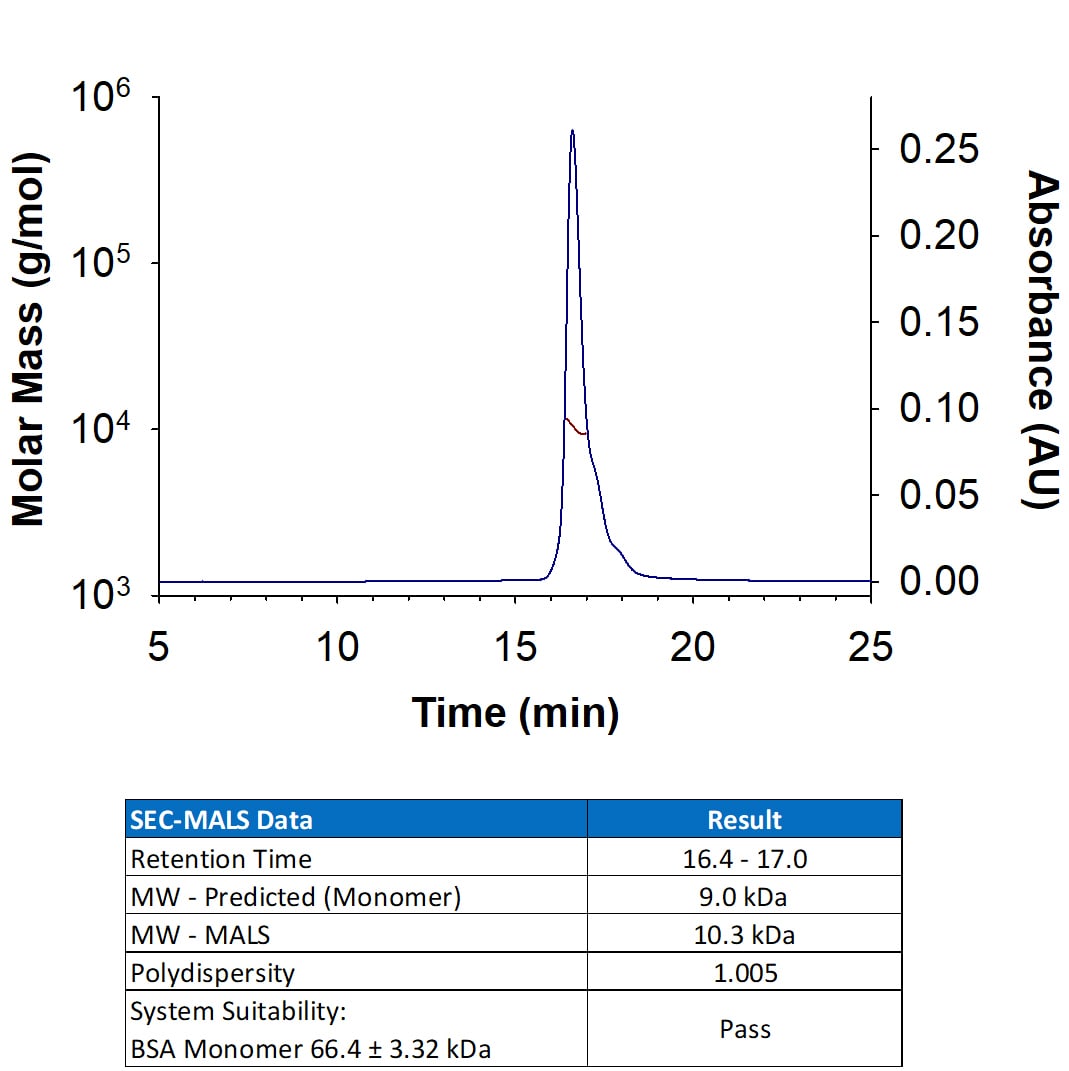
Recombinant Human Betacellulin/BTC Protein SEC-MALS.
Recombinant Human Betacellulin (Catalog # 261-CE) has a molecular weight (MW) of 10.3 kDa as analyzed by SEC-MALS, suggesting that this protein is a monomer.Formulation, Preparation, and Storage
Carrier Free
What does CF mean?CF stands for Carrier Free (CF). We typically add Bovine Serum Albumin (BSA) as a carrier protein to our recombinant proteins. Adding a carrier protein enhances protein stability, increases shelf-life, and allows the recombinant protein to be stored at a more dilute concentration. The carrier free version does not contain BSA.
What formulation is right for me?In general, we advise purchasing the recombinant protein with BSA for use in cell or tissue culture, or as an ELISA standard. In contrast, the carrier free protein is recommended for applications, in which the presence of BSA could interfere.
Carrier: 261-CE
| Formulation | Lyophilized from a 0.2 μm filtered solution in PBS with BSA as a carrier protein. |
| Reconstitution | Reconstitute at 0.1-1 mg/mL in sterile PBS. |
| Shipping | The product is shipped at ambient temperature. Upon receipt, store it immediately at the temperature recommended below. |
| Stability & Storage | Use a manual defrost freezer and avoid repeated freeze-thaw cycles.
|
Carrier Free: 261-CE/CF
| Formulation | Lyophilized from a 0.2 μm filtered solution in PBS. |
| Reconstitution | Reconstitute at 0.1-1 mg/mL in sterile PBS. |
| Shipping | The product is shipped at ambient temperature. Upon receipt, store it immediately at the temperature recommended below. |
| Stability & Storage | Use a manual defrost freezer and avoid repeated freeze-thaw cycles.
|
Calculators
Background: Betacellulin/BTC
Additional Betacellulin/BTC Products
Product Documents for Recombinant Human Betacellulin Protein
Certificate of Analysis
To download a Certificate of Analysis, please enter a lot or batch number in the search box below.
Note: Certificate of Analysis not available for kit components.
Product Specific Notices for Recombinant Human Betacellulin Protein
For research use only
Related Research Areas
Citations for Recombinant Human Betacellulin Protein
 Powered by Bioz
Customer Reviews for Recombinant Human Betacellulin Protein
There are currently no reviews for this product. Be the first to review Recombinant Human Betacellulin Protein and earn rewards!
Have you used Recombinant Human Betacellulin Protein?
Submit a review and receive an Amazon gift card!
$25/€18/£15/$25CAN/¥2500 for a review with an image
$10/€7/£6/$10CAN/¥1110 for a review without an image
Submit a review