
CXADR (coxsackie and adenovirus receptor), also known as CAR, is a 46 kDa type I transmembrane glycoprotein that belongs to the CTX family of the Ig superfamily (1 - 3). CXADR has received attention as a receptor that facilitates gene transfer mediated by most adenoviruses (1, 2). It is also an adhesion molecule within junctional complexes, notably between epithelial cells lining body cavities and within myocardial intercalated discs (1, 2, 4). CXADR is essential for normal cardiac development in the mouse (7). It is expressed throughout brain neuroepithelium during development, but mainly in ependymal cells in the adult (4 - 6). The 365 amino acid (aa) human CXADR contains a 19 aa signal sequence, a 218 aa extracellular domain (ECD) with a V-type (D1) and a C2-type (D2) Ig-like domain, a 21 aa transmembrane segment and a 107 aa intracellular domain. D1 is thought to be responsible for homodimer formation in trans within tight junctions (2). The fiber knob of adenoviruses attaches at a similar site, and evidence suggests that disruption of tight junctions facilitates virus binding (1, 2). The C-terminus interacts with several cytoplasmic junctional proteins, microtubules and the actin cytoskeleton (1, 8, 9). CXADR interaction with junctional adhesion molecule-like protein (JAML) has been shown to have important functional roles in immunity, inflammation, and tissue homeostatsis (10).The ECD of human CXADR shares 90% aa sequence identity with mouse, rat, and porcine CXADR, and 92% and 89% aa identity with bovine and canine CXADR, respectively. An alternately spliced isoform (CXADR2) that diverges in the C-terminal 15 aa shows a similar expression pattern (4, 11). Transcription of splice variants that produce soluble forms of CXADR has been detected, and secreted forms in serum and pleural fluid potentially block viral infection (12).
Recombinant Human CXADR Fc Chimera Protein, CF
R&D Systems | Catalog # 3336-CX


Loading...
Key Product Details
- R&D Systems NS0-derived Recombinant Human CXADR Fc Chimera Protein (3336-CX)
- Quality control testing to verify active proteins with lot specific assays by in-house scientists
- All R&D Systems proteins are covered with a 100% guarantee
Source
NS0
Accession Number
Structure / Form
Disulfide-linked homodimer
Applications
Bioactivity
Loading...
Product Specifications
Source
Mouse myeloma cell line, NS0-derived human CXADR protein
| Human CXADR (Leu20 - Gly237) Accession # P78310 |
IEGRMD | Human IgG1 (Pro100 - Lys330) |
| N-terminus | C-terminus |
Purity
>95%, by SDS-PAGE under reducing conditions and visualized by silver stain.
Endotoxin Level
<0.10 EU per 1 μg of the protein by the LAL method.
N-terminal Sequence Analysis
Leu20
Predicted Molecular Mass
50.6 kDa (monomer)
SDS-PAGE
60-65 kDa, reducing conditions
Activity
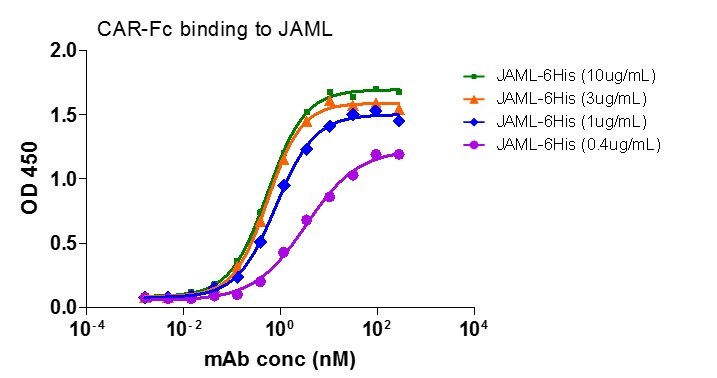
Measured by its binding ability in a functional ELISA.
Recombinant Human CXADR Fc Chimera (Catalog # 3336-CX) binds Recombinant Human AMICA/JAML Fc Chimera (Catalog # 3449-AM) with an ED50 of 2.50-25.0 ng/mL.
Recombinant Human CXADR Fc Chimera (Catalog # 3336-CX) binds Recombinant Human AMICA/JAML Fc Chimera (Catalog # 3449-AM) with an ED50 of 2.50-25.0 ng/mL.
Reviewed Applications
Read 3 reviews rated 5 using 3336-CX in the following applications:
Formulation, Preparation, and Storage
3336-CX
| Formulation | Lyophilized from a 0.2 μm filtered solution in PBS. |
| Reconstitution | Reconstitute at 100 μg/mL in sterile PBS.
Loading...
|
| Shipping | The product is shipped at ambient temperature. Upon receipt, store it immediately at the temperature recommended below. |
| Stability & Storage | Use a manual defrost freezer and avoid repeated freeze-thaw cycles.
|
Calculators
Background: CXADR
References
- Coyne, C.B. and J.M. Bergelson (2005) Adv. Drug Deliv. Rev. 57:869.
- Philipson, L. and R.F. Pettersson (2004) Curr. Top. Microbiol. Immunol. 273:87.
- Tomko, R.P. et al. (1997) Proc. Natl. Acad. Sci. USA 94:3352.
- Raschperger, E. et al. (2006) Exp. Cell Res. 312:1566.
- Hotta, Y. et al. Dev. Brain Res. 143:1.
- Hauwel, M. et al. (2005) Brain Res. Rev. 48:265.
- Chen, J. et al. (2006) Circ. Res. 98:923.
- Fok, P.T. et al. (2007) J. Biol. Chem. 282:7512.
- Huang, K-C. et al. (2007) FEBS Lett. 581:2702.
- Verdino, P. et al. Science (2010) Science 329:1210.
- Mirza, M. et al. (2006) Exp. Cell Res. 312:817.
- Bernal, R.M. et al. (2002) Clin. Cancer Res. 8:1915.
Long Name
Coxsackie and Adenovirus Receptor
Alternate Names
CVB3 BP
Gene Symbol
CXADR
UniProt
Additional CXADR Products
Product Documents for Recombinant Human CXADR Fc Chimera Protein, CF
Certificate of Analysis
To download a Certificate of Analysis, please enter a lot or batch number in the search box below.
Note: Certificate of Analysis not available for kit components.
Product Specific Notices for Recombinant Human CXADR Fc Chimera Protein, CF
For research use only
Related Research Areas
Citations for Recombinant Human CXADR Fc Chimera Protein, CF
 Powered by Bioz
Customer Reviews for Recombinant Human CXADR Fc Chimera Protein, CF (3)
5 out of 5
3 Customer Ratings
Have you used Recombinant Human CXADR Fc Chimera Protein, CF?
Submit a review and receive an Amazon gift card!
$25/€18/£15/$25CAN/¥2500 for a review with an image
$10/€7/£6/$10CAN/¥1110 for a review without an image
Submit a review
Customer Images
Showing
1
-
3 of
3 reviews
Showing All
Filter By:
-
Application: Binding assay/Protein-protein interactionVerified Customer | Posted 03/10/2021
-
Application: Cell AdhesionVerified Customer | Posted 11/16/2020
-
Application: Binding ELISAVerified Customer | Posted 12/13/2019

There are no reviews that match your criteria.
Loading...