
Recombinant Human Enolase 2 His-tag Protein, CF
R&D Systems | Catalog # 10412-EN

Key Product Details
- R&D Systems E. coli-derived Recombinant Human Enolase 2 His-tag Protein (10412-EN)
- Quality control testing to verify active proteins with lot specific assays by in-house scientists
- All R&D Systems proteins are covered with a 100% guarantee
Source
Accession Number
Applications
Product Specifications
Source
Met1-Leu434
with an N-terminal Met and 6-His tag
Purity
Endotoxin Level
N-terminal Sequence Analysis
Predicted Molecular Mass
SDS-PAGE
Activity
The specific activity is >6,000 pmol/min/μg, as measured under the described conditions.
Scientific Data Images for Recombinant Human Enolase 2 His-tag Protein, CF
Recombinant Human Enolase 2 His-tag Protein Binding Activity
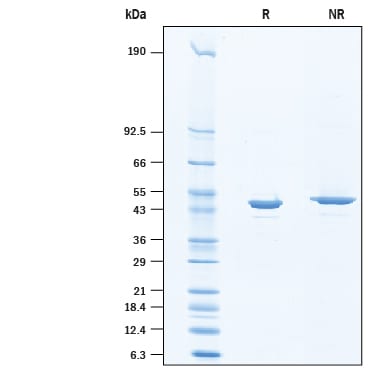
2 μg/lane of Recombinant Human Enolase 2/Neuron-specific Enolase His-tag (Catalog # 10412-EN) was resolved with SDS-PAGE under reducing (R) and non-reducing (NR) conditions and visualized by Coomassie® Blue staining, showing a band at 46 kDa under reducing conditions.Formulation, Preparation, and Storage
10412-EN
| Formulation | Supplied as a 0.2 μm filtered solution in MES, NaCl, KCl and MgSO4. |
| Shipping | The product is shipped with polar packs. Upon receipt, store it immediately at the temperature recommended below. |
| Stability & Storage | Use a manual defrost freezer and avoid repeated freeze-thaw cycles.
|
Background: Enolase 2/Neuron-specific Enolase
References
- Marangos, P.J. and D.E. Schmechel, (1987) Annu. Rev. Neurosci. 10:269.
- Huang, L. et al. (2017) Oncotarget 38:64358.
- Muoio, B. et al. (2018) Int. J. Markers 33:10.
- Yang, H. et al. (2014) PLoS One. 9:e94304.
- Cheng, F. et al. (2014) PLoS One 9:e106680.
- Haque, A. et al. (2016) Metab. Brain Dis. 31:487.
- Anand, N. et al. (2005) Cerebrovasc. Dis. 20:213.
- Mercier, E. et al. (2018) Brain Inj. 32:29.
- Isgro, M.A. et al. (2015) Adv. Exp. Med. Biol. 867:125.
- Hafner, A. et al. (2013) Aging Cell 12:604.
- Polcyn, R. et al. (2017) J. Clin. Cell. Immunol. 8:536.
- Haque, A. et al. (2017) Neurochem. Res. 42:2777.
- Obermajer, N. et al. (2009) Int. J. Biochem. Cell Biol. 41:1685.
- Hafner, A. et al. (2012) Biochem. J. 443:439.
- Leonard, P.G. et al. (2016) Nat. Chem. Bio. 12:1053.
- Muller, F.L. et al. (2012) Nature. 488:337.
Alternate Names
Gene Symbol
UniProt
Additional Enolase 2/Neuron-specific Enolase Products
- All Products for Enolase 2/Neuron-specific Enolase
- Enolase 2/Neuron-specific Enolase cDNA Clones
- Enolase 2/Neuron-specific Enolase ELISA Kits
- Enolase 2/Neuron-specific Enolase Lysates
- Enolase 2/Neuron-specific Enolase Primary Antibodies
- Enolase 2/Neuron-specific Enolase Proteins and Enzymes
- Enolase 2/Neuron-specific Enolase Simple Plex
Product Documents for Recombinant Human Enolase 2 His-tag Protein, CF
Certificate of Analysis
To download a Certificate of Analysis, please enter a lot or batch number in the search box below.
Note: Certificate of Analysis not available for kit components.
Product Specific Notices for Recombinant Human Enolase 2 His-tag Protein, CF
For research use only
Related Research Areas
Customer Reviews for Recombinant Human Enolase 2 His-tag Protein, CF
There are currently no reviews for this product. Be the first to review Recombinant Human Enolase 2 His-tag Protein, CF and earn rewards!
Have you used Recombinant Human Enolase 2 His-tag Protein, CF?
Submit a review and receive an Amazon gift card!
$25/€18/£15/$25CAN/¥2500 for a review with an image
$10/€7/£6/$10CAN/¥1110 for a review without an image
Submit a review
Protocols
View specific protocols for Recombinant Human Enolase 2 His-tag Protein, CF (10412-EN):
- Assay Buffer: 50 mM Tris, 30 mM MgCl2, 200 mM KCl, pH 7.5
- Recombinant Human Enolase 2/Neuron‑specific Enolase His-tag (rhENO-2) (Catalog # 10412-EN).
- Substrate: L-2-Phosphoglyceric acid (2-PG) (Sigma, Catalog # 19710), 100 mM stock in deionized water
- Recombinant Human PKM-2 (PKM-2) (Catalog # 7244-PK)
- Recombinant Human LDH-A (LDH-A) (Catalog # 9158-HA)
- Adenosine diphosphate (ADP) (Sigma, Catalog # A2754), 200 mM stock in deionized water
- beta -Nicotinamide adenine dinucleotide, reduced disodium salt hydrate ( beta -NADH) (Sigma, Catalog # N8129), 20 mM stock in 0.1 M Sodium Borate, pH 9.0
- 96-well clear Plate (Catalog # DY990)
- Plate Reader (Model: SpectraMax Plus by Molecular Devices) or equivalent
- Prepare Reaction Mixture containing 20 µg/mL rhPKM-2, 5 µg/mL rhLDH-A, 14 mM ADP, 800 µM beta -NADH, and 8 mM 2-PG in Assay Buffer.
- Incubate Reaction Mixture at room temperature for 5 minutes.
- Dilute rhENO-2 to 1 µg/mL in Assay Buffer.
- In a plate, load 50 µL of 1 µg/mL rhENO-2, and start the reaction by adding 50 µL of Reaction Mixture. Include a Substrate Blank containing 50 µL of Assay Buffer and 50 µL of Reaction Mixture.
- Read at an absorbance of 340 nm in kinetic mode for 10 minutes with a lag time of 3 minutes.
- Calculate specific activity:
Specific Activity (pmol/min/µg) = | Adjusted Vmax* (OD/min) x well volume (L) x 1012 pmol/mol x (-1) |
| ext. coeff** (M-1cm-1) x path corr.*** (cm) x amount of enzyme (µg) |
*Adjusted for Substrate Blank
**Using the extinction coefficient 6220 M-1cm-1
***Using the path correction 0.32 cm
Note: the output of many spectrophotometers is in mOD
Per Well:
- rhENO-2: 0.05 µg
- 2-PG: 4 mM
- ADP: 7 mM
- beta -NADH: 400 µM