
Hepsin, also known as TMPRSS1, is a Type II membrane protein with an extracellular serine protease domain (1). It is most highly expressed in liver, but is also present in many other tissues, notably lung, kidney, and skeletal muscle (2). A soluble form of Hepsin lacking the transmembrane domain has been identified (3). Hepsin is capable of activating Factor VII, and may initiate blood coagulation at the cell surface (4). Hepsin is overexpressed in various human tumors, including prostate (5), and is considered to be a biomarker for prostate cancer (6). Recombinant human Hepsin was expressed as a secreted, soluble protein lacking its cytosolic and transmembrane domains. The D161E and R162K mutations were introduced into the prosequence to improve expression of the recombinant human Hepsin.
Recombinant Human Hepsin Protein, CF
R&D Systems | Catalog # 4776-SE


Please see our Next Generation Hepsin (Catalog # 11416-SE) that does not require an activation step!
Key Product Details
- R&D Systems NS0-derived Recombinant Human Hepsin Protein (4776-SE)
- Quality control testing to verify active proteins with lot specific assays by in-house scientists
- All R&D Systems proteins are covered with a 100% guarantee
Source
Accession Number
Applications
Product Specifications
Source
Arg45-Leu417 (Asp161Glu & Arg162Lys), with a C-terminal 10-His tag
Purity
Endotoxin Level
N-terminal Sequence Analysis
Predicted Molecular Mass
SDS-PAGE
Activity
The specific activity is >20,000 pmol/min/μg, as measured under the described conditions.
Reviewed Applications
Read 3 reviews rated 5 using 4776-SE in the following applications:
Formulation, Preparation, and Storage
4776-SE
| Formulation | Supplied as a 0.2 μm filtered solution in Sodium Acetate and NaCl. |
| Shipping | The product is shipped with dry ice or equivalent. Upon receipt, store it immediately at the temperature recommended below. |
| Stability & Storage | Use a manual defrost freezer and avoid repeated freeze-thaw cycles.
|
Background: Hepsin
References
- Leytus, S.P. et al. (1988) Biochemistry 27:1067.
- Tsuji, A. et al. (1991) J. Biol. Chem. 266:16948.
- Li, Y. et al. (2005) Biomed. Biochim. Acta 1681:157.
- Kazama, Y. et al. (1995) J. Biol. Chem. 270:66.
- Dhanasekaran, S.M. et al. (2001) Nature 412:822.
- Wu, Q. and Parry, G. (2007) Front. Biosci. 12:5052.
Alternate Names
Gene Symbol
UniProt
Additional Hepsin Products
Product Documents for Recombinant Human Hepsin Protein, CF
Certificate of Analysis
To download a Certificate of Analysis, please enter a lot or batch number in the search box below.
Note: Certificate of Analysis not available for kit components.
Product Specific Notices for Recombinant Human Hepsin Protein, CF
For research use only
Related Research Areas
Citations for Recombinant Human Hepsin Protein, CF
 Powered by Bioz
Customer Reviews for Recombinant Human Hepsin Protein, CF (3)
Have you used Recombinant Human Hepsin Protein, CF?
Submit a review and receive an Amazon gift card!
$25/€18/£15/$25CAN/¥2500 for a review with an image
$10/€7/£6/$10CAN/¥1110 for a review without an image
Submit a review
Customer Images
-
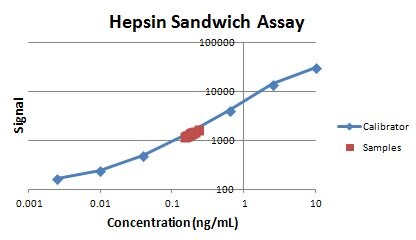
Application: Immunoassay StandardVerified Customer | Posted 05/22/2019AF4776 was used as the detection antibody in a sandwich ELISA with MAB4776 as the capture antibody and 4776-SE-010 as the calibrator.

-
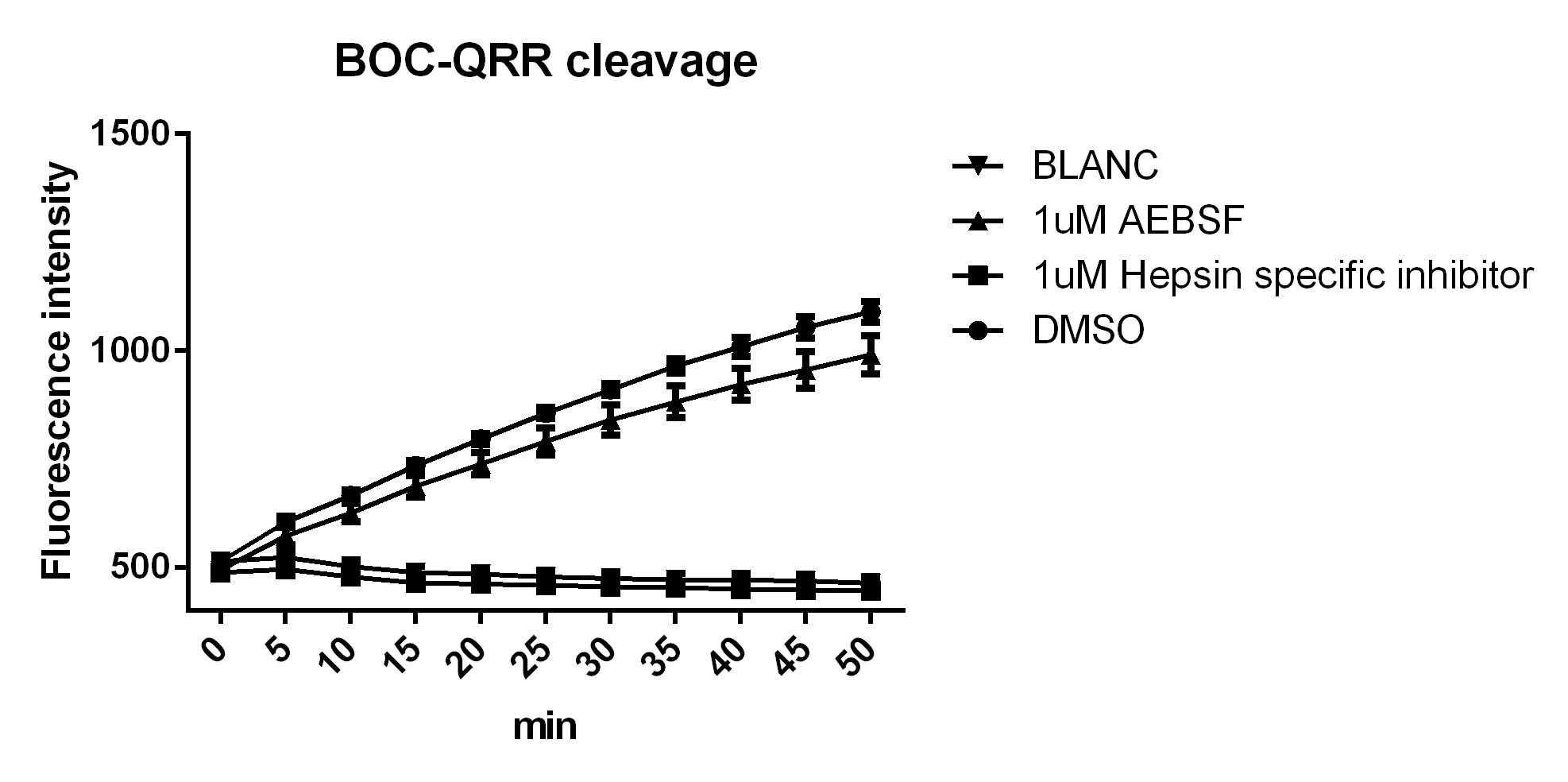
Application: Enzymatic activity in vitroVerified Customer | Posted 04/20/2019Activated hepsin was used at a concentration of 0.03nM. Assay was performed in PBS. The hepsin inhibitor was from Pant et al., 2018 (J Med Chem. 2018 May 24;61(10):4335-4347. doi: 10.1021/acs.jmedchem.7b01698. Epub 2018 May 14. Design, Synthesis, and Testing of Potent, Selective Hepsin Inhibitors via Application of an Automated Closed-Loop Optimization Platform.)
-
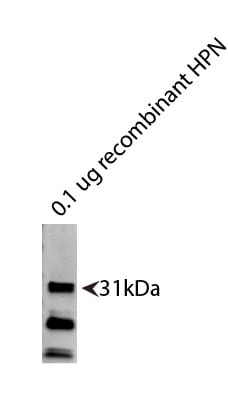
Application: Silver stained gel to test purityVerified Customer | Posted 04/20/2019Loaded 0.1ug, reduces SDS-PAGE on gradient gel, followed by silver staining
There are no reviews that match your criteria.
Protocols
View specific protocols for Recombinant Human Hepsin Protein, CF (4776-SE):
- Activation Buffer: 0.1 M Tris, 10 mM CaCl2, 0.15 M NaCl, 0.05 % Brij-35, pH 8.0
- Assay Buffer: 50 mM Tris, pH 9.0
- Recombinant Human Hepsin (rhHepsin) (Catalog # 4776-SE)
- Fluorogenic Peptide Substrate: BOC-Gln-Arg-Arg-AMC (Bachem, Catalog # I-1655), 5 mM stock in 50:50 DMSO:Methanol
- F16 Black Maxisorp Plate (Nunc, Catalog # 475515)
- Fluorescent Plate Reader (Model: SpectraMax Gemini EM by Molecular Devices) or equivalent
- Dilute rhHepsin to 100 µg/mL in Activation Buffer.
- Incubate at 37 °C for 24 hours.
- Dilute activated rhHepsin to 0.2 ng/µL in Assay Buffer.
- Dilute Substrate to 200 µM in Assay Buffer.
- Load 50 µL of the 0.2 ng/µL rhHepsin in a black well plate and start the reaction by adding 50 µL of 200 µM Substrate. Include a Substrate Blank containing 50 µL Assay Buffer and 50 µL of 200 µM Substrate.
- Read at excitation and emission wavelengths of 380 nm and 460 nm (top read), respectively in kinetic mode for 5 minutes.
- Calculate specific activity:
|
Specific Activity (pmol/min/µg) = |
Adjusted Vmax* (RFU/min) x Conversion Factor** (pmol/RFU) |
| amount of enzyme (µg) |
*Adjusted for Substrate Blank
**Derived using calibration standard 7-Amino, 4-Methyl Coumarin (AMC) (Sigma, Catalog # A-9891).
Per Well:- rhHepsin: 0.010 µg
- Substrate: 100 µM