
Recombinant Human HMGB1 Protein, CF
R&D Systems | Catalog # 1690-HMB

Key Product Details
- R&D Systems NS0-derived Recombinant Human HMGB1 Protein (1690-HMB)
- Quality control testing to verify active proteins with lot specific assays by in-house scientists
- All R&D Systems proteins are covered with a 100% guarantee
Source
Accession Number
Applications
Product Specifications
Source
Met1-Glu215
Purity
Endotoxin Level
N-terminal Sequence Analysis
Predicted Molecular Mass
SDS-PAGE
Activity
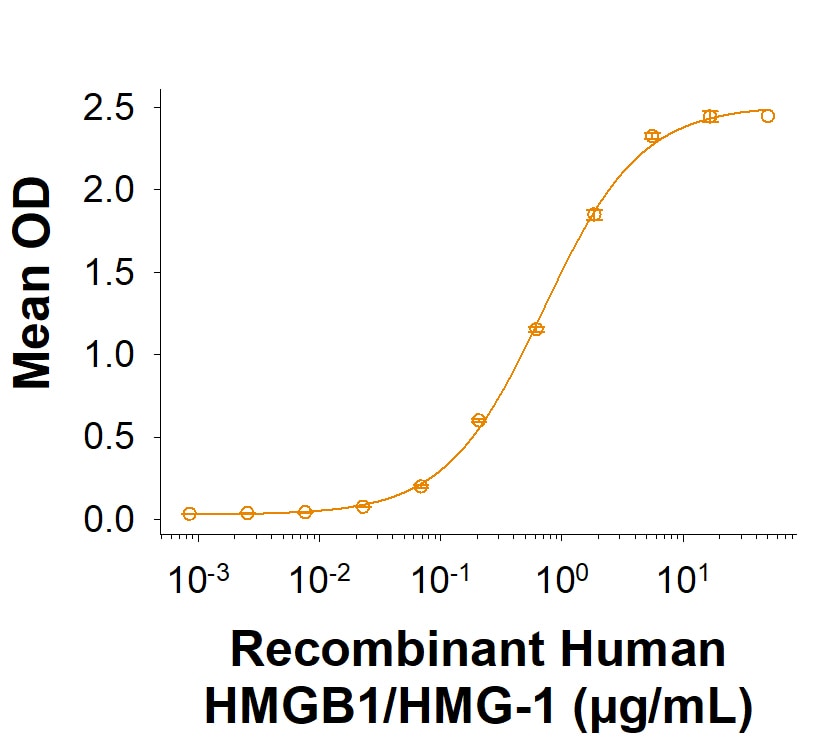
Recombinant Human HMGB1/HMG‑1 binds to Recombinant Human RAGE Fc Chimera Protein (Catalog # 1145-RG) with an ED50 of 0.150-1.50 μg/mL.
Reviewed Applications
Read 1 review rated 4 using 1690-HMB in the following applications:
Scientific Data Images for Recombinant Human HMGB1 Protein, CF
Recombinant Human HMGB1/HMG‑1 Protein Binding Activity.
Measured by its binding ability in a functional ELISA. Recombinant Human HMGB1/HMG‑1 Protein (Catalog # 1690-HMB) binds to Recombinant Human RAGE Fc Chimera Protein (1145-RG) with an ED50 of 0.150-1.50 μg/mL.Formulation, Preparation, and Storage
1690-HMB
| Formulation | Lyophilized from a 0.2 μm filtered solution in PBS with Trehalose. |
| Reconstitution | Reconstitute at 200 μg/mL in PBS. |
| Shipping | The product is shipped with polar packs. Upon receipt, store it immediately at the temperature recommended below. |
| Stability & Storage | Use a manual defrost freezer and avoid repeated freeze-thaw cycles.
|
Calculators
Background: HMGB1/HMG-1
References
- Yanai, H. et al. (2012) Trends Immunol. 33:633.
- Yang, H. et al. (2013) J. Leukoc. Biol. 93:865.
- Harris, H.E. et al. (2012) Nat. Rev. Rheumatol. 8:195.
- Degryse, B. and M. de Virgilio (2003) FEBS Lett. 553:11.
- Wen, L. et al. (1989) Nucleic Acids Res. 17:1197.
- Yang, H. et al. (2021) Mol. Med. 27:58.
- Venereau, E. et al. (2012) J. Exp. Med. 209:1519.
- Bianchi, M.E. and A. Agresti (2005) Curr. Opin. Genet. Dev. 15:496.
- Bonaldi, T. et al. (2003) EMBO J. 22:5551.
- Diener, K.R. et al. (2013) Immunol. Cell Biol. 91:443.
- Fang, P. et al. (2012) Mol. Neurobiol. 45:499.
- de Souza, A.W. et al. (2012) Autoimmun. Rev. 11:909.
- Bae, J.S. (2012) Arch. Pharm. Res. 35:1511.
Long Name
Alternate Names
Entrez Gene IDs
Gene Symbol
UniProt
Additional HMGB1/HMG-1 Products
Product Documents for Recombinant Human HMGB1 Protein, CF
Certificate of Analysis
To download a Certificate of Analysis, please enter a lot or batch number in the search box below.
Note: Certificate of Analysis not available for kit components.
Product Specific Notices for Recombinant Human HMGB1 Protein, CF
For research use only
Related Research Areas
Citations for Recombinant Human HMGB1 Protein, CF
 Powered by Bioz
Customer Reviews for Recombinant Human HMGB1 Protein, CF (1)
Have you used Recombinant Human HMGB1 Protein, CF?
Submit a review and receive an Amazon gift card!
$25/€18/£15/$25CAN/¥2500 for a review with an image
$10/€7/£6/$10CAN/¥1110 for a review without an image
Submit a review
Customer Images
-
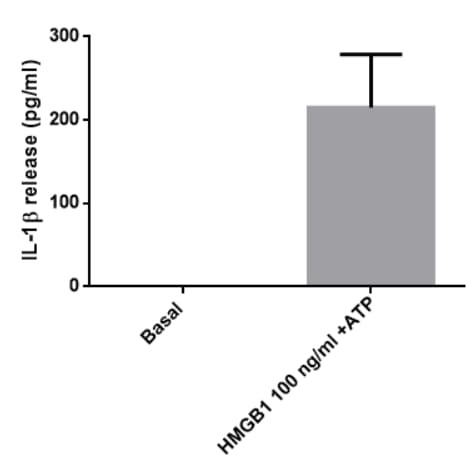
Application: In vitro bioactivity in cell cultureVerified Customer | Posted 07/17/2018

There are no reviews that match your criteria.
FAQs for Recombinant Human HMGB1 Protein, CF
-
Q: What is the oxidation state of Recombinant Human HMGB1 Protein, CF (Catalog # 1690-HMB)?
A: The presence of both a disulfide bond between Cys23 and Cys45, as well as an unpaired Cys106 thiol, has been reported in the literature to be critical for HMBG1-induced TNF-alpha secretion. The activity of 1690-HMB is measured by its ability to induce TNF-alpha secretion by RAW 264.7 mouse monocyte/macrophage cells. Each new bulk lot of 1690-HMB must exhibit acceptable activity in the TNF-alpha secretion assay to pass our activity specifications. The oxidiation state of 1690-HMB is not a product specification and has not been fully characterized in-house.