
Recombinant Human Lysyl Oxidase Homolog 2 Protein, CF
R&D Systems | Catalog # 2639-AO

Key Product Details
- R&D Systems NS0-derived Recombinant Human Lysyl Oxidase Homolog 2 Protein (2639-AO)
- Quality control testing to verify active proteins with lot specific assays by in-house scientists
- All R&D Systems proteins are covered with a 100% guarantee
Source
Accession Number
Structure / Form
Applications
Product Specifications
Source
Met1-Gln774, with a C-terminal 10-His tag
Purity
Endotoxin Level
N-terminal Sequence Analysis
Predicted Molecular Mass
SDS-PAGE
Activity
The specific activity is >2 pmol/min/μg, as measured under the described conditions.
Reviewed Applications
Read 1 review rated 4 using 2639-AO in the following applications:
Scientific Data Images for Recombinant Human Lysyl Oxidase Homolog 2 Protein, CF
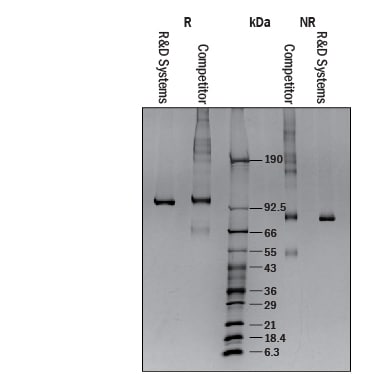
Recombinant Human Lysyl Oxidase Homolog 2 Protein SDS-PAGE
1 μg/lane of Recombinant Human Lysyl Oxidase Homolog 2 (Catalog # 2639-AO) and 1 μg/lane of competitor Lysyl Oxidase Homolog 2 were resolved with 4-20% SDS-PAGE under reducing (R) and non-reducing (NR) conditions and visualized by silver staining.Formulation, Preparation, and Storage
2639-AO
| Formulation | Supplied as a 0.2 μm filtered solution in MES and NaCl. |
| Shipping | The product is shipped with dry ice or equivalent. Upon receipt, store it immediately at the temperature recommended below. |
| Stability & Storage | Use a manual defrost freezer and avoid repeated freeze-thaw cycles.
|
Background: Lysyl Oxidase Homolog 2/LOXL2
References
- Csiszar, H. (2001) Prog. Nucleic Acid Res. Mol. Biol. 70:1.
- Maki, J.M. and K.I. Kivirikko (2001) Biochem J. 355:381.
- Akiri, G. et al. (2003) Cancer Res. 63:1657.
- Hollosi, P. et al. (2009) Int. J. Cancer. 125:318.
- Peinado, H. et al. (2008) Cancer Res. 68:4541.
- Jourdan-Le Saux C. et al. (1999) J. Biol. Chem. 274:12939.
Alternate Names
Gene Symbol
UniProt
Additional Lysyl Oxidase Homolog 2/LOXL2 Products
Product Documents for Recombinant Human Lysyl Oxidase Homolog 2 Protein, CF
Certificate of Analysis
To download a Certificate of Analysis, please enter a lot or batch number in the search box below.
Note: Certificate of Analysis not available for kit components.
Product Specific Notices for Recombinant Human Lysyl Oxidase Homolog 2 Protein, CF
For research use only
Related Research Areas
Citations for Recombinant Human Lysyl Oxidase Homolog 2 Protein, CF
 Powered by Bioz
Customer Reviews for Recombinant Human Lysyl Oxidase Homolog 2 Protein, CF (1)
Have you used Recombinant Human Lysyl Oxidase Homolog 2 Protein, CF?
Submit a review and receive an Amazon gift card!
$25/€18/£15/$25CAN/¥2500 for a review with an image
$10/€7/£6/$10CAN/¥1110 for a review without an image
Submit a review
-
Application: Binding assay/Protein-protein interactionVerified Customer | Posted 08/18/2017
There are no reviews that match your criteria.
Protocols
View specific protocols for Recombinant Human Lysyl Oxidase Homolog 2 Protein, CF (2639-AO):
- Assay Buffer: 50 mM Sodium Borate, 1.2 M Urea, 10 mM CaCl2, pH 8.0
- Recombinant Human Lysyl Oxidase Homolog 2/LOXL2 (rhLOXL2) (Catalog # 2639-AO)
- Coupling Enzyme: Horseradish Peroxidase (HRP), 250 units/mL stock in 0.1 M Sodium Phosphate, pH 8.0
- Substrate Component 1: Benzylamine, 100 mM stock in deionized water
- Substrate Component 2: Amplex Ultra Red (AUR), 10 mM stock in DMSO
- 96-well Black Plate
- Plate Reader with Fluorescent Read Capability
- Prepare 50 mM Sodium Borate, 1.2 M Urea, pH 8.0 by dissolving Boric Acid and Urea in deionized water and adjusting the pH with Sodium Hydroxide. Then, prepare the Assay Buffer by adding 1 M CaCl2 to a final concentration of 10 mM.
- Dilute rhLOXL2 to 10 ng/µL in Assay Buffer.
- Dilute Benzylamine to 4 mM in Assay Buffer.
- Combine equal volumes of 10 ng/µL rhLOXL2 and 4 mM Benzylamine. Also create a Substrate Blank by combining equal volumes of Assay Buffer and 4 mM Benzylamine.
- Incubate the reactions for 30 minutes at 37 °C.
- Prepare the Substrate Mixture, 2 units/mL HRP and 40 µM AUR, in Assay Buffer.
- Load 50 µL of the incubated reactions into the wells of a plate and add 50 µL of Substrate Mixture.
- Read at excitation and emission wavelengths of 544 nm and 590 nm (top read), respectively in endpoint mode. Note: A cutoff must be set manually at a wavelength of 570 nm.
- Calculate specific activity:
|
Specific Activity (pmol/min/µg) = |
Adjusted Fluorescence* (RFU) x Conversion Factor** (pmol/RFU) |
| Incubation time (min) x amount of enzyme (µg) |
*Adjusted for Substrate Blank
**Derived using a fluorescent standard prepared by incubating 20 µM AUR, 1 unit/mL HRP, 1 mM Benzylamine, and a curve of Hydrogen Peroxide in Assay Buffer. Use this oxidized AUR curve to determine the conversion factor.
- rhLOXL2: 0.25 µg
- Benzylamine: 1 mM
- HRP: 1 unit/mL
- AUR: 20 µM