
Recombinant Human Serpin G1 His-tag Protein, CF
R&D Systems | Catalog # 10951-PI

Key Product Details
- R&D Systems CHO-derived Recombinant Human Serpin G1 His-tag Protein (10951-PI)
- Quality control testing to verify active proteins with lot specific assays by in-house scientists
- All R&D Systems proteins are covered with a 100% guarantee
Source
Accession Number
Applications
Product Specifications
Source
Asn23-Ala500 with a C-terminal 6-His tag
Purity
Endotoxin Level
N-terminal Sequence Analysis
Predicted Molecular Mass
SDS-PAGE
Activity
The IC50 is <5 nM, as measured under the described conditions.
Scientific Data Images for Recombinant Human Serpin G1 His-tag Protein, CF
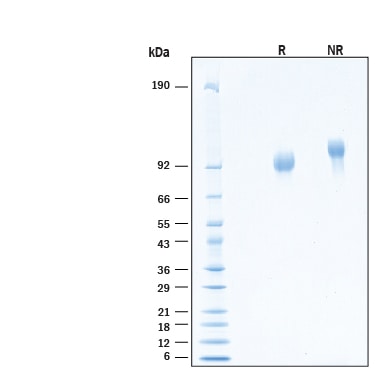
Recombinant Human Serpin G1 His-tag Protein SDS-PAGE.
2 μg/lane of Recombinant Human Serpin G1 His-tag Protein (Catalog # 10951-PI) was resolved with SDS-PAGE under reducing (R) and non-reducing (NR) conditions and visualized by Coomassie® Blue staining, showing bands at 89-98 kDa.Formulation, Preparation, and Storage
10951-PI
| Formulation | Lyophilized from a 0.2 μm filtered solution in Sodium Acetate and NaCl. |
| Reconstitution | Reconstitute at 0.5 mg/mL in sterile, deionized water. |
| Shipping | The product is shipped with polar packs. Upon receipt, store it immediately at the temperature recommended below. |
| Stability & Storage | Use a manual defrost freezer and avoid repeated freeze-thaw cycles.
|
Calculators
Background: Serpin G1/C1 Inhibitor
References
- Karnaukhova, E. (2013) J. Hematol. Thromb. Dis. 1:3.
- Beinrohr, L. et al. (2007) J. Biol. Chem. 282:21100.
- Davis, A.E. III (2010) Thromb. Haemost. 104:886.
- Ennis, S. et al. (2008) Lancet 372:1828.
- Cicardi, M and A. Zanichelli (2010) Drugs Today. 46:867.
- Caliezi, C. et al. (2000) Pharmacol. Rev. 52:91.
- Thielmann, M. et al. (2006) Eur. J. Cardiothorac. Surg. 30:285.
- Singer, M. and Jones, A.M. (2011) Crit. Care 15:203.
- Berger, M. et al. (2016) Transplantation 100:1415.
- Weiss, E. et al. (2020) Clin. Exp. Emerg. Med. 7:87.
- Adesanya, T.M.A. et al. (2021) J. Clin. Immunol. 41:729.
Alternate Names
Entrez Gene IDs
Gene Symbol
UniProt
Additional Serpin G1/C1 Inhibitor Products
Product Documents for Recombinant Human Serpin G1 His-tag Protein, CF
Certificate of Analysis
To download a Certificate of Analysis, please enter a lot or batch number in the search box below.
Note: Certificate of Analysis not available for kit components.
Product Specific Notices for Recombinant Human Serpin G1 His-tag Protein, CF
For research use only
Related Research Areas
Customer Reviews for Recombinant Human Serpin G1 His-tag Protein, CF
There are currently no reviews for this product. Be the first to review Recombinant Human Serpin G1 His-tag Protein, CF and earn rewards!
Have you used Recombinant Human Serpin G1 His-tag Protein, CF?
Submit a review and receive an Amazon gift card!
$25/€18/£15/$25CAN/¥2500 for a review with an image
$10/€7/£6/$10CAN/¥1110 for a review without an image
Submit a review
Protocols
View specific protocols for Recombinant Human Serpin G1 His-tag Protein, CF (10951-PI):
- Assay Buffer: 50 mM Tris, 10 mM CaCl2, 150 mM NaCl, and 0.05% Brij-35 (w/v), pH 7.5 (TCNB)
- Recombinant Human Serpin G1 (Catalog # 10951-PI)
- Recombinant Human Complement Component C1s (rhC1s) (Catalog # 2060-SE)
- Substrate: L-Lys-SBzl (Bachem, Catalog # M-1300), 10 mM stock in DMSO
- 5,5'-Dithobis(2-Nitrozenzoic acid) (DTNB) (Sigma, Catalog # D8130), 10 mM stock in DMSO
- 96-well Clear Plate (Catalog # DY990)
- Fluorescent Plate Reader (Model: SpectraMax Plus by Molecular Devices) or equivalent
- Dilute rhC1s to 2 µg/mL in Assay Buffer.
- Prepare a curve of rhSerpin G1 (MW: 54,000 Da) in Assay Buffer. Make the following serial dilutions: 2000, 1000, 500, 100, 50, 25, 12.5, 4, 0.8, and 0.2 nM.
- Combine 25 µL of diluted rhC1s and 25 µL of rhSerpin G1 at each concentration of the curve. Include a Control containing 25 µL of Assay Buffer and 25 µL of diluted rhC1s.
- Incubate mixtures at room temperature for 30 minutes.
- Dilute the mixtures 5-fold by adding 200 µL of Assay Buffer to each reaction and control vial.
- Dilute the Substrate to 200 µM with Assay Buffer containing 200 µM DTNB.
- Load into plate 50 µL of the diluted incubated mixtures and start the reaction by adding 50 µL of 200 µM Substrate/200 µM DTNB mixture. Include a Substrate Blank containing 50 µL of Assay Buffer and 50 µL of 200 µM Substrate/ µM DTNB mixture.
- Read at an absorbance wavelength of 405 nm in kinetic mode for 5 minutes.
- Derive the 50% inhibition concentration (IC50) value for rhSerpin G1 by plotting OD/min (or specific activity) versus concentration with 4-PL fitting.
- The specific activity for rhC1s at each point may be determined using the following formula (if needed):
Specific Activity(pmol/min/µg) = | Adjusted Vmax* (OD/min) x well volume (L) x 1012 pmol/mol |
| (ext. coeff** (M-1cm-1) x path corr.*** (cm) x amount of enzyme (μg) |
Per Well:
- rhSerpin G1 curve: 100, 50, 25, 5, 2.5, 1.25, 0.625, 0.2, 0.04, and 0.01 nM
- rhC1s: 0.01 µg
- Substrate: 100 µM
- DTNB: 100 µM