
CCL6, also known as C10 and SCYA6, is an 11 kDa member of the MIP-I family of beta -chemokines. CCL6, along with CCL9, CCL15, and CCL23, belongs to the N6 subfamily of proteins that have an N-terminal extension relative to other beta -chemokines (1 - 4). The mouse CCL6 cDNA encodes a 116 amino acid (aa) precursor that includes a 21 aa signal sequence (5). Removal of an additional 20 aa at the N-terminal results in an 8 kDa protein (aa 42 - 116) and the transition from a weak CCR1 agonist to a dramatically more potent and efficacious macrophage chemoattractant (3, 6). The N-terminal region of CCL6 and other N6 subfamily chemokines is cleaved following incubation with synovial fluid from inflamed joints as well as with inflammation-associated proteases such as chymase, cathepsin G, and elastase (3). CCL6 is upregulated in activated macrophages at sites of inflammation (5, 7 - 10) and functions as a chemoattractant for additional macrophage influx (8, 9). The inflammatory cytokine IL-13 stimulates CCL6 production which then induces the release of CCL2, CCL3, and proteases involved in tissue repair (10). CCL6 expression is upregulated by the oncoprotein L-Myc but repressed by c-Myc. CCL6 induced by L-Myc promotes cellular transformation and the development of a tumorigenic phenotype (11). N-terminally truncated mouse CCL6 shares 77% and 64% aa sequence identity with rat CCL6 and mouse CCL9, respectively. A human orthologue for mouse CCL6 has not been identified. Conversely, CCL15 and CCL23 and other members of the N6 subfamily have been described in human but not in mouse.
Recombinant Mouse CCL6/C10 (Truncated, aa 42-116) Protein
R&D Systems | Catalog # 3210-C

Key Product Details
- R&D Systems E. coli-derived Recombinant Mouse CCL6/C10 (Truncated, aa 42-116) Protein (3210-C)
- Quality control testing to verify active proteins with lot specific assays by in-house scientists
- All R&D Systems proteins are covered with a 100% guarantee
Source
Accession Number
Applications
Product Specifications
Source
Gly42-Ala116
Purity
Endotoxin Level
N-terminal Sequence Analysis
Predicted Molecular Mass
Activity
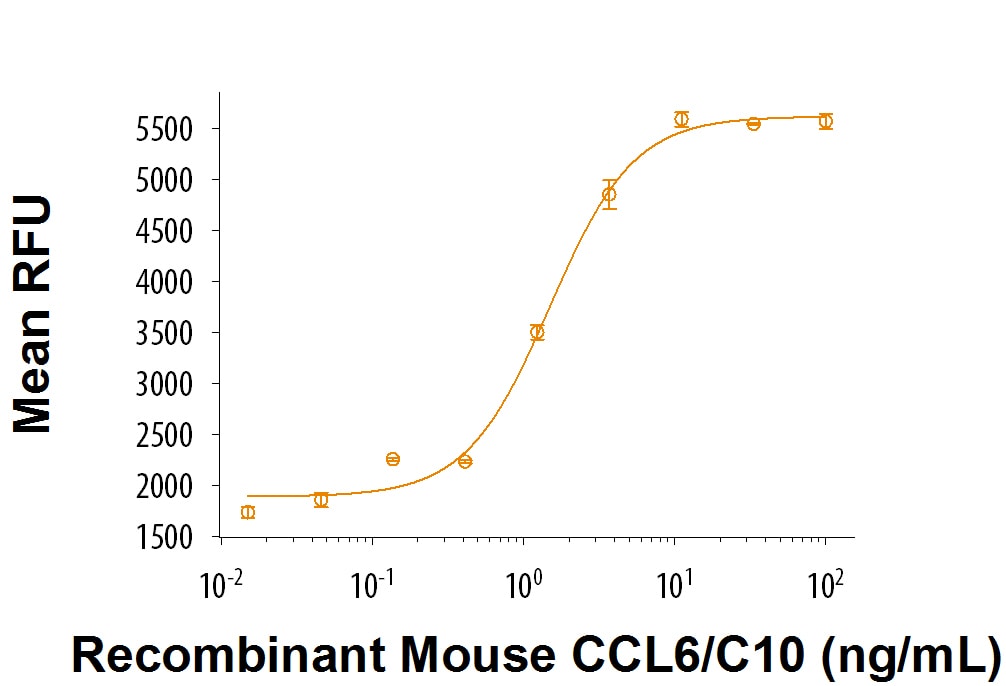
The ED50 for this effect is 0.5-2 ng/mL.
Scientific Data Images for Recombinant Mouse CCL6/C10 (Truncated, aa 42-116) Protein
Recombinant Mouse CCL6/C10 (Truncated, aa 42-116) Protein Bioactivity
Recombinant Mouse CCL6/C10 (Catalog # 3210-C) chemoattracts BaF3 mouse pro B cells transfected with human CCR1. The ED50 for this effect is 0.5-2 ng/mL.Formulation, Preparation, and Storage
Carrier Free
What does CF mean?CF stands for Carrier Free (CF). We typically add Bovine Serum Albumin (BSA) as a carrier protein to our recombinant proteins. Adding a carrier protein enhances protein stability, increases shelf-life, and allows the recombinant protein to be stored at a more dilute concentration. The carrier free version does not contain BSA.
What formulation is right for me?In general, we advise purchasing the recombinant protein with BSA for use in cell or tissue culture, or as an ELISA standard. In contrast, the carrier free protein is recommended for applications, in which the presence of BSA could interfere.
Carrier: 3210-C
| Formulation | Lyophilized from a 0.2 μm filtered solution in PBS with BSA as a carrier protein. |
| Reconstitution | Reconstitute at 100 μg/mL in sterile PBS containing at least 0.1% human or bovine serum albumin. |
| Shipping | The product is shipped at ambient temperature. Upon receipt, store it immediately at the temperature recommended below. |
| Stability & Storage | Use a manual defrost freezer and avoid repeated freeze-thaw cycles.
|
Carrier Free: 3210-C/CF
| Formulation | Lyophilized from a 0.2 μm filtered solution in PBS. |
| Reconstitution | Reconstitute at 100 μg/mL in sterile PBS. |
| Shipping | The product is shipped at ambient temperature. Upon receipt, store it immediately at the temperature recommended below. |
| Stability & Storage | Use a manual defrost freezer and avoid repeated freeze-thaw cycles.
|
Calculators
Background: CCL6/C10
References
- Maurer, M. and E. von Stebut (2004) Int. J. Biochem. Cell Biol. 36:1882.
- Trakatelli, C. et al. (2005) Int. J. Biol. Markers 20:197.
- Berahovich, R.D. et al. (2005) J. Immunol. 174:7341.
- Berger, M.S. et al. (1993) DNA Cell Biol. 12:839.
- Orlofsky, A. et al. (1991) Cell Regul. 2:403.
- Berger, M.S. et al. (1996) Cytokine 8:439.
- Orlofsky, A. et al. (1994) J. Immunol. 152:5084.
- Kaesler, S. et al. (2002) Cytokine 3:157.
- LaFleur, A.M. et al. (2004) Mediators Inflamm. 13:349.
- Ma, B. et al. (2004) J. Immunol. 172:1872.
- Yi, F. et al. (2003) Cancer Res. 63:2923.
Alternate Names
Gene Symbol
UniProt
Additional CCL6/C10 Products
Product Documents for Recombinant Mouse CCL6/C10 (Truncated, aa 42-116) Protein
Certificate of Analysis
To download a Certificate of Analysis, please enter a lot or batch number in the search box below.
Note: Certificate of Analysis not available for kit components.
Product Specific Notices for Recombinant Mouse CCL6/C10 (Truncated, aa 42-116) Protein
For research use only
Related Research Areas
Citations for Recombinant Mouse CCL6/C10 (Truncated, aa 42-116) Protein
 Powered by Bioz
Customer Reviews for Recombinant Mouse CCL6/C10 (Truncated, aa 42-116) Protein
There are currently no reviews for this product. Be the first to review Recombinant Mouse CCL6/C10 (Truncated, aa 42-116) Protein and earn rewards!
Have you used Recombinant Mouse CCL6/C10 (Truncated, aa 42-116) Protein?
Submit a review and receive an Amazon gift card!
$25/€18/£15/$25CAN/¥2500 for a review with an image
$10/€7/£6/$10CAN/¥1110 for a review without an image
Submit a review