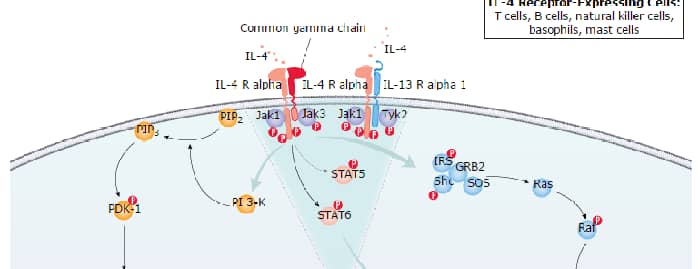
Mouse IL-13 receptor alpha one (IL‑13 R alpha 1), previously called NR4, IL-13 R alpha, and IL13R alpha ', is a member of the hemopoietin receptor family that was cloned on the basis of its conserved WSXWS motif. Mouse IL‑13 R alpha 1 encodes a 424 amino acid (aa) residue precursor type I membrane protein with a 26 aa residue signal peptide, a 314 aa residue extracellular domain (containing an immunoglobulin-like domain and a typical hemopoietin receptor domain), a 24 aa residue transmembrane region and a 60 aa residue cytoplasmic tail. Human IL‑13 R alpha 1, with 76% amino acid sequence identity to mouse IL‑13 R alpha 1, has also been cloned. In addition, a second human IL‑13 binding protein, designated IL‑13 R alpha 2 and previously known as IL‑13 R beta, IL‑13 R and IL‑13 R alpha, has been cloned from the Caki‑1 human renal carcinoma cell line. Murine IL‑13 R alpha 2 has been cloned from a mouse thymus cDNA library. The amino terminal 27 amino acid residues of the human and mouse IL‑13 R alpha 2 is nearly identical to that of a soluble mouse IL ‑3 binding proteinpurified from mouse serum and urine.
Both human and mouse IL‑13 R alpha 2 and mouse IL‑13 binding protein bind IL‑13 with high‑affinity. In cells transfected with mouse IL‑13 R alpha 1 only, low‑affinity binding with mouse IL13 is observed. However, in cells expressing both the mouse IL‑13 R alpha 1 and mouse IL4 receptor, a high affinity IL‑13 receptor complex capable of transducing an IL‑13 or IL‑4‑dependent proliferative signal, is generated.These results suggest that mouse IL‑13 R alpha 1, in addition to its role as a IL‑13 binding subunit in the IL‑13 receptor complex, can serve as an alternative to the common gamma chain for IL‑4 signaling.
 Powered by Bioz