
TRANCE (receptor activator of NF-kappa B ligand [RANK L], also called TNF-related activation-induced cytokines, osteoprotegerin ligand [OPGL], and osteoclast differentiation factor [ODF]), is a member of the tumor necrosis factor (TNF) family. In the TNF superfamily nomenclature, TRANCE is referred to as TNFSF11. TRANCE was originally identified as an immediate early gene upregulated by T cell receptor stimulation. The murine TRANCE cDNA encodes a type II transmembrane protein of 316 amino acids with a predicted cytoplasmic domain of 48 amino acids and an extracellular domain of 247 amino acids. The extracellular domain contains two potential N-linked glycosylation sites. Mouse and human TRANCE share 85% amino acid identity. TRANCE is primarily expressed in T cells and T cell rich organs, such as thymus and lymph nodes. The multi-functions of TRANCE include induction of activation of the c-jun N-terminal kinase, enhancement of T cell growth and dendritic cell function, induction of osteoclastogenesis, and lymph node organogenesis. RANK is the cell surface signaling receptor of TRANCE. RANK has been shown to undergo receptor clustering during signal transduction. Osteoprotegerin, a soluble member of the TNF receptor family which binds TRANCE, is a naturally occurring decoy receptor that counterbalances the effects of TRANCE.
Recombinant Mouse TRANCE/TNFSF11/RANK L His Protein, CF
R&D Systems | Catalog # 462-TRB
His-tag

Loading...
Key Product Details
Source
NS0
Accession Number
Applications
Bioactivity
Loading...
Product Specifications
Source
Mouse myeloma cell line, NS0-derived mouse TRANCE/TNFSF11/RANK L protein
Arg72-Asp316, with an N-terminal Met-His6 tag
Arg72-Asp316, with an N-terminal Met-His6 tag
Purity
>95%, by SDS-PAGE visualized with Silver Staining and quantitative densitometry by Coomassie® Blue Staining.
Endotoxin Level
<0.10 EU per 1 μg of the protein by the LAL method.
N-terminal Sequence Analysis
Met-His
Predicted Molecular Mass
28 kDa
SDS-PAGE
32-37 kDa, under reducing conditions.
Activity
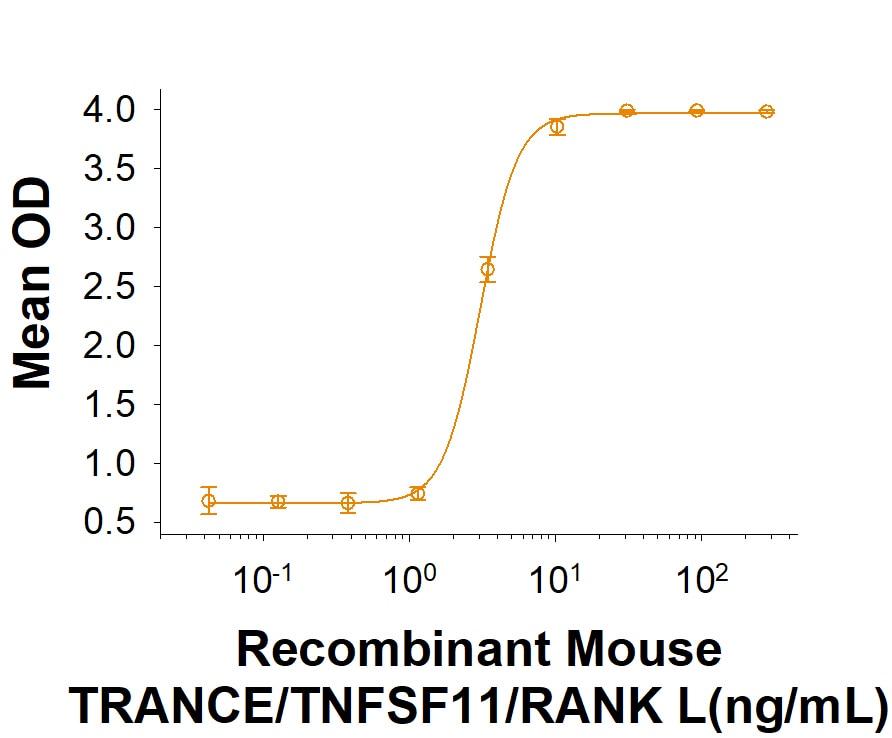
Measured by its ability to induce osteoclast differentiation of RAW 264.7 mouse monocyte/macrophage cells.
The ED50 for this effect is 1.00‑10.0 ng/mL.
The ED50 for this effect is 1.00‑10.0 ng/mL.
Scientific Data Images for Recombinant Mouse TRANCE/TNFSF11/RANK L His Protein, CF
Recombinant Mouse TRANCE/TNFSF11/RANK L His-tag Protein Bioactivity.
Measured by its ability to induce osteoclast differentiation of RAW 264.7 mouse monocyte/ macrophage cells. The ED50 for this effect is 1.00-10.0 ng/mL.Formulation, Preparation, and Storage
462-TRB
| Formulation | Lyophilized from a 0.2 μm filtered solution in MOPS and NaCl. |
| Reconstitution | Reconstitute at 250 μg/mL in water. |
| Shipping | The product is shipped at ambient temperature. Upon receipt, store it immediately at the temperature recommended below. |
| Stability & Storage | Use a manual defrost freezer and avoid repeated freeze-thaw cycles.
|
Calculators
Background: TRANCE/TNFSF11/RANK L
References
- Wong, B.R. et al. (1997) J. Biol. Chem. 272:25190.
- Anderson, D.M. et al. (1997) Nature 390:175.
- Nakagawa, N. et al. (1998) Biochem. Biophys. Res. Commun. 245:382.
- Kong, Y-Y. et al. (1999) Nature 397:315.
Long Name
TNF-related Activation-induced Cytokine
Alternate Names
CD254, ODF, OPGL, RANK L, RANKL, TNFSF11
Gene Symbol
TNFSF11
UniProt
Additional TRANCE/TNFSF11/RANK L Products
Product Documents for Recombinant Mouse TRANCE/TNFSF11/RANK L His Protein, CF
Certificate of Analysis
To download a Certificate of Analysis, please enter a lot or batch number in the search box below.
Note: Certificate of Analysis not available for kit components.
Product Specific Notices for Recombinant Mouse TRANCE/TNFSF11/RANK L His Protein, CF
For research use only
Related Research Areas
Customer Reviews for Recombinant Mouse TRANCE/TNFSF11/RANK L His Protein, CF
There are currently no reviews for this product. Be the first to review Recombinant Mouse TRANCE/TNFSF11/RANK L His Protein, CF and earn rewards!
Have you used Recombinant Mouse TRANCE/TNFSF11/RANK L His Protein, CF?
Submit a review and receive an Amazon gift card!
$25/€18/£15/$25CAN/¥2500 for a review with an image
$10/€7/£6/$10CAN/¥1110 for a review without an image
Submit a review
Loading...
Associated Pathways
