
Ubiquitin-Propargylamine (Ub-PA) is a potent, irreversible and specific inhibitor of C-terminal hydrolases (UCHs), ubiquitin-specific proteases (USPs), and other deubiquitinases including the Otubains (OTU’s). When mixed together, the reactive site cysteine of deubiquitinases and the C-terminal alkyne functional group of Ub-PA rapidly form a covalent bond (vinyl thioether) that is resistant to denaturing conditions. This product is useful for inhibiting the hydrolysis of poly-ubiquitin chains on substrate proteins in vitro and thus enhances poly-ubiquitin chain accumulation.


Loading...
Key Product Details
- R&D Systems Synthetic-derived Ubiquitin-Propargylamide Protein (U-214)
- Quality control testing to verify active proteins with lot specific assays by in-house scientists
- All R&D Systems proteins are covered with a 100% guarantee
Source
Synthetic
Accession Number
Structure / Form
Modified
Conjugate
Propargylamide
Applications
Bioactivity
Loading...
Product Specifications
Source
Chemically Synthesized Ubiquitin protein
Met1 - Gly75
Met1 - Gly75
Purity
>95%, by HPLC.
Predicted Molecular Mass
8.5 kDa
Activity
Reaction conditions will need to be optimized for each specific application. We recommend an initial Recombinant Human Ubiquitin-Propargylamide concentration of 0.5-5 μM.
Reviewed Applications
Read 1 review rated 4 using U-214 in the following applications:
Formulation, Preparation, and Storage
U-214
| Formulation | Lyophilized from a solution containing Acetonitrile and TFA. |
| Reconstitution | Reconstitute at 2 mg/ml in DMSO. |
| Shipping | The product is shipped at ambient temperature. Upon receipt, store it immediately at the temperature recommended below. |
| Stability & Storage | Use a manual defrost freezer and avoid repeated freeze-thaw cycles.
|
Calculators
Background: Ubiquitin
References
- Ekkebus, R., et al. (2013) J. Am. Chem. Soc 135:2867.
- Sommer, S., et al. (2013) Bioorg Med Chem. 21:2511.
Alternate Names
UBB
Gene Symbol
UBB
UniProt
Additional Ubiquitin Products
Product Documents for Ubiquitin-Propargylamide Protein
Certificate of Analysis
To download a Certificate of Analysis, please enter a lot or batch number in the search box below.
Note: Certificate of Analysis not available for kit components.
Product Specific Notices for Ubiquitin-Propargylamide Protein
For research use only
Related Research Areas
Citations for Ubiquitin-Propargylamide Protein
 Powered by Bioz
Customer Reviews for Ubiquitin-Propargylamide Protein (1)
4 out of 5
1 Customer Rating
Have you used Ubiquitin-Propargylamide Protein?
Submit a review and receive an Amazon gift card!
$25/€18/£15/$25CAN/¥2500 for a review with an image
$10/€7/£6/$10CAN/¥1110 for a review without an image
Submit a review
Customer Images
Showing
1
-
1 of
1 review
Showing All
Filter By:
-
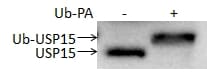
Application: In vitro bioactivity in cell cultureVerified Customer | Posted 06/01/2019293T cell lysates (40μg)were incubated with this probe for 15 min at 37℃。

There are no reviews that match your criteria.
Loading...