Phosphatase-Coupled Sulfotransferase Assay
by Brittany Prather, Cheryl M. Ethen, Miranda Machacek, & Zhengliang L. Wu.
Scientific Meeting PostersABSTRACT
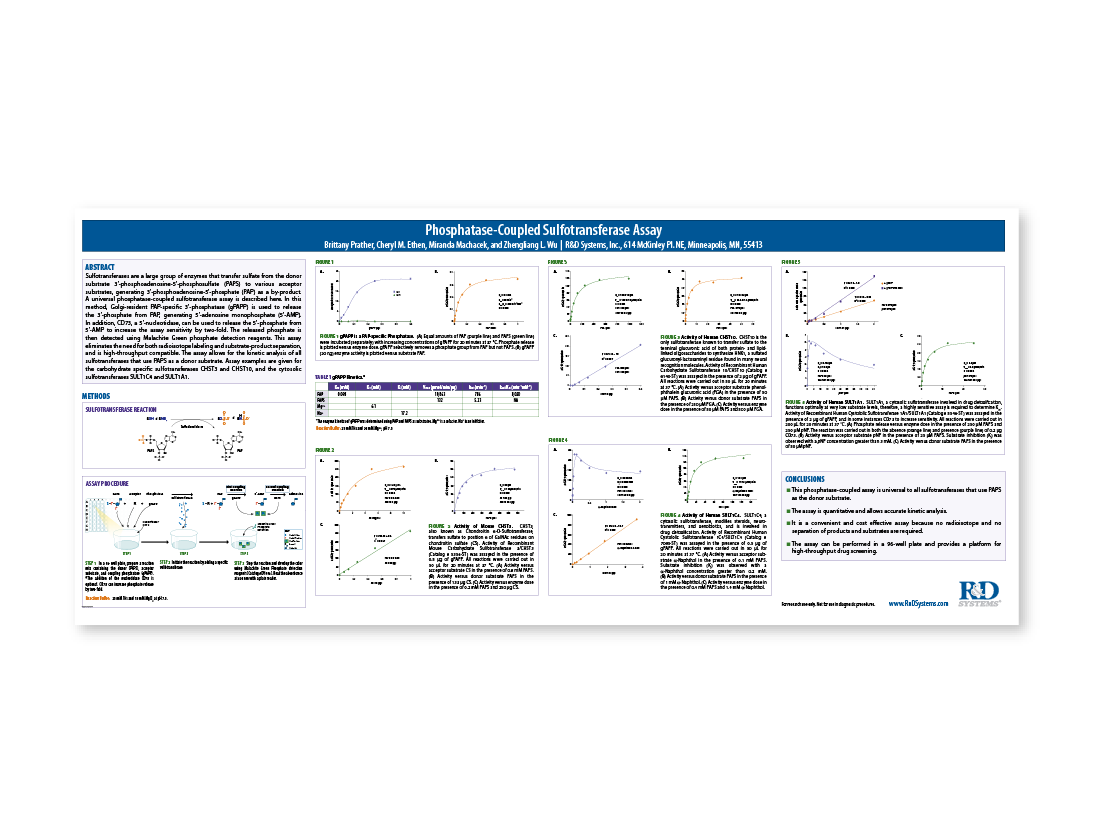
Sulfotransferases are a large group of enzymes that transfer sulfate from the donor substrate 3’-phosphoadenosine-5’-phosphosulfate (PAPS) to various acceptor substrates, generating 3’-phosphoadenosine-5’-phosphate (PAP) as a by-product. A universal phosphatase-coupled sulfotransferase assay is described here. In this method, Golgi-resident PAP-specific 3’-phosphatase (gPAPP) is used to release the 3’-phosphate from PAP, generating 5’-adenosine monophosphate (5’-AMP). In addition, CD73, a 5’-nucleotidase, can be used to release the 5’-phosphate from 5’-AMP to increase the assay sensitivity by two-fold. The released phosphate is then detected using Malachite Green phosphate detection reagents. This assay eliminates the need for both radioisotope labeling and substrate-product separation, and is high-throughput compatible. The assay allows for the kinetic analysis of all sulfotransferases that use PAPS as a donor substrate. Assay examples are given for the carbohydrate specific sulfotransferases CHST3 and CHST10, and the cytosolic sulfotransferases SULT1C4 and SULT1A1.
Related Information
Download PDF