
Having trouble trying to find the right product? Chat with our scientists below - we're here to help!
Select a category to see relevant filters and products
3 results for "Ubiquitin E3 Ligase Degraders Small Molecules and Peptides" in Products
Ubiquitin E3 Ligase Degraders Small Molecules and Peptides
Ubiquitin E3 ligases (EC 6.3.2.19) attach ubiquitin molecules onto lysine residues of proteins in order to target the protein for a specific cellular process, such as proteasomal degradation or an alteration in subcellular localization. In addition to the specific ubiquitin ligases such as MDM2, E3A and anaphase-promoting complex (APC), many other proteins also contain domains that possess ubiquitin ligase activity. Almost all known ubiquitin E3 ligases contain one of three domains: a HECT, ...

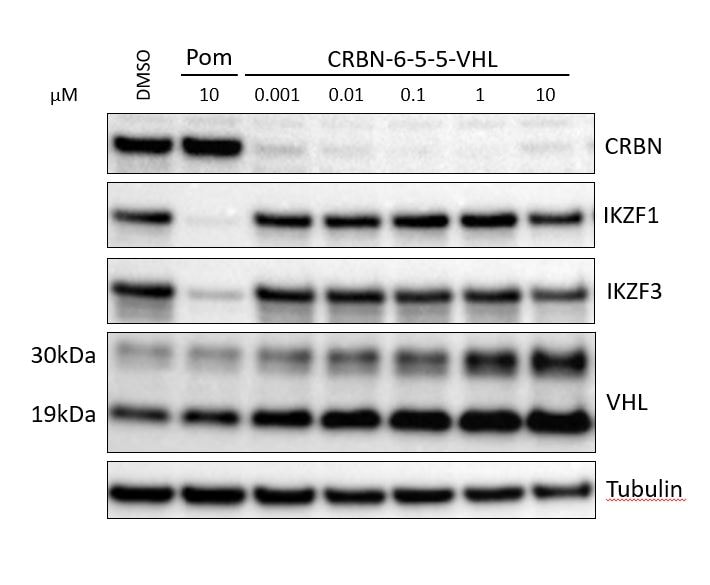
Potent and selective cereblon Degrader (PROTAC®); cell-permeable
| Chemical Name: | (2S,4R)-1-((2S)-2-(5-((5-((6-((2-(2,6-Dioxopiperidin-3-yl)-1,3-dioxoisoindolin-4-yl)amino)hexyl)oxy)pentyl)oxy)pentanamido)-3,3-dimethylbutanoyl)-4-hydroxy-N-(4-(4-methylthiazol-5-yl)benzyl)pyrrolidine-2-carboxamide |
| Purity: | ≥96% |
Loading...
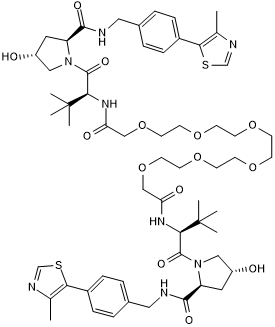
Homo-PROTAC® for self-degradation of pVHL30
| Chemical Name: | N1,N20-bis((S)-1-((2S,4R)-4-Hydroxy-2-((4-(4-methylthiazol-5-yl)benzyl)carbamoyl)pyrrolidin-1-yl)-3,3-dimethyl-1-oxobutan-2-yl)-3,6,9,12,15,18-hexaoxaicosanediamide |
| Purity: | ≥98% |
Loading...
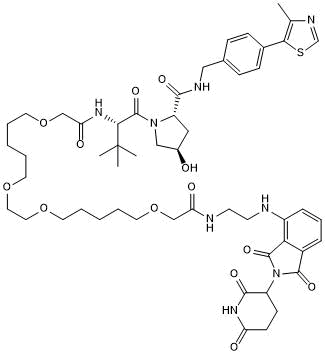
Cereblon Degrader (PROTAC®)
| Chemical Name: | N1-(2-((2-(2,6-Dioxopiperidin-3-yl)-1,3-dioxoisoindolin-4-yl)amino)ethyl)-N20-((S)-1-((2S,4R)-4-hydroxy-2-((4-(4-methylthiazol-5-yl)benzyl)carbamoyl)pyrrolidin-1-yl)-3,3-dimethyl-1-oxobutan-2-yl)-3,9,12,18-tetraoxaicosanediamide |
| Purity: | ≥98% |
Loading...